Uttar Pradesh Government Launches Sarus Circuit to Safeguard State Bird
Synopsis
Discover how the Uttar Pradesh government is spearheading the Sarus Circuit initiative to protect the Sarus crane, the tallest flying bird in the world, while promoting eco-tourism and local community engagement.
Key Takeaways
Sarus Circuit promotes conservation of the Sarus crane.
Enhances local eco-tourism opportunities.
Includes development of essential facilities for tourists.
Supports local communities through income generation .
Aims for sustainable development and environmental awareness .
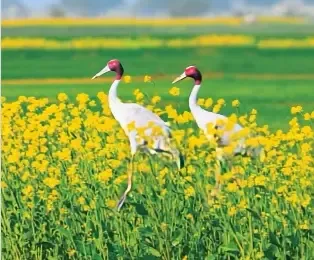
Lucknow, March 6 (NationPress) The Sarus Crane, recognized as the tallest flying bird in the world, primarily inhabits the Gangetic plains and has recently encountered significant threats to its survival. In response, the Uttar Pradesh government has devised an extensive plan aimed at the conservation of this majestic bird, alongside the protection of its natural environments.
The administration led by Yogi Adityanath has unveiled a comprehensive strategy to create a "Sarus Circuit" that focuses on the preservation of the Sarus crane, which is the state bird of Uttar Pradesh, and aims to enhance eco-tourism.
This initiative will be implemented in the wetlands of Mainpuri and Etawah districts, encompassing various wetland regions such as Kirthua, Sahas, Kurra Jarawan, Soj, and Saman in Mainpuri, as well as Sarsai Nawar and Parauli Ramayan in Etawah.
In addition to safeguarding the Sarus crane, the Sarus Circuit will promote eco-tourism activities. The primary goal is to advance both the conservation of the Sarus and the preservation of wetlands while stimulating local tourism. These projects will be executed by the forest department through the UP Eco-Tourism Development Board.
This initiative is expected to generate income opportunities for local communities and inspire residents to take action in protecting the Sarus crane and their wetlands.
The Sarus crane, known as the tallest flying bird globally, is not only the state bird of Uttar Pradesh but also predominantly breeds in the wetlands located in Mainpuri, Etawah, Etah, and Aligarh.
In light of this, the state government is committed to developing the Sarus Circuit for its conservation.
Under this initiative, the Forest Department, alongside the UP Eco-Tourism Development Board, is actively working to conserve shallow water bodies, ponds, and wetlands in the area, making them more conducive habitats for Sarus cranes. Concurrently, eco-tourism ventures are being fostered.
The development plans include essential facilities such as entrance gates, viewpoints, observation decks, boating areas, butterfly gardens, solar-powered lighting, interpretation centers, and parking facilities within the Sarus Circuit. Moreover, visitor centers, eco-friendly toilet facilities, interactive signage, food kiosks, and shops offering One District One Product (ODOP) goods and souvenirs will be established for tourists, allowing them to experience and appreciate the natural habitat of the Sarus crane.
This initiative by the Yogi government not only aims to safeguard the Sarus crane and other birds, such as the grey heron and open-billed stork, but also to enhance the conservation of wetlands in the region. It will contribute to raising groundwater levels, mitigating the effects of global warming, and fostering sustainable development.
The promotion of eco-tourism activities is anticipated to create significant income and employment opportunities for local communities, while also enhancing environmental awareness and sensitivity toward nature among both residents and visiting tourists.
Point of View
The establishment of the Sarus Circuit is a proactive step that intertwines wildlife protection with economic opportunities for local communities, fostering a sustainable relationship between nature and tourism.
NationPress
7 Oct 2026
Frequently Asked Questions
What is the Sarus Circuit?
The Sarus Circuit is an initiative by the Uttar Pradesh government aimed at conserving the Sarus crane and its natural habitat while promoting eco-tourism in Mainpuri and Etawah districts.
Why is the Sarus crane important?
The Sarus crane is the tallest flying bird in the world and is Uttar Pradesh's state bird, making its conservation crucial for biodiversity and local ecosystems.
How will the Sarus Circuit benefit local communities?
The Sarus Circuit will create income opportunities and promote eco-tourism, encouraging locals to engage in conservation efforts.
What facilities will be available in the Sarus Circuit?
Facilities include entrance gates, viewpoints, observation decks, boating spots, and visitor centers with eco-friendly amenities.
How does this initiative address environmental concerns?
The initiative aims to enhance wetland conservation, improve groundwater levels, and mitigate global warming impacts through sustainable development.