V.D. Satheesan Surpasses Pinarayi Vijayan in Kerala's CM Preference: Pre-Election Analysis
Synopsis
A recent survey reveals V.D. Satheesan as the leading choice for Kerala's chief minister ahead of the 2026 elections, indicating a shift in voter sentiment as Chief Minister Pinarayi Vijayan seeks a third term. This could lead to a tightly contested electoral battle.
Key Takeaways
Satheesan leads in CM preference with 25.2% support.
Chief Minister Pinarayi Vijayan follows with 21.5% .
The electoral contest between UDF and LDF is extremely close.
Economic issues dominate voter concerns, notably unemployment .
A significant portion of voters remains undecided.
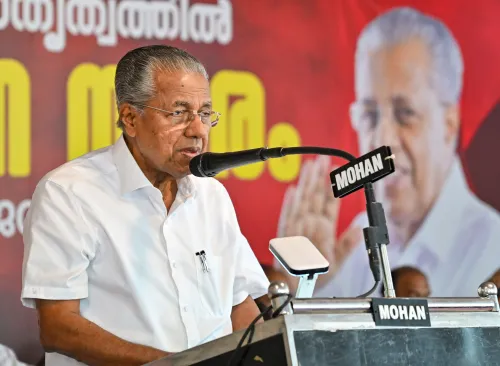
Thiruvananthapuram, March 7 (NationPress) V.D. Satheesan, the Leader of Opposition in the Assembly, has been identified as the leading candidate for the chief ministerial position in Kerala as the state gears up for the 2026 Assembly elections, according to a pre-election survey conducted by the independent public opinion platform, Vote Vibe.
This development signifies a notable shift in political preferences as Chief Minister Pinarayi Vijayan aims for an unprecedented third consecutive term in office.
The survey reveals that Satheesan enjoys a support level of 25.2 percent, slightly surpassing Vijayan's 21.5 percent.
Though the lead is slim, analysts suggest that an Opposition leader outperforming a two-term incumbent indicates voter fatigue and a desire for change in leadership.
Nonetheless, the overall competition between the two political alliances remains extremely close.
The United Democratic Front (UDF) has a combined leadership preference of 38 percent, which trails just behind the Left Democratic Front's (LDF) 39.1 percent, highlighting the highly competitive nature of the upcoming elections.
The survey also brings to light what analysts refer to as the LDF's central dilemma: strong public support for welfare initiatives alongside diminishing trust in governance.
Approximately 44 percent of survey participants expressed satisfaction with key programs such as the LIFE Mission housing scheme, KASP, and Kudumbashree.
However, a similar 44.2 percent believe the corruption allegations against the government are credible.
Economic challenges are evidently influencing voter opinions.
Unemployment ranks as the primary concern for 23.2 percent of respondents, followed by rising prices at 18.8 percent and corruption at 11.4 percent.
These issues collectively represent over half of the voters' concerns, suggesting that opposition to the incumbent may be driven more by economic strains than by ideological preferences.
The independent public opinion platform's survey also indicates the significant role of the Bharatiya Janata Party (BJP) in the state's electoral dynamics.
While 27.7 percent of participants feel that the BJP's rise is more detrimental to the LDF than the UDF (18.7 percent), a noteworthy 26.8 percent believe it negatively affects both parties.
This implies that the BJP may serve more as a vote splitter than a decisive player.
Efforts by competing fronts to shape public discourse have also produced mixed results.
Claims of a covert understanding between the CPM and BJP resulted in a nearly three-way division of opinion, with 33.6 percent agreeing, 32.3 percent disagreeing, and 34.1 percent undecided.
Similarly, the assertion that the Indian Union Muslim League would function as a “backseat driver” in a UDF government has failed to resonate with voters.
Demographic patterns provide further insights into the evolving political landscape.
Women show notably greater satisfaction with welfare initiatives compared to men, indicating that social programs continue to be a vital support base for the LDF.
Younger voters, especially those aged 18 to 24, are particularly concerned about unemployment, while the 25–34 age bracket is more critical of the government regarding corruption.
Community affiliations also play a significant role.
Scheduled Caste voters exhibit stronger support for the LDF, whereas Muslim and Christian constituencies remain firmly with the UDF coalition.
A crucial observation is the substantial portion of undecided voters.
Across various questions, over 30 percent of respondents remained neutral or unwilling to express a preference, forming a potentially influential group that could sway outcomes in tightly contested areas.
The study concludes that Kerala approaches the 2026 elections with two competing political narratives.
The LDF benefits from its credibility in welfare and organizational strength, while the UDF appears to have gained traction through perceived leadership and issue advantages.
With a significant undecided demographic and various factors influencing voter behavior, the electoral contest is set to be one of Kerala's closest in recent history.
Point of View
The political dynamics seem to be shifting. With the incumbent CM facing growing voter fatigue, the upcoming elections could be pivotal. Voter concerns primarily revolve around economic issues, highlighting the need for responsive governance.
NationPress
1 Oct 2026
Frequently Asked Questions
Who is the most preferred CM candidate in Kerala according to the survey?
V.D. Satheesan has been identified as the most preferred chief ministerial candidate in Kerala ahead of the 2026 Assembly elections.
What percentage of support does V.D. Satheesan have?
V.D. Satheesan has a support level of 25.2 percent according to the pre-poll survey.
How does Pinarayi Vijayan's support compare?
Pinarayi Vijayan has a support level of 21.5 percent, which is slightly behind Satheesan.
What are the primary concerns of voters according to the survey?
The top concerns include unemployment, rising prices, and corruption.
What role does the BJP play in this electoral context?
The BJP is perceived as a potential vote splitter, affecting both LDF and UDF strategies.