CM Sawant Hails India-Oman CEPA, Eyes Goa Export Boost
Synopsis
Goa Chief Minister Pramod Sawant hailed the India-Oman Comprehensive Economic Partnership Agreement, congratulating Prime Minister Narendra Modi and projecting fresh export opportunities for Goa's pharmaceuticals, marine products, beverages and processed foods, linking the bilateral pact to his Swayampurna Goa and Viksit Goa 2037 vision.
Key Takeaways
Goa CM Pramod Sawant welcomed the operationalisation of the India-Oman CEPA in an X post.
He congratulated PM Narendra Modi and tied the pact to Atmanirbhar Bharat and Viksit Bharat.
Sawant flagged gains for pharmaceuticals, marine products, food processing, textiles and MSMEs.
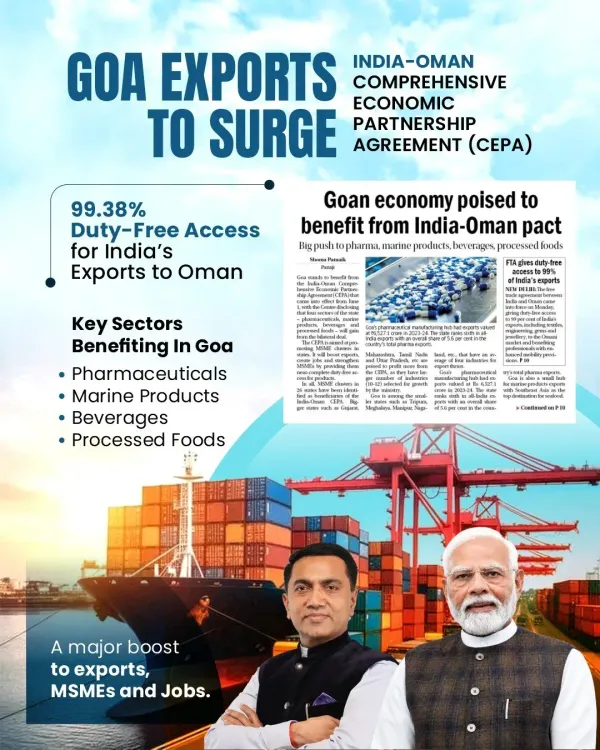
For Goa, he projected export growth in pharma, marine products, beverages and processed foods.
The deal extends a Gulf trade push that began with the India-UAE CEPA effective May 2022.
Sawant linked the pact to his Swayampurna Goa and Viksit Goa 2037 roadmap.
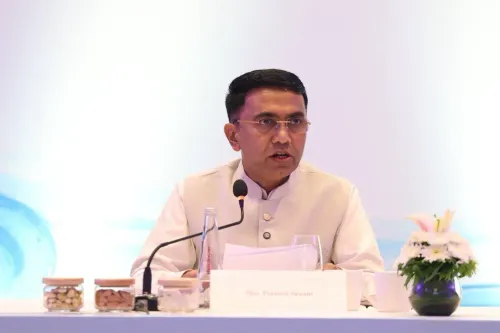
Goa Chief Minister Pramod Sawant on Wednesday welcomed the operationalisation of the India-Oman Comprehensive Economic Partnership Agreement (CEPA), congratulating Prime Minister Narendra Modi and framing the pact as a fresh export opening for Goa's pharmaceutical, marine and food-processing industries. In a post on X, Sawant tied the bilateral deal to the state-level vision of Swayampurna Goa and Viksit Goa 2037.
Context
Sawant called the agreement 'a landmark step towards strengthening India's global trade partnerships and accelerating the vision of Atmanirbhar Bharat and Viksit Bharat.' He cited duty-free access for the bulk of Indian exports to Oman, flagging gains for pharmaceuticals, marine products, food processing, textiles and MSMEs.
The Chief Minister added that the CEPA would create 'new opportunities for trade, investment and employment generation', and projected concrete spillovers for Goa in pharmaceuticals, marine products, beverages and processed foods.
Policy backdrop
The India-Oman CEPA extends a Gulf-focused trade push that began with the India-UAE CEPA, signed in February 2022 and effective from May 2022, which delivered duty-free access on more than 80 percent of Indian exports and served as a template for subsequent agreements. Negotiations for an India-GCC free trade agreement, suspended since 2008, were revived in 2022, with Oman emerging as an early bilateral partner.
Since 2020, India has concluded or advanced CEPAs with Australia, the UAE and other partners as part of a broader strategy to diversify trade, lower tariff barriers and embed Indian producers in global value chains beyond China-centric supply routes. The Atmanirbhar Bharat initiative, launched in 2020, has provided the framing for this preferential trade push.
Stakeholders and impact
Oman, a Gulf Cooperation Council member, is a long-standing Indian partner with deep energy, maritime and diaspora links, making it a natural early node in the Gulf trade architecture. The agreement is expected to benefit MSME exporters, pharmaceutical manufacturers and marine product exporters, segments that depend heavily on tariff competitiveness in West Asian markets.
Coastal states such as Goa are positioned to gain from tariff cuts on precisely the categories they already ship in volume. The state hosts established clusters in pharmaceutical formulations, fisheries and processed foods, and Sawant has consistently tied national trade initiatives to his Viksit Goa 2037 roadmap, which targets a higher-value export economy by the state's diamond jubilee of liberation.
What's next
Attention will now turn to the first quarterly trade data after the CEPA enters into force, which will indicate whether duty cuts translate into measurable export growth for sectors flagged by the Chief Minister. Follow-on announcements on a wider India-GCC framework or a bilateral pact with Saudi Arabia will be watched closely, as will any state-level facilitation steps in Goa to help exporters access the new tariff lines.
For Sawant, the post signals an intent to position Goa not merely as a tourism economy but as a small-state export contributor riding national trade diplomacy — a pitch likely to recur as the CEPA's early numbers come in.
Point of View
Marine, beverages, processed foods — he is signalling intent to convert tariff concessions into local industrial gains rather than treating the CEPA as a Delhi-level abstraction. The framing also reinforces the BJP's wider Gulf strategy, which has steadily shifted from the stalled India-GCC track to bilateral CEPAs with willing partners. The real test will be whether Goa's export agencies can move fast enough to capture early-mover advantage.
NationPress
18 Oct 2026
Frequently Asked Questions
What is the India-Oman CEPA?
The India-Oman Comprehensive Economic Partnership Agreement is a bilateral trade pact designed to cut tariffs and expand goods, services and investment flows between the two countries. It is part of India's wider Gulf trade strategy that also includes the India-UAE CEPA.
What did Pramod Sawant say about the India-Oman CEPA?
Goa Chief Minister Pramod Sawant congratulated Prime Minister Narendra Modi and called the CEPA a landmark step for India's global trade partnerships. He said it would boost pharmaceuticals, marine products, food processing, textiles and MSMEs nationally and open major export avenues for Goa.
Which Goa sectors stand to gain from the India-Oman CEPA?
Sawant identified pharmaceuticals, marine products, beverages and processed foods as the main beneficiaries in Goa. These align with the state's established industrial clusters and existing export profile.
How does the India-Oman CEPA fit into India's broader trade strategy?
It extends a Gulf-focused trade push that began with the India-UAE CEPA, which took effect in May 2022. Since 2020 India has also concluded or advanced CEPAs with Australia and others to diversify trade and reduce dependence on China-centric supply chains.
What is Viksit Goa 2037?
Viksit Goa 2037 is the state government's long-term development vision aimed at building a higher-value, self-reliant economy by the milestone year. Sawant frequently links national initiatives, including trade pacts, to this roadmap and to the Swayampurna Goa programme.