Joshi Hails SECI's Record ₹18,554 Cr Income in FY26
Synopsis
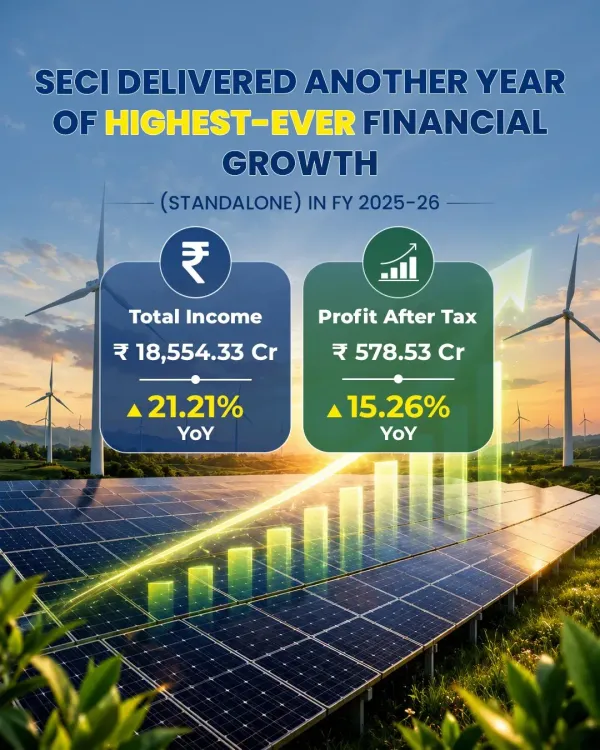
Union Minister Pralhad Joshi has congratulated Solar Energy Corporation of India on its highest-ever standalone financial results in FY 2025–26, with total income at ₹18,554.33 crore and Profit After Tax at ₹578.53 crore, marking a landmark for the Navratna PSU driving India's clean energy targets.
Key Takeaways
Union Minister Pralhad Joshi congratulated SECI on its best-ever standalone financial performance in FY 2025–26 .
SECI's total income reached ₹18,554.33 crore , the highest in the PSU's history on a standalone basis.
Profit After Tax rose to ₹578.53 crore for the same financial year.
SECI was incorporated in 2011 as the nodal agency for the Jawaharlal Nehru National Solar Mission and holds Navratna status.
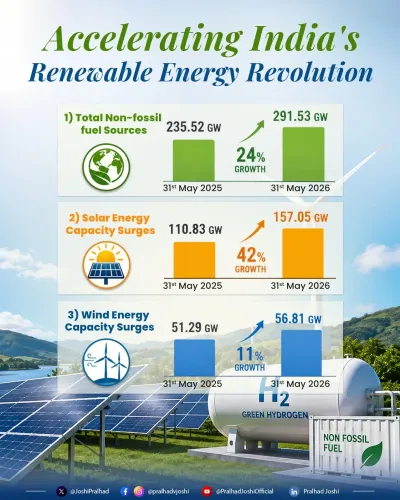
India's updated NDC (2022) targets 50 per cent of cumulative electric capacity from non-fossil sources by 2030 , with SECI central to execution.
The record results strengthen SECI's capacity to underwrite larger renewable tenders including green hydrogen and offshore wind without full budgetary support.
Union Consumer Affairs and New and Renewable Energy Minister Pralhad Joshi on Friday, 12 June 2026 congratulated Solar Energy Corporation of India Limited (SECI) on posting its highest-ever standalone financial performance in FY 2025–26, with total income touching ₹18,554.33 crore and Profit After Tax rising to ₹578.53 crore.
Context
Minister Joshi, who oversees the Ministry of New and Renewable Energy (MNRE), described the results as reflecting SECI's 'unwavering commitment to advancing India's clean energy ambitions and driving sustainable growth.' The figures represent a landmark for the Navratna public sector undertaking, which has served as the central government's primary vehicle for executing large-scale renewable energy tenders since its incorporation in 2011.
SECI was established as the nodal agency under the Jawaharlal Nehru National Solar Mission, launched in 2010, and has since evolved into a full-spectrum renewable energy implementing body conducting competitive reverse auctions for solar, wind, and hybrid projects across the country.
Policy Backdrop
The record performance arrives as India presses ahead with its updated Nationally Determined Contribution (NDC), submitted in 2022, which commits the country to sourcing 50 per cent of cumulative electric power capacity from non-fossil sources by 2030. SECI sits at the operational heart of that commitment, aggregating demand from state distribution companies and floating tenders that have consistently pushed solar and wind tariffs to competitive lows.
The improving financial trajectory mirrors a broader commercial maturation across the renewable sector, where stabilising project pipelines and stronger payment security mechanisms have reduced counterparty risk for central PSUs. The central government has placed emphasis on energy security and meeting international climate targets without depending solely on budgetary transfers, making SECI's self-sustaining revenue model strategically significant.
Stakeholders and Impact
Private renewable energy developers, state electricity distribution companies, and the broader power-sector PSU ecosystem are among the key stakeholders affected by SECI's financial health. A stronger balance sheet enables SECI to underwrite larger and more complex tenders — including offshore wind, green hydrogen, and round-the-clock renewable bundles — without requiring sovereign guarantees on every transaction.
For the renewable energy industry, the record income signals that the auction-based model championed by MNRE is generating durable commercial returns, potentially attracting deeper participation from domestic and international project developers in upcoming bidding rounds.
What's Next
Analysts and industry participants will watch SECI's next slate of solar, wind, and hybrid tenders as a gauge of whether the financial momentum translates into accelerated capacity commissioning against the 500 GW non-fossil target by 2030. Any adjustments to payment security mechanisms or state-level offtake guarantees — potentially signalled in the upcoming Union Budget or parliamentary sessions — could further shape the PSU's revenue outlook.
With Minister Joshi publicly underlining SECI's role in 'powering the nation's renewable energy journey,' the milestone is likely to reinforce the government's narrative of PSU-led clean energy scale-up ahead of India's international climate review cycles.
Point of View
Reducing the sector's dependence on budgetary props. For Minister Joshi, the numbers offer tangible evidence that MNRE's PSU-led execution strategy is delivering results ahead of India's 2030 non-fossil capacity commitments. The timing also matters geopolitically: strong PSU balance sheets give India greater credibility at international climate forums where financing capacity is scrutinised. If SECI sustains this trajectory, it could anchor a more ambitious next generation of green hydrogen and offshore wind tenders without sovereign guarantees.
NationPress
26 Oct 2026
Frequently Asked Questions
What is SECI and what does it do?
SECI, or Solar Energy Corporation of India Limited, is a Navratna central public sector undertaking under the Ministry of New and Renewable Energy. It conducts competitive reverse auctions for solar, wind, hybrid, and green energy projects, acting as the government's primary implementing agency for large-scale renewable capacity addition.
What were SECI's financial results for FY 2025–26?
SECI reported its highest-ever standalone total income of ₹18,554.33 crore and a Profit After Tax of ₹578.53 crore in FY 2025–26, according to Union Minister Pralhad Joshi's official post on 12 June 2026.
Why did Pralhad Joshi congratulate SECI?
As Union Minister for New and Renewable Energy, Pralhad Joshi oversees SECI and congratulated the PSU for achieving its best-ever standalone financial performance in FY 2025–26, calling it a reflection of SECI's commitment to India's clean energy goals.
How does SECI's performance connect to India's 2030 renewable energy targets?
India has committed under its updated Nationally Determined Contribution to sourcing 50 per cent of cumulative electric capacity from non-fossil sources by 2030. SECI is the central implementing agency for this target, and its stronger financials improve its ability to float and execute larger tenders without full government budgetary support.
What is the Jawaharlal Nehru National Solar Mission?
The Jawaharlal Nehru National Solar Mission is a flagship scheme launched in 2010 that set India's initial grid-connected solar targets. It led directly to the creation of SECI in 2011 as the nodal agency to implement the mission's renewable energy programmes.