Second severe cyclone to hit Andhra Pradesh coast by Nov 3, weeks after Arnab
Synopsis
Andhra Pradesh is bracing for a second severe cyclonic storm in less than a week — set to hit between Nellore and Narsapur by 3 November — even as the state's coastal districts remain battered by Cyclone Arnab, which killed seven and caused ₹4,600 crore in damage. The back-to-back strikes on overlapping terrain could compound losses before relief work has even begun.
Key Takeaways
A severe cyclonic storm in the Bay of Bengal is forecast to make landfall between Nellore and Narsapur, Andhra Pradesh by the morning of 3 November 2026 .
The IMD recorded the system as a deep depression at 0530 hours IST on 1 November , moving west-northwestwards at 23 kmph .
Landfall winds are expected at 100–110 kmph with gusts up to 120 kmph .
Cyclone Arnab struck the same coastline near Narsapur on 28 October 2026 , killing seven people and causing estimated losses of ₹4,600 crore .
A Central assessment team is currently in Andhra Pradesh surveying Arnab's damage as the new threat approaches.
A fresh severe cyclonic storm is bearing down on the Andhra Pradesh coast and is likely to make landfall between Nellore and Narsapur by the morning of 3 November 2026 — less than a week after Very Severe Cyclonic Storm Arnab battered the same coastline, killing seven people and causing an estimated ₹4,600 crore in losses.
The India Meteorological Department (IMD) confirmed on 1 November 2026 that a depression over the Southeast Bay of Bengal had intensified into a deep depression and was moving west-northwestwards at 23 kmph. As of 0530 hours IST on 1 November, the system was centred approximately 700 km east-southeast of Chennai, 770 km south-southeast of Visakhapatnam, and 810 km east-southeast of Ongole.
IMD's Forecast Trajectory
According to the IMD bulletin, the system is expected to intensify into a cyclonic storm over the Southwest and adjoining West-Central Bay of Bengal within six hours of Sunday's bulletin, and further strengthen into a severe cyclonic storm over the West-Central Bay of Bengal by 2 November. The IMD projected landfall as a severe cyclonic storm packing sustained wind speeds of 100 to 110 kmph, with gusts reaching 120 kmph, between Nellore and Narsapur on the morning of 3 November.
'Continuing to move west-northwestwards, it is very likely to cross the south Andhra Pradesh coast as a Severe Cyclonic Storm with wind speed of 100 to 110 kmph gusting at 120 kmph between Nellore and Narsapur by the morning of 3rd November 2026,' the IMD bulletin stated.
Andhra Pradesh Still Reeling from Cyclone Arnab
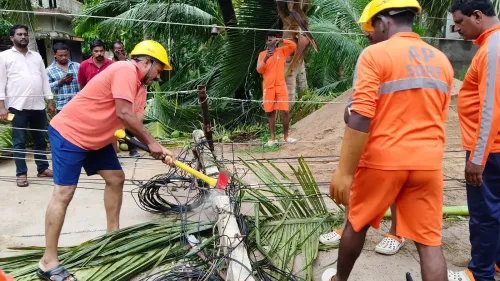
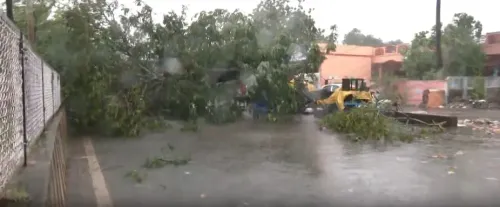
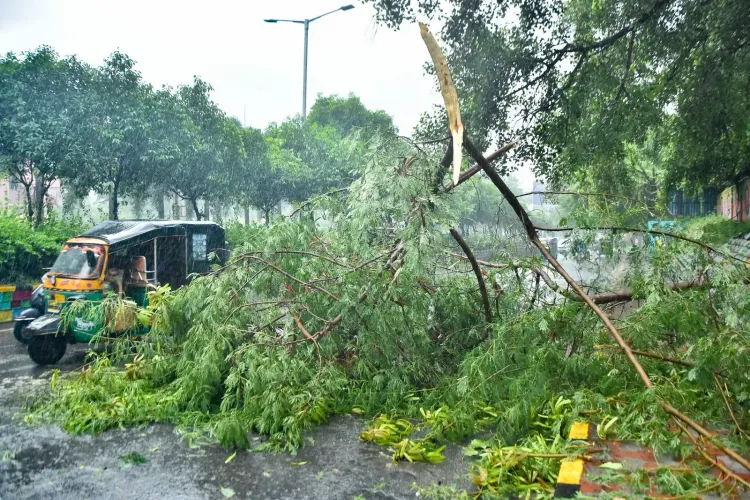
Cyclone Arnab made landfall near Narsapur in the early hours of 28 October 2026, with maximum sustained winds of 125–135 kmph gusting to 150 kmph. The storm claimed seven lives and inflicted extensive damage across coastal districts — uprooting hundreds of electricity poles and trees, flooding crops across thousands of acres, and disrupting roads, power supply, and telecom networks. Preliminary loss estimates stand at ₹4,600 crore. A Central assessment team is currently on the ground in the state evaluating the damage.
Double Cyclone Threat: What It Means for the Coast
The successive strikes represent an unusually compressed cyclone sequence for the region. Andhra Pradesh's coastal districts — many of which are still unrestored after Arnab — now face compounded risk: weakened infrastructure, waterlogged agricultural land, and emergency response teams already stretched by the first storm. Notably, the forecast landfall zone for the new system overlaps with the area hit by Arnab just days earlier, raising concerns about cumulative damage to crops, housing, and power networks that have not yet been repaired.
What Comes Next
State authorities are reportedly mobilising disaster response teams and evacuation resources ahead of the projected landfall. Fishing communities along the Nellore-to-Narsapur coastal belt have been warned not to venture into the sea. The IMD is expected to issue updated bulletins every few hours as the system intensifies. The full scale of impact will depend on the storm's precise landfall point and any last-minute variations in track or intensity — both of which the IMD is monitoring closely.
Point of View
600 crore in unrepaired damage, a Central team still mid-assessment, and coastal infrastructure already compromised, the state's disaster response capacity will be pushed to its limits before the first round of relief has been disbursed. The back-to-back pattern also raises a harder question: as Bay of Bengal cyclone frequency and intensity increase under warming sea-surface temperatures, India's disaster preparedness frameworks need to account for compound events, not just single-strike scenarios. Rebuilding roads and restoring power to villages hit by Arnab while simultaneously evacuating the same communities for the next storm is not a contingency most state disaster manuals anticipate.
NationPress
1 Nov 2026
Frequently Asked Questions
When and where will the new cyclone hit Andhra Pradesh?
According to the IMD, the severe cyclonic storm is expected to cross the south Andhra Pradesh coast between Nellore and Narsapur by the morning of 3 November 2026, with wind speeds of 100–110 kmph and gusts up to 120 kmph.
How does this cyclone compare to Cyclone Arnab?
Cyclone Arnab, which struck near Narsapur on 28 October 2026, was classified as a 'very severe cyclonic storm' with winds of 125–135 kmph gusting to 150 kmph — stronger than the incoming system. However, the new storm is set to hit terrain that is already damaged and partially unprotected, potentially amplifying its effective impact.
What damage did Cyclone Arnab cause?
Cyclone Arnab killed seven people and caused preliminary estimated losses of ₹4,600 crore. Crops over thousands of acres were damaged, and hundreds of electricity poles and trees were uprooted across coastal districts of Andhra Pradesh. Roads, power supply, and telecom networks also suffered significant damage.
Who is at risk from the approaching cyclone?
Coastal communities between Nellore and Narsapur in Andhra Pradesh face the greatest immediate risk. Fishing communities have been warned against venturing into the sea. Districts still recovering from Arnab's damage are particularly vulnerable to compounded losses.
What is the current status of the storm as of 1 November 2026?
As of 0530 hours IST on 1 November 2026, the system had intensified into a deep depression and was located about 700 km east-southeast of Chennai. The IMD expects it to become a cyclonic storm within six hours and a severe cyclonic storm by 2 November before landfall on 3 November.