Is the Jungle Naxal Threat Decreasing While Urban Cells Emerge?
Click to start listening
Synopsis
As the deadline to eradicate the Naxal threat looms, security forces are changing their strategy. The decline in Maoist influence opens the door for state forces, but a new concern arises with the emergence of urban Naxal cells. What does this mean for India's security landscape? Read on to discover crucial insights!
Key Takeaways
- The Naxal threat is diminishing in rural areas.
- State forces are set to play a larger role.
- Urban Naxal cells are emerging, posing new challenges.
- Continued vigilance is essential to prevent resurgence.
- Security audits are critical for future strategy adjustments.
New Delhi, Dec 5 (NationPress) As the deadline to eliminate the Naxal threat approaches, security forces, particularly from the central government, are gradually changing their tactics. Presently, the central forces are deployed in full strength across Maoist-affected regions, and with the threat decreasing rapidly, state security forces are poised to take on a more significant role.
While security agencies are confident in their ability to neutralize every remaining Naxalite, it is crucial to ensure that no resurgence occurs.
As the deadline nears, there may be a slight reduction in the number of central security forces. While a complete withdrawal is not anticipated for safety reasons, a significant decrease in troop strength is expected, according to an official.
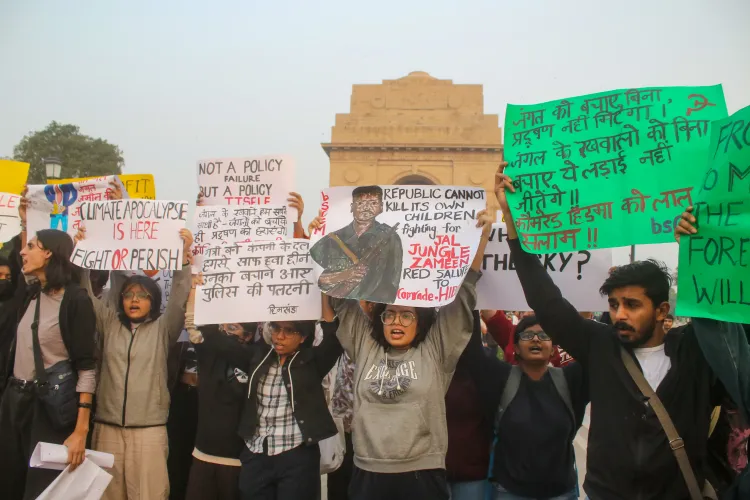
With extensive realignment of forces in Maoist-impacted areas, the Intelligence Bureau's responsibilities are set to expand, particularly in addressing the urban threat. Agencies have been alerting about the rising ideological threat in cities, and the investigation into the protests at India Gate underscores this concern.
The inquiry revealed that certain individuals from the Bhagat Singh Chatra Ekta Manch (BSCEM), who organized the protest, allegedly have ties to Naxalites. One notable member, E. R. Akshay, is reportedly connected to the Maoist movement, with videos related to Naxal activities found on his phone. Conversations regarding the death of prominent Maoist Madvi Hidma were also discovered.
Intelligence agencies have cautioned for months that efforts to propagate ideology in urban centers are underway, and recent protests indicate that this initiative has already commenced. An officer noted that plans are in place to expand this movement significantly across various regions of the country, with the latest protest serving as a prime example.
Indeed, one could assert that the groundwork has been laid, and these elements are strategizing for a more extensive operation, stated another official.
During the protests, the primary focus was on pollution. However, a poster condemning Hidma's killing surfaced with the slogan, ‘Lal Salam.’ Protesters also incited police reactions, aware that such provocations could serve as a catalyst for further protests elsewhere in the country. These individuals recognize that the situation in the jungles is deteriorating and are attempting to shift the discourse to urban settings by seizing on topical issues to advocate for Naxalism.
This presents a perilous scenario, warns an official, as such protests frequently escalate into violence. The overarching objective is to keep major cities in a state of unrest as the situation in rural areas progresses toward resolution, remarked another official.
Meanwhile, routine security audits are being conducted in Maoist-affected regions.
Officials are evaluating the necessity of maintaining a large presence in these areas, given the significant reduction in the threat level.
When asked about the possibility of a complete troop withdrawal and whether security would be entirely entrusted to state authorities, the official cautioned that this would be unwise. Central forces will remain in these regions for several more years until state agencies can fully manage the situation.
However, a gradual reduction in forces is expected over the coming months to preempt any resurgence and to support state police until they are fully capable of independent operations.
Security experts emphasize the importance of close cooperation between state police forces during this period, as attempts by remaining Maoists to move between states could occur. This is where inter-state coordination becomes vital, experts advise.
While the Naxal issue may be resolved well before the March 2026 deadline, agencies have instructed security personnel to remain vigilant regarding some Maoists who might still be in hiding. Although their numbers are not extensive, exercising caution is advisable, according to an official.
Ongoing security audits will inform decisions on whether to maintain or decrease troop levels. As evaluations in rural areas continue, a significant portion of the struggle has shifted to urban spaces, with various groups striving to keep the ideology alive and ensuring that India remains in turmoil, stated an official from the Intelligence Bureau.
Point of View
The ongoing transformation in the fight against Naxalism is significant. While the reduction in rural threats is promising, the emergence of urban cells raises alarm bells. It is essential that security forces remain vigilant and proactive, ensuring that the ideological battle does not shift to urban settings, ultimately safeguarding national integrity.
NationPress
05/12/2025
Frequently Asked Questions
What is the current state of the Naxal threat in India?
The Naxal threat is reportedly decreasing, particularly in rural areas, prompting a shift in security strategies.
How are urban cells related to the Naxal issue?
Recent investigations suggest that urban cells are attempting to propagate Naxalite ideology, indicating a shift in focus from rural to urban activism.
What role do state forces play now?
As the threat decreases, state security forces are expected to take a more prominent role in managing security in Maoist-affected areas.
Are there ongoing security audits?
Yes, security audits are being conducted regularly to assess the need for central forces in Maoist-hit regions.
What precautions are being taken against a resurgence?
Officials are planning a gradual reduction of central forces while closely monitoring remaining Naxal elements to prevent any resurgence.