Delimitation Bill special session 'stabs democracy': Sena (UBT)
Synopsis
Shiv Sena (UBT) says the Delimitation Bill would let the 'cow belt' dominate India permanently, so that no PM from Maharashtra or the south could ever rise. The bill failed in April. The Lok Sabha meets on 30 November, and the 28 DMK MPs and 8 NCP (SP) MPs could decide its fate.
Key Takeaways
Shiv Sena (UBT) , in a Samaana editorial on 28 November 2026 , warned that the Delimitation Bill would be 'stabbing democracy in the back'.
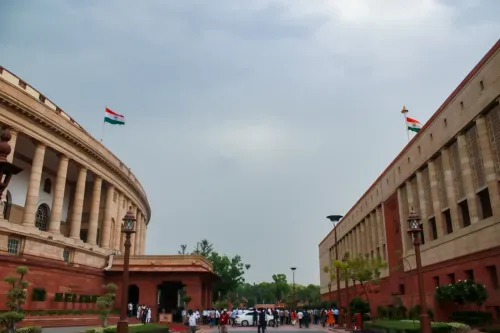
The Lok Sabha is to convene on 30 November and the Rajya Sabha on 2 December for the special session.
The bill earlier failed in the Lok Sabha on 17 April for lack of a two-thirds majority .
The editorial said the proposed expansion to 850 Lok Sabha seats favours northern states and penalises Kerala and Tamil Nadu .
It flagged reports that the DMK (28 MPs) and NCP-SP (8 MPs) may back the bill.
Minister Kiren Rijiju was criticised for announcing the session on social media without consulting the Opposition.
Shiv Sena (UBT) on Saturday, 28 November 2026 attacked the Centre over its decision to convene a special session of Parliament to push through the Delimitation Bill. The party accused the government of bypassing the traditional winter session to pass a law that, it alleged, would permanently entrench north India's political dominance. The attack came in an editorial in the party mouthpiece Samaana, published from Mumbai.
The Uddhav Thackeray-led party warned that passing the bill would be recorded in history as “stabbing democracy in the back.” It argued the move was aimed at retaining an iron grip on power through communal polarisation.
Key Allegations in the Samaana Editorial
According to the editorial, the legislation is a calculated move to impose the dominance of north India, which it referred to as the “cow belt,” over the rest of the country. The Thackeray camp alleged this would ensure that a Prime Minister from Maharashtra or southern India can never rise to power.
The editorial said the government's push to expand the Lok Sabha to 850 seats on the basis of population would disproportionately favour northern states with rapid population growth. It argued this would penalise southern states such as Kerala and Tamil Nadu, which successfully implemented population control measures.
Criticism of How the Session Was Called
The editorial targeted Parliamentary Affairs Minister Kiren Rijiju for announcing the special session on social media. Rijiju requested Lok Sabha Speaker Om Birla to convene the House on 30 November and the Rajya Sabha Chairman to convene the Upper House on 2 December. The editorial said he did so without consulting the Leader of the Opposition or other senior parliamentary leaders.
Notably, the editorial pointed out that the 2026 monsoon session was adjourned sine die more than 100 days ago. It alleged the government deliberately did not prorogue Parliament so that it could summon a session at short notice once it had the required numbers.
The Numbers Game Behind the Bill
The Delimitation Bill previously collapsed in the Lok Sabha on 17 April, when the government failed to muster the required two-thirds majority. The editorial questioned how the ruling dispensation has now gathered the extra support.
It raised concerns over reports that Tamil Nadu's Dravida Munnetra Kazhagam (DMK) and Maharashtra's NCP (Sharad Pawar) might vote in favour of the bill. The editorial warned that backing it would amount to a betrayal of the core ideologies both parties have upheld.
The editorial acknowledged recent friction between the DMK and the Congress, which led the DMK to distance itself from the INDIA bloc. However, it asserted that aligning with the Bharatiya Janata Party (BJP) would cost the DMK its public support base, given the weight of its 28 MPs.
It also stressed the crucial role of the NCP (SP)'s eight MPs. The editorial alleged that lawmakers were being intimidated with threats of party splits and central agency action. As an example, it cited pending ED and CBI cases against YSR Congress chief Jagan Mohan Reddy.
The editorial also dismissed the so-called “third front” of Chandrashekhar Azad and AIMIM, alleging that they routinely act in line with the BJP's interests.
Opposition Charge on National Priorities
The Sena (UBT) accused the leadership of Prime Minister Narendra Modi and Home Minister Amit Shah of putting electoral calculations for the 2029 general elections ahead of pressing national concerns. It listed inflation, border tensions, internal security and severe drought in Maharashtra among these concerns.
All eyes now turn to 30 November, when the Lok Sabha convenes. The positions of the DMK and the NCP (SP) could decide whether the bill clears the two-thirds threshold it failed to reach in April.
Point of View
The editorial's strongest point is about process, not ideology. Keeping Parliament unprorogued for over 100 days so a session can be called at short notice, and announcing it without consulting the Opposition, weakens the consensus a constitutional change of this scale needs. If the government secures two-thirds by peeling away the DMK and NCP (SP), it will need to show the votes were won through persuasion, not pressure. Otherwise, the redrawn map will carry a legitimacy deficit for decades.
NationPress
28 Nov 2026
Frequently Asked Questions
Why is Shiv Sena (UBT) opposing the Delimitation Bill?
Shiv Sena (UBT) alleges the bill would permanently impose north India's political dominance over the rest of the country. It argues the bill would ensure that no Prime Minister from Maharashtra or southern India can rise to power.
When is the special session of Parliament on the Delimitation Bill?
The Lok Sabha is to convene on 30 November and the Rajya Sabha on 2 December 2026. Parliamentary Affairs Minister Kiren Rijiju made the request on social media.
What happened to the Delimitation Bill earlier?
The bill collapsed in the Lok Sabha on 17 April after the government failed to secure the required two-thirds majority. Shiv Sena (UBT) has questioned how the government has now gathered the extra support.
How would the Delimitation Bill affect southern states?
According to the Samaana editorial, expanding the Lok Sabha to 850 seats based on population would favour fast-growing northern states. It would penalise states like Kerala and Tamil Nadu that controlled population growth.
Which parties could decide the fate of the Delimitation Bill?
The editorial highlighted the DMK, with 28 MPs, and the NCP (Sharad Pawar), with eight MPs, amid reports they might back the bill. It warned that doing so would betray both parties' core ideologies.