Amit Shah credits Doval for building MAC into India's security spine
Synopsis
Union Home Minister Amit Shah on 1 August 2026 credited NSA Ajit Doval with laying the foundations of the Multi Agency Centre, calling it the backbone of India's internal security under the Modi government. MAC, established in 2001 post-Kargil, fuses real-time intelligence across central and state agencies.
Key Takeaways
Amit Shah publicly credited NSA Ajit Doval as the founding chairman who built the strong foundation of the Multi Agency Centre (MAC) .
Shah called MAC the 'backbone of the country's internal security' under the Modi government .
MAC was established in 2001 following Kargil Review Committee recommendations on intelligence-sharing gaps.
MAC functions as a real-time intelligence fusion centre under the Intelligence Bureau , coordinating central and state agencies.
Post- 2014 , MAC has been integrated into a broader architecture including NATGRID and state-level fusion centres targeting terrorism, left-wing extremism, and border threats.
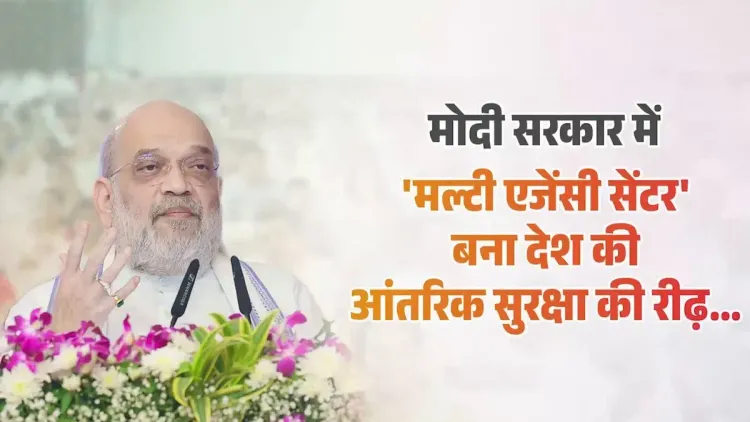
India's internal security architecture runs on real-time intelligence — and Union Home Minister Amit Shah says the nerve centre of that system, the Multi Agency Centre (MAC), owes its foundations to one man: National Security Advisor Ajit Doval. On Saturday, 1 August 2026, Shah posted on X crediting Doval with laying the strong groundwork for MAC under the Modi government, calling the centre the 'backbone of the country's internal security.'
In his post, Shah wrote: 'मोदी सरकार में मल्टी एजेंसी सेंटर (MAC) देश की आंतरिक सुरक्षा की रीढ़ की हड्डी बना है और इसकी मजबूत नींव डालने का काम संस्थापक अध्यक्ष के रूप में अजीत डोभाल जी ने किया।' — translated: 'Under the Modi government, the Multi Agency Centre has become the backbone of the country's internal security, and the work of laying its strong foundation was done by Ajit Doval ji as its founding chairman.'
What MAC does — and why it matters
The Multi Agency Centre is a real-time intelligence fusion hub housed under the Intelligence Bureau. Its core function: pulling together inputs from central and state agencies on internal security threats — terrorism, left-wing extremism, border infiltration — and getting that information to the right hands fast. The gap it was designed to close was brutally exposed before it existed.
MAC was established in 2001, directly following the Kargil Review Committee's recommendations, which identified fragmented intelligence sharing as a critical national vulnerability. The committee's verdict was stark — agencies were not talking to each other, and the country was paying the price. MAC was the structural answer.
Doval's role and the post-2014 push
Ajit Doval has served as National Security Advisor since 2014, bringing decades of experience as a former Director of the Intelligence Bureau and one of India's most decorated intelligence operatives. Shah's attribution of MAC's 'strong foundation' to Doval as 'founding chairman' places the NSA at the centre of the Modi government's internal security story — though the research base notes the exact formal title and timeline of that role remain in limited public record.
Since 2014, the central government has pursued a broader architecture around MAC: NATGRID — the National Intelligence Grid — and subsidiary state-level fusion centres have been built into the same ecosystem, creating layered, interconnected intelligence pipelines across agencies and state police forces. MAC sits at the apex of that network.
The larger architecture Shah is signalling
Shah's framing is deliberate. By calling MAC the 'backbone' and crediting Doval personally, the Home Minister is publicly anchoring the Modi government's internal security legacy to a specific institutional reform — not just rhetoric. The message to agencies, state governments, and the public is that coordination, not just capability, is what has hardened India's security posture over the past decade.
The real test of that claim lies in the operational outputs: whether inter-agency friction has genuinely fallen, whether threat warnings are reaching state police in time, and whether the next stress-test on India's security grid finds MAC equal to the moment.
Point of View
Where security achievements are typically claimed collectively. By naming Doval personally as MAC's architect, Shah is reinforcing the NSA's legacy at a moment when the government has been consistently publicising internal security gains. The framing also serves a broader narrative: that the Modi administration inherited fragmented intelligence infrastructure and systematically rebuilt it. Analysts will note that MAC's real operational effectiveness — measured by pre-empted threats and inter-agency friction — remains largely outside public scrutiny, making political attribution of its success difficult to independently verify.
NationPress
16 Sept 2026
Frequently Asked Questions
What is the Multi Agency Centre (MAC) in India?
The Multi Agency Centre is a real-time intelligence fusion centre under the Intelligence Bureau that coordinates threat inputs from central and state security agencies on internal security matters including terrorism and left-wing extremism.
When was MAC established and why?
MAC was established in 2001 following recommendations by the Kargil Review Committee, which identified poor intelligence sharing between agencies as a critical national security vulnerability.
What did Amit Shah say about Ajit Doval and MAC?
Amit Shah posted on X on 1 August 2026 that MAC has become the backbone of India's internal security under the Modi government and credited Doval with laying its strong foundation as its founding chairman.
What is Ajit Doval's role in India's security setup?
Ajit Doval has served as India's National Security Advisor since 2014 . He is a former Director of the Intelligence Bureau and one of India's most experienced intelligence professionals.
How does MAC connect to NATGRID?
MAC and NATGRID (National Intelligence Grid) are complementary parts of India's internal security architecture, both designed to improve real-time data sharing across agencies and state police forces — an effort expanded significantly after 2014 .