Amit Shah hails Vanvasi Kalyan Ashram's tribal service mission
Synopsis
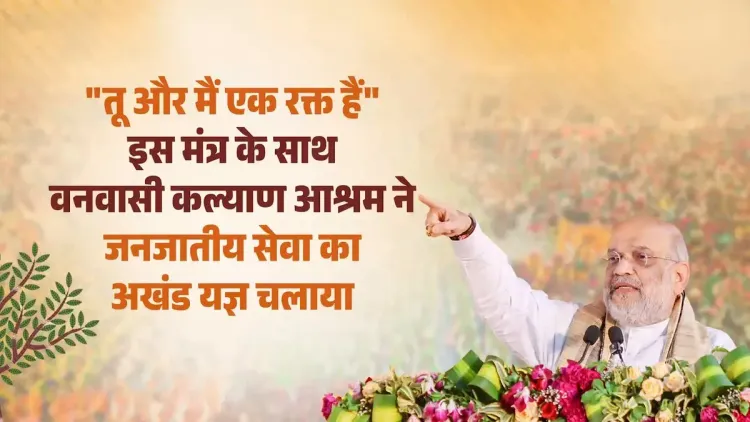
Union Home Minister Amit Shah on 24 May 2026 praised the Vanvasi Kalyan Ashram, invoking the mantra 'You and I are of one blood' to describe the RSS-affiliated organisation's decades of silent, unbroken service to India's tribal communities.
Key Takeaways
Union Home Minister Amit Shah publicly praised the Vanvasi Kalyan Ashram on 24 May 2026 .
He cited the Hindi mantra 'तू और मैं एक रक्त हैं' ('You and I are of one blood') as the organisation's guiding principle.
The Vanvasi Kalyan Ashram was founded in 1952 and works on education, health, and cultural integration among Scheduled Tribe communities.
The BJP government has since 2014 combined state-run tribal welfare schemes such as the Vanbandhu Kalyan Yojana with outreach by Sangh Parivar organisations.
India's Scheduled Tribe population exceeds 10 crore , concentrated in central, eastern, and north-eastern states.
Union Home Minister Amit Shah on Sunday, 24 May 2026 paid tribute to the Vanvasi Kalyan Ashram, praising the RSS-affiliated organisation for its decades-long service among India's tribal communities under the guiding principle of shared kinship.
Context
In his post, Shah invoked the Hindi phrase 'तू और मैं एक रक्त हैं' ('You and I are of one blood'), describing it as the central mantra driving the Ashram's work. He characterised the organisation as a 'mook sewak' — a silent servant — that has kept an unbroken yagya (sacred endeavour) of tribal service alive across generations.
The Vanvasi Kalyan Ashram was founded in 1952 and operates across multiple states, running schools, health centres, and cultural outreach programmes in Scheduled Tribe-dominated regions of central and eastern India.
Policy Backdrop
Tribal welfare has been a recurring theme in the BJP government's administrative and electoral strategy since 2014. The Vanbandhu Kalyan Yojana, launched that year, channelled central funds into infrastructure, education, and livelihoods in tribal-heavy districts.
The Ministry of Tribal Affairs, established in 1999, coordinates development programmes for Scheduled Tribe communities. The Forest Rights Act of 2006 remains a landmark legislation recognising individual and community rights over forest land, forming part of the legal backbone of tribal welfare policy.
The ruling party has increasingly combined state-run welfare delivery with the cultural integration work of Sangh Parivar organisations like the Vanvasi Kalyan Ashram, presenting both as complementary pillars of outreach to tribal populations.
Stakeholders and Impact
India's Scheduled Tribe population, numbering over 10 crore people, is spread across states including Jharkhand, Chhattisgarh, Madhya Pradesh, Odisha, and the North-East. These communities have historically faced gaps in education, healthcare, and land rights.
The Vanvasi Kalyan Ashram's grassroots network — operating through volunteers rather than large institutional budgets — has given it reach into remote forest regions where government services have often been slow to arrive. Shah's endorsement signals continued political and moral support for the organisation's model of community-embedded service.
What's Next
Observers will watch for any new guidelines from the Ministry of Tribal Affairs in the upcoming parliamentary session, as well as state-level implementation reviews of centrally sponsored tribal welfare schemes. Shah's public affirmation of the Ashram's work may also intensify focus on expanding the organisation's footprint in states where tribal electoral constituencies carry significant political weight.
Point of View
Blending administrative reach with cultural messaging. The invocation of 'one blood' kinship language is significant — it frames tribal integration not as a top-down policy project but as an organic civilisational bond, which carries both ideological and electoral resonance in Scheduled Tribe-heavy constituencies. With parliamentary sessions approaching and tribal districts remaining battlegrounds in several state elections, such statements serve simultaneously as policy endorsement and political signalling. The broader arc points toward a sustained effort to consolidate the BJP's foothold among tribal voters through a combination of scheme delivery and cultural affinity.
NationPress
12 Oct 2026
Frequently Asked Questions
What is Vanvasi Kalyan Ashram and what does it do?
The Vanvasi Kalyan Ashram is an RSS-affiliated organisation founded in 1952 that runs schools, health centres, and cultural programmes for Scheduled Tribe communities across India, particularly in central and eastern states.
What did Amit Shah say about Vanvasi Kalyan Ashram?
On 24 May 2026, Amit Shah praised the Vanvasi Kalyan Ashram, calling it a 'silent servant' that has kept an unbroken sacred endeavour of tribal service alive, guided by the mantra 'You and I are of one blood'.
What is the Vanbandhu Kalyan Yojana?
The Vanbandhu Kalyan Yojana is a central government scheme launched in 2014 to improve infrastructure, education, and livelihoods in tribal-dominated districts across India.
What is the BJP government's approach to tribal welfare?
Since 2014, the BJP government has combined centrally sponsored tribal welfare schemes with outreach by Sangh Parivar organisations that emphasise cultural integration, targeting districts with large Scheduled Tribe populations.
How large is India's tribal population?
India's Scheduled Tribe population exceeds 10 crore people, spread across states including Jharkhand, Chhattisgarh, Madhya Pradesh, Odisha, and the North-East.