Amit Shah Questions Punjab Law-Order, Vows Drug-Free State
Synopsis
Union Home Minister Amit Shah attacked the Bhagwant Mann-led AAP government over Punjab's worsening drug and crime crisis, citing the daylight murder of anti-drug activist Parvinder Singh Jhota in Mansa and a poisoning case in Dirba, and announced the Home Ministry will formally seek answers from the state government.
Key Takeaways
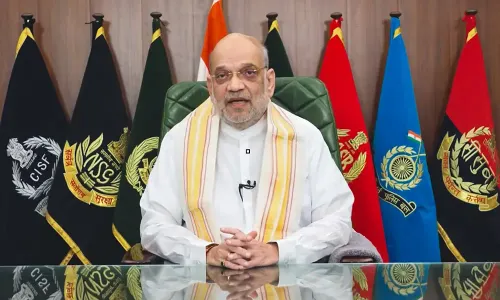
Union Home Minister Amit Shah publicly indicted the Bhagwant Mann (AAP) government over Punjab's drug and organised-crime situation on October 16, 2026 .
Shah cited two specific incidents: the murder of anti-drug activist Parvinder Singh Jhota in Mansa and a father's alleged poisoning under pressure in Dirba .
Jhota's father has reportedly levelled 'serious allegations' against the AAP government and one of its MLAs.
The Union Home Ministry will formally seek answers from the Punjab government on both cases, elevating the matter to a Centre-state accountability issue.
Shah pledged that a BJP government in Punjab would deliver a 'drug-free, gangster-free and safe Punjab' — renewing the party's core electoral promise for the state.
AAP had swept Punjab's 2022 elections on an anti-drug platform, making Shah's critique a direct test of the ruling party's signature commitment.
Two incidents — a father driven to poison himself under pressure in Dirba, and the broad-daylight murder of anti-drug activist Parvinder Singh Jhota in Mansa — have given Union Home Minister Amit Shah the sharpest possible ammunition to challenge the Bhagwant Mann government on Punjab's deteriorating law-and-order situation on Friday, October 16, 2026.
Shah's post on X pulled no punches. Translating from Hindi: 'Punjab today is battling the growing menace of drugs, gangsterism and organised crime. The biggest question before the Bhagwant Mann government is: who will take responsibility for the safety of Punjab's people?' He named both incidents directly, noting that Jhota's father has levelled serious allegations against the AAP government and one of its MLAs.
Then came the institutional escalation: Shah announced that the Union Home Ministry would formally seek answers from the Punjab government on both cases. That transforms this from political criticism into a Centre-state accountability moment — with a paper trail.
The Jhota Murder and the Dirba Poisoning Case
According to Shah's post, Parvinder Singh Jhota was killed in broad daylight in Mansa — a man whose only stated offence was raising his voice against the drug trade. In Dirba, a father allegedly consumed poison under pressure, a tragedy Shah framed as a direct consequence of the state's inability to protect ordinary citizens who dare to speak out.
Shah underlined that Jhota's father has made 'serious allegations' against the AAP government and its legislator. The Home Ministry's decision to demand a response from the Punjab government means the state will be compelled to put its version on record at the central level.
AAP's 2022 Drug Promise vs. 2026 Ground Reality
Aam Aadmi Party swept Punjab's 2022 assembly elections on a wave of anti-drug sentiment, with its manifesto pledging decisive action against narcotics networks within weeks of assuming office. Four-plus years later, Shah is using that very promise as a measuring stick — and finding it wanting.
Punjab's struggle with synthetic narcotics and cross-border drug trafficking is not a new story; it has featured in every election cycle and in successive Union Home Ministry advisories to state governments for over a decade. What is new is a sitting Home Minister publicly naming specific victims, announcing a formal ministry-level inquiry, and staking a BJP return-to-power pledge around it — all in a single post.
Shah's Pledge: 'Decisive Strike on Drug Networks'
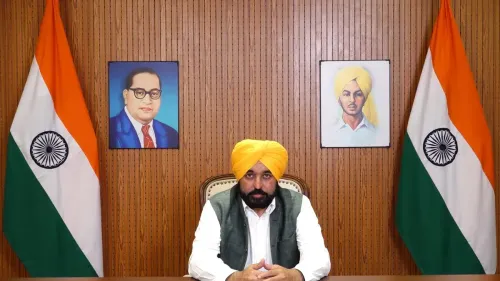
Shah closed with a direct challenge to Chief Minister Bhagwant Mann — 'Punjab's people want answers, not publicity; results, not announcements; a decisive strike on drug networks and an impartial investigation into any political protection given to criminals.' He then renewed the BJP's election commitment: a drug-free, gangster-free, safe Punjab 'with full force' once the party forms government in the state.
The BJP's electoral footprint in Punjab has historically been modest, but the party has consistently positioned itself as the harder-line option on security. Shah's intervention today sharpens that contrast ahead of the next state election cycle — and it does so by grounding the argument not in ideology, but in two names: Parvinder Singh Jhota and the unnamed father in Dirba.
The Home Ministry's formal query to Chandigarh is the one to watch. Punjab's response — or silence — will define the next chapter of this standoff.
Point of View
A tactic that has precedent in Centre-state relations but is relatively rare when executed this publicly. The naming of specific victims (Jhota, the Dirba father) anchors what could have been abstract political criticism in human cost, making it harder for the AAP government to dismiss as electioneering. For the BJP, Punjab remains an aspirational target — the party governs few large states outright in the north-west — and framing a law-and-order offensive as a moral obligation to named citizens rather than a partisan attack is a deliberate strategic posture. The Home Ministry query, if formally issued, will force a paper-trail response from Chandigarh, creating accountability optics regardless of the electoral cycle's timing.
NationPress
16 Oct 2026
Frequently Asked Questions
Why is the Home Ministry seeking answers from Punjab over the Parvinder Singh Jhota case?
Union Home Minister Amit Shah announced that the Home Ministry will formally seek answers from the Punjab government because Jhota, an anti-drug activist, was murdered in broad daylight in Mansa and his father has levelled serious allegations against the AAP government and one of its MLAs. Shah cited the case as evidence of a breakdown in law and order in the state.
Who was Parvinder Singh Jhota?
According to Amit Shah's post, Parvinder Singh Jhota was an anti-drug activist from Mansa, Punjab, who was killed in broad daylight. Shah described him as someone who had raised his voice against the drug trade, and his murder has triggered a political storm over the Punjab government's ability to protect citizens who speak out against narcotics networks.
What is the Dirba poisoning case mentioned by Amit Shah?
Shah's post references an incident in Dirba, Punjab, where a father allegedly consumed poison under pressure. Shah cited it alongside the Mansa murder as an example of the human cost of Punjab's deteriorating security situation under the Bhagwant Mann government.
What did AAP promise on drugs when it won Punjab in 2022?
When Aam Aadmi Party won Punjab's 2022 assembly elections, its manifesto promised decisive action to eradicate the drug trade within weeks of forming government. Shah's post in October 2026 uses that unfulfilled pledge as a direct line of attack against Chief Minister Bhagwant Mann.
Can the Centre direct a state government on law and order matters like drug crime?
Law and order is primarily a state subject under the Indian Constitution, but the Union Home Ministry can issue advisories, seek reports, and formally request information from state governments on matters touching internal security. Amit Shah announcing a formal query to Punjab is within those powers, though the state retains primary operational responsibility.