Amit Shah reviews Amarnath Yatra 2025 security, Yatra begins July 3
Synopsis
With the Amarnath Yatra just weeks away, Home Minister Amit Shah convened the country's top security brass — NSA Doval, the Army Chief, and CRPF DG — for a single-room review. The deployment of RCIED jammers, a new QR-based vendor verification app, and personal route inspections by the CRPF chief signal that this year's security operation is among the most technologically layered in the pilgrimage's recent history.
Key Takeaways
Amit Shah chaired a high-level Amarnath Yatra 2025 security review on 12 June , attended by NSA Ajit Doval , Army Chief General Upendra Dwivedi , and CRPF DG G.P.
The Amarnath Yatra runs from 3 July to 28 August 2025 — a 57-day pilgrimage concluding on Raksha Bandhan .
The cave shrine stands at 3,880 metres above sea level; pilgrims access it via the 48 km Pahalgam route or the 14 km Baltal route.
J&K Police have deployed RCIED jammers , XBIS units, NLJDs, and a QR-based 'Pahchan App' for digital vendor verification.
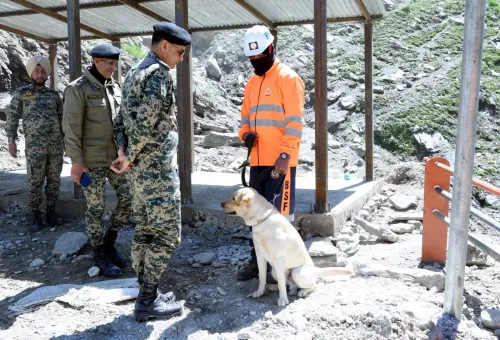
Singh personally inspected the Baltal route, directing commanders to maintain a robust, proactive security grid.
Union Home Minister Amit Shah on Friday, 12 June chaired a high-level security review meeting in New Delhi to assess operational preparedness for the upcoming Amarnath Yatra 2025, which is scheduled to commence on 3 July and conclude on 28 August after 57 days. The meeting brought together the country's top security establishment to ensure the pilgrimage to the Himalayan cave shrine proceeds without incident.
Who Attended the High-Level Meeting
The security review was attended by Jammu and Kashmir Lieutenant Governor Manoj Singh, National Security Advisor Ajit Doval, Army Chief General Upendra Dwivedi, and Central Reserve Police Force (CRPF) Director-General G.P. Singh, along with other senior security and administrative officials. The convergence of the NSA, Army Chief, and CRPF chief at a single preparedness review signals the scale of the security operation being mounted this year.
Security Grid and Technology Deployment
Security agencies are deploying a layered approach combining advanced surveillance technology, intelligence-led monitoring, and multi-agency coordination. The Jammu and Kashmir Police have positioned sophisticated equipment along the route, including portable RCIED jammers, deep search metal detectors, explosive and liquid explosive detectors, non-linear junction detectors (NLJDs), contraband busters, vehicle search mirrors, optical fibrescopes, multi-type CCTV systems, XBIS units, vehicle-mounted XBIS, multi-zone DFMDs, HHMDs, and other specialised gear, according to IGP Security Sujit Kumar.
In a notable digital initiative, police have launched the QR-based 'Pahchan App' to digitally verify workers and vendors operating along the yatra route. Officials said the system is designed to prevent unverified individuals from entering the pilgrimage ecosystem while improving accountability and crowd management. Tenant verification drives, inspections of lodgement centres, and intelligence-gathering operations have also been intensified.
Routes, Terrain, and the Shrine
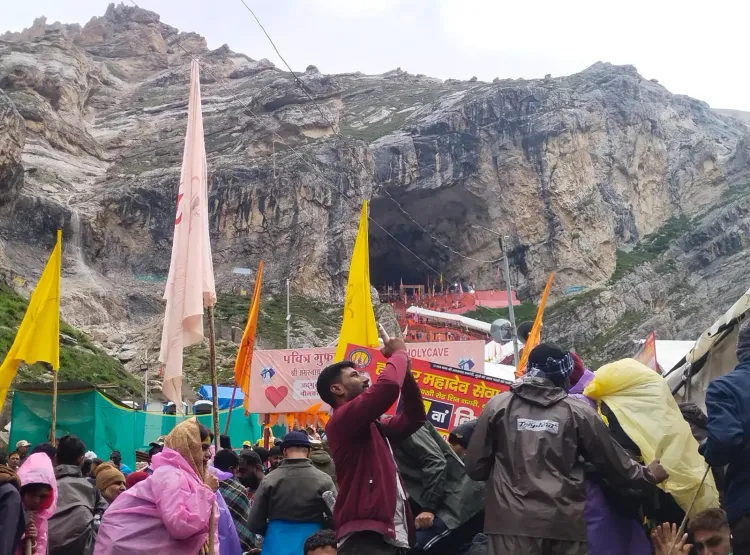
The Amarnath cave shrine is situated at 3,880 metres above sea level in the Himalayas. Pilgrims can reach it via two routes: the traditional 48 km trail from the Pahalgam base camp in Anantnag district, or the shorter 14 km route from the Baltal base camp in Ganderbal district. The shrine houses an ice stalagmite structure that is believed by devotees to symbolise the powers of Lord Shiva, waxing and waning with the lunar cycle. This year's yatra concludes on 28 August, coinciding with Shravan Purnima and Raksha Bandhan.
Ground-Level Preparations and Community Role
CRPF Director General G.P. Singh visited the Kashmir Valley earlier this week and personally reviewed security and logistical arrangements along the route to the Baltal base camp, directing commanders to adopt proactive measures and maintain a robust security grid through close coordination among all stakeholders. Separately, Lt Governor Manoj Singh also reviewed preparations, directing departments to ensure smooth arrangements covering infrastructure, security, healthcare, sanitation, connectivity, and pilgrim services.
Notably, local Muslim communities traditionally play a significant supporting role in the yatra's conduct, serving as guides, porters, ponywallahs, and small-scale shopkeepers along the route — a tradition that underscores the pilgrimage's broader social fabric in the region.
What Happens Next
With the yatra less than three weeks away, agencies are expected to complete final security drills and route inspections before the 3 July start date. The scale of this year's review — involving the Home Minister, NSA, and Army Chief simultaneously — reflects heightened vigilance in the security environment surrounding the pilgrimage.
Point of View
Army Chief, and CRPF chief at a pre-yatra security review is not routine — it reflects a security calculus that goes well beyond standard pilgrimage logistics. The launch of the 'Pahchan App' for vendor verification is a meaningful step toward closing a long-standing gap in the pilgrimage's soft-security perimeter, where unverified individuals in the service ecosystem have historically been a vulnerability. What remains to be assessed is whether the technology-heavy deployment translates into seamless pilgrim experience or creates bottlenecks at already-congested base camps. The community participation angle — local Muslims as guides and porters — is a reminder that the yatra's security architecture works best when it complements, rather than disrupts, the social compact that has sustained it for decades.
NationPress
26 Oct 2026
Frequently Asked Questions
When does the Amarnath Yatra 2025 begin and end?
The Amarnath Yatra 2025 begins on 3 July and concludes on 28 August, spanning 57 days. It ends on Shravan Purnima, which coincides with Raksha Bandhan this year.
Who attended Amit Shah's Amarnath Yatra security review meeting?
The meeting on 12 June was attended by J&K Lt Governor Manoj Singh, National Security Advisor Ajit Doval, Army Chief General Upendra Dwivedi, and CRPF Director-General G.P. Singh, along with other senior security and administrative officials.
What is the 'Pahchan App' launched for the Amarnath Yatra?
The 'Pahchan App' is a QR-based digital verification system launched by the Jammu and Kashmir Police to authenticate workers and vendors operating along the yatra route. It is designed to prevent unverified individuals from entering the pilgrimage ecosystem and to improve crowd management and accountability.
What are the two routes to the Amarnath cave shrine?
Pilgrims can reach the Amarnath shrine via the traditional 48 km route from the Pahalgam base camp in Anantnag district, or the shorter 14 km route from the Baltal base camp in Ganderbal district. The cave shrine is located at 3,880 metres above sea level.
What security equipment has been deployed for Amarnath Yatra 2025?
According to IGP Security Sujit Kumar, the J&K Police have deployed RCIED jammers, deep search metal detectors, explosive and liquid explosive detectors, non-linear junction detectors (NLJDs), XBIS and vehicle-mounted XBIS units, multi-zone DFMDs, CCTV systems, and other specialised screening equipment along the yatra route.