Dr. Jitendra Singh hails Shahpur Kandi Project near completion

Synopsis
Union Minister Dr. Jitendra Singh has highlighted the near-completion of the Shahpur Kandi National Project on the Ravi river in Kathua, a scheme first envisaged in the 1970s and whose foundation stone was laid by Indira Gandhi in 1984, revived only after PM Modi's 2019 Jammu rally announcement.
Key Takeaways
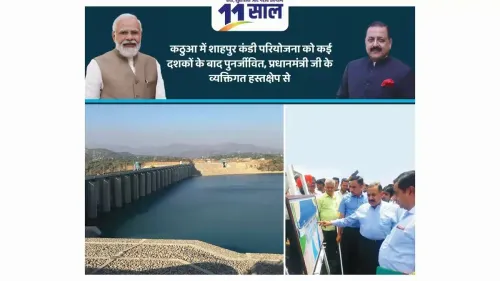
The Shahpur Kandi National Project on the Ravi river in Kathua district is described as 'almost complete' by Union Minister Dr.
The project was conceived to utilise India's share of the Ravi river under the Indus Waters Treaty of 1960 , preventing the water from flowing unused into Pakistan.
The foundation stone was laid by PM Indira Gandhi in 1984 ; the project was shelved after her assassination and remained stalled for nearly three decades.
The BJP government revived the project after 2014 ; PM Narendra Modi formally announced its revival at a Jammu rally in February 2019 .
The completed project is expected to transform irrigation and agriculture in the bordering districts of Jammu and Kashmir and Punjab .
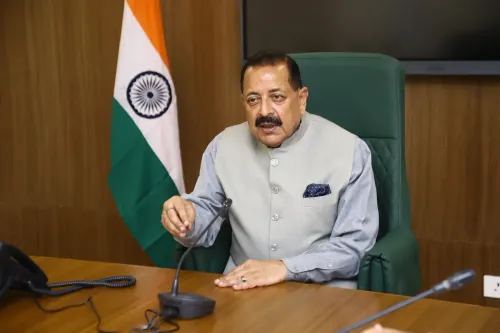
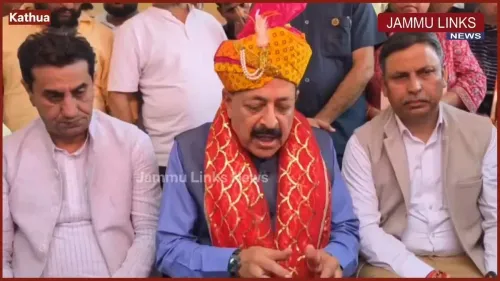
Union Science and Technology Minister Dr. Jitendra Singh on Thursday, 18 June 2026, highlighted the near-completion of the Shahpur Kandi National Project on the Kathua district border, calling it the fulfilment of a decades-old aspiration for the people of Jammu and Kashmir and Punjab.
Context
The Shahpur Kandi National Project is a multipurpose dam project on the Ravi river, designed to harness India's treaty-allocated share of the river's waters for irrigation and hydropower. Dr. Jitendra Singh noted in his post that the project's origins lie in the framework established by the Indus Waters Treaty of 1960, under which India was allocated the exclusive use of the eastern rivers — Ravi, Beas, and Sutlej — with Ravi being the largest among them.
The central concern driving the project, as the minister described it, was ensuring that India's rightful share of Ravi's waters was utilised domestically 'without allowing it to flow into Pakistan.'
Policy Backdrop
The project's history stretches back over four decades. The foundation stone was laid in 1984 by then Prime Minister Mrs. Indira Gandhi, but her assassination later that year effectively stalled the initiative. Dr. Jitendra Singh stated plainly that 'successive governments, both at the Centre and in J&K State, remained indifferent' for nearly three decades.
It was only after the BJP government took office in 2014 that efforts to revive the project were formally initiated. Chief Secretaries of Jammu and Kashmir and Punjab were brought into the process, fresh documentation was prepared, and in February 2019, Prime Minister Narendra Modi announced the project's revival at a public rally in Jammu. The minister's post underscores this as a deliberate policy reversal after years of institutional neglect.
Stakeholders and Impact
The project is positioned to directly benefit farming communities in the bordering districts of Jammu and Kashmir — particularly Kathua district — and Punjab, through expanded irrigation infrastructure and agricultural growth. Dr. Jitendra Singh described the project as one 'set to transform bordering districts of J&K and Punjab through enhanced irrigation and agricultural growth.'
The broader significance lies in India's long-standing goal of fully operationalising its entitlements under the Indus Waters Treaty. River valley projects of this nature represent a strategic use of treaty rights that successive administrations had left underutilised, leaving allocated water flowing unused into Pakistan.
What's Next
With the project described as 'almost complete,' attention will now turn to the rollout of actual irrigation benefits — the area brought under irrigation, agricultural productivity gains in Kathua and adjacent districts, and the hydropower generation capacity once the dam becomes fully operational. Official figures on irrigated area and power output will be the key metrics by which the project's real-world impact is measured.
The Shahpur Kandi project's trajectory — from a 1984 foundation stone to a near-complete dam in 2026 — illustrates both the chronic delays that have plagued India's large river infrastructure projects and the current government's stated priority of completing long-pending border-area schemes.
Point of View
' the minister connects an infrastructure milestone to a broader national-security and sovereignty argument that resonates strongly in border districts. The near-completion of the dam also arrives at a time when India's posture on the Indus Waters Treaty has been under heightened scrutiny, lending the announcement added strategic weight. For the ruling dispensation, completing long-stalled border infrastructure projects has become a signature governance narrative ahead of electoral cycles in both J&K and Punjab.
NationPress
18 Sept 2026
Frequently Asked Questions
What is the Shahpur Kandi National Project?
The Shahpur Kandi National Project is a multipurpose dam on the Ravi river at the Kathua district border of Jammu and Kashmir, designed to harness India's treaty-allocated share of the river's waters for irrigation and hydropower generation.
Why was the Shahpur Kandi project delayed for so long?
The project's foundation stone was laid by PM Indira Gandhi in 1984, but her assassination later that year stalled it. Successive central and J&K state governments did not prioritise its revival, leaving it dormant for nearly three decades.
Who revived the Shahpur Kandi project?
The BJP government initiated revival efforts after coming to power in 2014. Prime Minister Narendra Modi formally announced the project's revival at a public rally in Jammu in February 2019.
How does the Indus Waters Treaty relate to the Shahpur Kandi project?
The Indus Waters Treaty of 1960 allocated the eastern rivers — Ravi, Beas, and Sutlej — exclusively to India. The Shahpur Kandi project was conceived specifically to utilise India's share of the Ravi river domestically rather than letting it flow into Pakistan unused.
Which areas will benefit from the Shahpur Kandi project?
The project is expected to benefit farming communities in the bordering districts of Jammu and Kashmir, particularly Kathua district, and Punjab, through expanded irrigation and agricultural growth.