Shekhawat Accuses Opposition of Bangladesh-Style Regime Change Plot
Synopsis
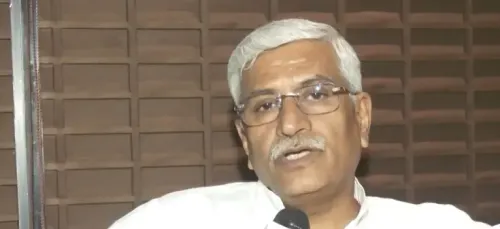
Union Culture and Tourism Minister Gajendra Singh Shekhawat accused unnamed opposition leaders of openly drawing inspiration from Bangladesh's 2024 government transition to pursue regime change in India, calling their agenda a bid to 'demolish democratic institutions and set the country on fire.'
Key Takeaways
Gajendra Singh Shekhawat posted on October 16, 2026 , accusing certain leaders of plotting 'regime change' inspired by Bangladesh's 2024 government transition.
He alleged that an opposition figure stated at a press conference that they drew 'inspiration from Bangladesh for regime change.' A second unnamed leader allegedly declared 'openly' the intent to bring down the government.
Shekhawat accused them of using India's youth as pawns in a politics of anarchy.
He concluded their 'sole agenda' is to destroy democratic institutions and 'set the country on fire.' The specific press conferences and statements referenced in the post have not been independently verified.
India's young are being turned into pawns of anarchy — that is the charge Union Culture and Tourism Minister Gajendra Singh Shekhawat levelled on Friday, October 16, 2026, in a sharp political broadside that invokes the spectre of Bangladesh's 2024 government transition and accuses unnamed opposition figures of openly plotting to bring down India's elected government.
Posting in Hindi on X, Shekhawat wrote: 'देश के नौजवानों को अराजकता की राजनीति का मोहरा बनाने की कोशिश की जा रही है' — 'An attempt is being made to turn the country's youth into pawns of the politics of anarchy.' He went further, alleging that certain leaders had stated at a press conference that they drew inspiration from Bangladesh for 'regime change', and that another had 'openly declared the intent to bring down the government.' His conclusion was unambiguous: 'Their sole agenda is to demolish democratic institutions and set the country on fire.'
The Bangladesh Reference and What It Signals
The invocation of Bangladesh is deliberate and pointed. In 2024, mass student-led protests in that country culminated in a dramatic government transition — an event that reverberated across South Asia and immediately entered the political vocabulary of India's ruling establishment. Since then, BJP leaders have periodically raised the Bangladesh parallel whenever domestic campus unrest or protest movements gain momentum, framing them as potential vectors of foreign-inspired destabilisation.
Shekhawat's post sharpens that framing considerably. By claiming that opposition figures have made these statements 'openly at press conferences' and 'without hesitation', he is not merely drawing an analogy — he is asserting an explicit, stated intent. The research notes these specific press conferences and statements cannot be independently verified from available records.
Youth as the Battleground
The opening line of the post is the most politically loaded: the targeting of India's youth. Framing young people as the intended instruments of 'anarchy' is a calculated move — it simultaneously positions the BJP as the protector of a demographic that both major political formations aggressively court, and paints the opposition as willing to sacrifice that generation's stability for narrow political ends.
The post accompanies a video, suggesting this is part of a coordinated communication push rather than an off-the-cuff remark. Shekhawat, as a senior Lok Sabha MP from Jodhpur and a cabinet minister with a national profile, carries the weight to set the tone of a political cycle.
Democratic Institutions in the Crosshairs — BJP's Recurring Warning
The closing phrase — 'demolish democratic institutions and set the country on fire' — maps onto a well-worn BJP counter-narrative that casts opposition disruption as structurally anti-democratic rather than constitutionally legitimate dissent. Whether that framing lands with voters will depend on the opposition's response and whether any parliamentary debate follows. Watch for opposition rebuttals that reframe Shekhawat's remarks as an attempt to delegitimise protest itself.
The charge is out in the open. The next move belongs to those named — even if only implicitly.
Point of View
Arriving with a video attachment and framed around two of the BJP's most potent long-term messaging pillars: the defence of democratic institutions and the protection of India's youth. The Bangladesh reference has become a recurring shorthand in the ruling party's playbook since 2024, deployed to preemptively delegitimise protest movements by associating them with foreign-inspired regime change. By attributing these intentions to unnamed leaders who allegedly spoke 'openly at press conferences,' Shekhawat raises the stakes without naming targets — a tactic that forces the opposition to either deny or own the framing. The key political question is whether this line of attack shifts debate from government performance to opposition intent.
NationPress
16 Oct 2026
Frequently Asked Questions
What did Gajendra Singh Shekhawat say about regime change in India?
Shekhawat accused unnamed opposition leaders of openly seeking 'regime change' in India on the lines of Bangladesh's 2024 government transition, alleging they stated this at a press conference and declared intent to bring down the government.
What happened in Bangladesh in 2024 that BJP leaders keep referencing?
In 2024, mass student-led protests in Bangladesh led to a dramatic government transition. BJP leaders have since invoked this event to warn against what they describe as foreign-inspired destabilisation tactics being attempted in India.
Who is Gajendra Singh Shekhawat?
Gajendra Singh Shekhawat is India's Union Minister of Culture and Tourism, a senior BJP leader, and a Lok Sabha MP representing the Jodhpur constituency in Rajasthan.
What does Shekhawat mean by using youth as 'pawns of anarchy'?
Shekhawat alleged that certain political actors are deliberately mobilising India's young population to fuel protest and instability, using them as instruments to destabilise the elected government rather than for constructive democratic engagement.
Has the opposition responded to Shekhawat's regime change accusation?
No verified opposition response to this specific post is available at the time of publication. The specific press conferences Shekhawat referenced also could not be independently verified from available records.