Shekhawat: E20 fuel is 20 years in the making, not a rushed call

Synopsis
Union Minister Gajendra Singh Shekhawat has defended India's E20 ethanol-blending programme as the product of two decades of planning, tracing its origins to a 2001 E5 pilot and citing the early achievement of the 10% blending target in 2022 as proof of the programme's methodical design.
Key Takeaways
India's ethanol blending programme began with an E5 pilot in 2001 and has evolved over two decades of policy reform.
The 10% ethanol blending target was achieved in 2022 , five months ahead of schedule.
Feedstocks were expanded beyond sugarcane molasses to include maize and surplus grains , strengthening farm linkages.
The E20 rollout followed formal consultations with the automobile industry and scientific validation to ensure engine compatibility.
The programme is designed to reduce India's crude oil import dependence while cutting carbon emissions.
The next milestone to watch is nationwide availability of E20-compatible vehicles and fuel pumps .
Twenty years of calibrated policy — not a sudden decree — delivered India's E20 ethanol-blending programme, and Union Culture and Tourism Minister Gajendra Singh Shekhawat wants that record front and centre. In an X post on Saturday, 8 August 2026, Shekhawat traced the full arc of India's biofuel journey, from a modest pilot to a national clean-energy milestone.
Posting in Hindi, Shekhawat wrote: 'E20 एक दिन में नहीं बना' — 'E20 was not built in a day.' The minister framed the 20% ethanol blend in petrol as the culmination of a journey that began in 2001 with an E5 pilot programme, expanded through successive policy reforms, and was powered by interest subvention schemes, assured procurement guarantees, and a deliberate diversification of feedstocks beyond sugarcane molasses to include maize and surplus grains.
From E5 pilot to 10% ahead of schedule
The numbers tell the story. India set a target of 10% ethanol blending — and hit it in 2022, a full five months before the deadline. That early delivery was not accidental. It reflected two decades of iterative policymaking: tweaking procurement rules, unlocking new feedstocks, and building supply chains that could absorb the programme's growing ambitions. The trajectory from E5 to E10 to E20 is, in effect, a textbook case of long-horizon industrial policy.Automakers at the table before the rollout
Shekhawat specifically highlighted consultations with the automobile industry and scientific validation as preconditions for the E20 rollout — a detail that matters. Higher ethanol blends can affect engine performance, fuel efficiency, and material compatibility, so phasing in E20 without industry sign-off would have risked a consumer backlash. The minister's emphasis on this process is a direct rebuttal to any criticism that the transition was imposed without technical due diligence.Why India's biofuel bet is bigger than the pump price
At its core, the ethanol blending programme is an energy-security play. India is one of the world's largest crude oil importers, and every percentage point of domestic ethanol substitution trims the import bill and cuts carbon emissions simultaneously. Expanding feedstocks to include maize and surplus grains also connects the programme to farm incomes — turning agricultural surpluses into a strategic asset rather than a price-depressing glut. The what-to-watch now is the nationwide rollout of E20-compatible vehicles and fuel pumps, and whether upcoming petroleum policy announcements push blending targets further still. Two decades of groundwork, one clean-energy destination — the only question left is how fast the rest of the infrastructure catches up.Point of View
Science-backed continuum rather than a politically driven imposition, at a moment when higher blending mandates are drawing scrutiny from vehicle owners and fuel retailers. By anchoring the narrative in the 2001 origin and the ahead-of-schedule 10% milestone, the BJP is signalling that India's clean-energy transitions are durable, not electoral. The inclusion of maize and grain feedstocks is also a quiet reminder that the programme serves farmer constituencies as much as it serves the environment — a dual dividend the ruling alliance is keen to keep visible ahead of any further blending mandate announcements.
NationPress
8 Aug 2026
Frequently Asked Questions
What is E20 fuel in India?
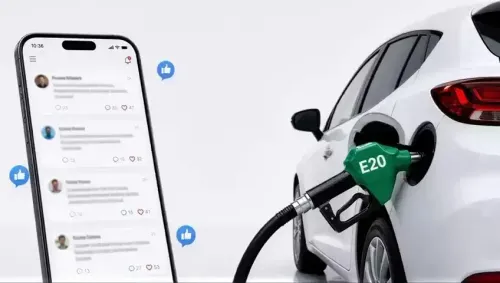
E20 is petrol blended with 20% ethanol , rolled out in India after automobile industry consultations and scientific validation as part of a two-decade biofuel programme aimed at cutting crude oil imports and carbon emissions.
When did India start the ethanol blending programme?
India's ethanol blending programme began with an E5 pilot in 2001 and has since expanded through successive policy reforms to reach the E20 standard.
Did India achieve the 10% ethanol blending target?
Yes. India achieved the 10% ethanol blending target in 2022 , five months ahead of the original deadline, driven by policy reforms, interest subvention, and expanded feedstocks.
What feedstocks are used for ethanol blending in India?
India's programme initially relied on sugarcane molasses but has since diversified to include maize and surplus grains , broadening the agricultural base of the supply chain.
Is E20 fuel compatible with all cars in India?
E20 compatibility requires specific engine and material standards; the government consulted the automobile industry and conducted scientific validation before implementing E20 in a phased manner to ensure vehicle compatibility.