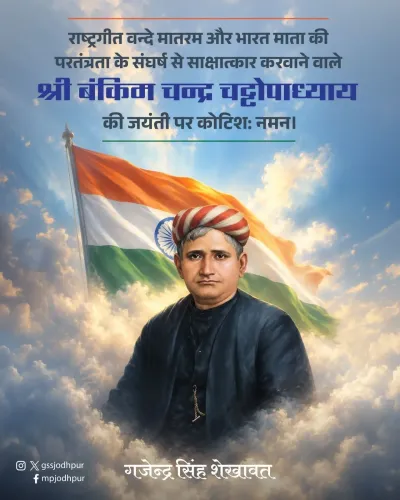
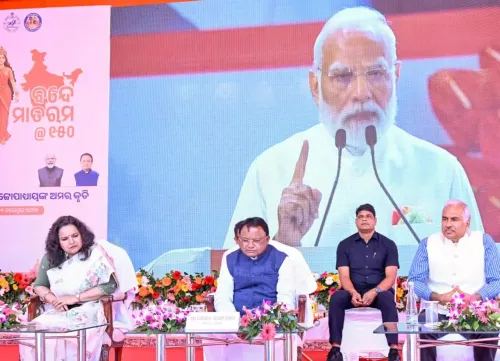
Shekhawat marks 151 years of Vande Mataram
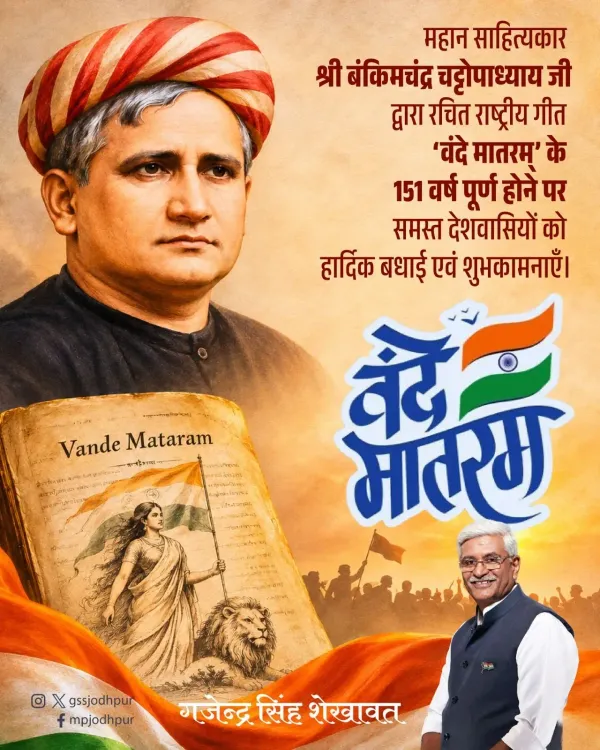
Synopsis
Union Culture Minister Gajendra Singh Shekhawat marked the 151st anniversary of Vande Mataram on 7 November 2026, calling the national song 'the immortal voice of India's national consciousness' and urging citizens to embody its spirit in nation-building.
Key Takeaways
Vande Mataram was composed by Bankim Chandra Chattopadhyay in 1875 and later included in his 1882 novel Anandamath .
The Constituent Assembly declared it India's national song on 24 January 1950 , alongside Jana Gana Mana as the national anthem.
Union Culture and Tourism Minister Gajendra Singh Shekhawat greeted the nation on the 151st anniversary on 7 November 2026.
The Minister described the song as 'the immortal voice of India's national consciousness' and called it an enduring inspiration for unity and national pride.
The hashtag #151YearsOfVandeMataram accompanied the post, reflecting the milestone's public resonance.
One hundred and fifty-one years after a Bengali novelist put pen to paper and wrote the lines that would one day echo across a freedom struggle, Union Culture and Tourism Minister Gajendra Singh Shekhawat on Saturday, 7 November 2026 greeted the nation on the anniversary of Vande Mataram — India's national song and, for millions, its most visceral expression of patriotic feeling.
Posting on X in Hindi, the Minister offered his message: 'वंदे मातरम् भारत की राष्ट्रीय चेतना का अमर स्वर है' — 'Vande Mataram is the immortal voice of India's national consciousness.' He called on every citizen to internalise the spirit of the song and contribute to building the nation's bright future, signing off with the rallying cry: वंदे मातरम्!
A poem born in 1875, a anthem forged in fire
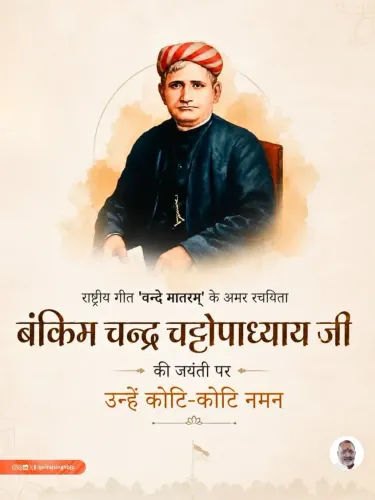
The story of Vande Mataram begins with Bankim Chandra Chattopadhyay, one of the giants of Bengali literature, who composed the poem in 1875. Seven years later, in 1882, he wove it into his novel Anandamath — a tale of ascetic warriors fighting colonial rule — giving the words a dramatic political context that history would soon amplify beyond anything a novelist could script.
During India's independence movement, the song became a battle cry. Protesters sang it on streets and inside courtrooms; colonial administrators tried, and largely failed, to suppress its spread. By the time independence came, Vande Mataram had long since ceased to be merely literature.
The Constituent Assembly's historic decision of January 1950
On 24 January 1950 — two days before the Republic was formally proclaimed — the Constituent Assembly declared Vande Mataram India's national song, placing it alongside Jana Gana Mana as the national anthem. The twin designations were a deliberate act of cultural statecraft: honouring both traditions while binding them to a new sovereign identity.
That constitutional moment is what gives anniversaries like today's their weight. This is not nostalgia — it is the government reminding citizens of a living civic commitment encoded in the republic's founding documents.
Culture Ministry's pattern of marking national symbols
Successive Indian administrations have used the anniversaries of national symbols to reinforce cultural and patriotic narratives, and the current BJP-led government has leaned into this practice with particular consistency — especially around pre-independence literary contributions to nation-building. For Minister Shekhawat, whose portfolio spans culture and tourism, such commemorations sit squarely within the Ministry's mandate to steward the country's intangible heritage.
The 151-year milestone is itself a marker worth pausing on: in Indian tradition, the year after a golden jubilee or centenary often carries ceremonial significance, and the hashtag #151YearsOfVandeMataram trended alongside the Minister's post, signalling broad public resonance.
When a song written by a novelist under colonial rule still stops a nation in its tracks nearly a century and a half later, the culture minister's post is less a congratulatory note and more a reminder that some words, once ignited, never stop burning.
Point of View
Using the Culture Ministry as a soft-power instrument. Marking the 151st year — not a round-number centenary — signals an intent to institutionalise annual commemoration rather than wait for landmark decades. For a minister whose portfolio bridges culture and tourism, such messaging also feeds into heritage tourism narratives around colonial-era literary sites. The broader pattern suggests these observances will grow more elaborate as the government approaches the centenary of Independence in 2047.
NationPress
7 Nov 2026
Frequently Asked Questions
When was Vande Mataram composed?
Vande Mataram was composed by Bengali writer Bankim Chandra Chattopadhyay in 1875 . It was later incorporated into his novel Anandamath in 1882.
When was Vande Mataram declared India's national song?
The Constituent Assembly declared Vande Mataram India's national song on 24 January 1950 , two days before India became a Republic.
What is the difference between India's national anthem and national song?
Jana Gana Mana , written by Rabindranath Tagore, is India's national anthem, adopted on 24 January 1950. Vande Mataram , written by Bankim Chandra Chattopadhyay, is the national song, adopted on the same date — both hold official constitutional status.
Why is Vande Mataram important to India's freedom struggle?
Vande Mataram became a rallying anthem during the independence movement, inspiring millions with its imagery of the motherland. Colonial authorities attempted to suppress its use, which only deepened its patriotic resonance across the country.
What did Culture Minister Shekhawat say about Vande Mataram?
Minister Gajendra Singh Shekhawat called Vande Mataram 'the immortal voice of India's national consciousness' and urged citizens to internalise its spirit to contribute to the nation's bright future, marking the song's 151st anniversary on 7 November 2026.