Shekhawat hails Lok Sabha passage of exam anti-cheating bill

Synopsis
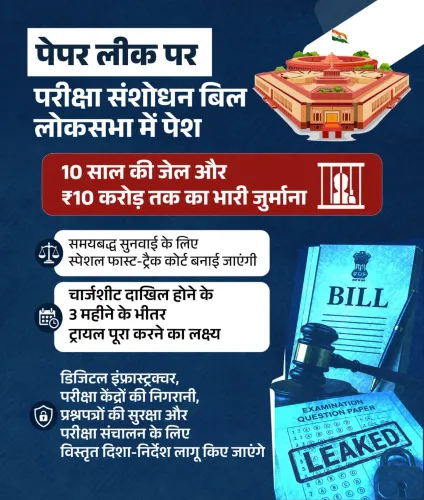
The Lok Sabha passed the Public Examinations (Prevention of Unfair Means) Amendment Bill, 2026 on 29 July, prescribing up to 10 years imprisonment and a minimum ₹10 crore fine for exam malpractice. Union Minister Gajendra Singh Shekhawat hailed it as a landmark protection for India's crores of young aspirants.
Key Takeaways
The Lok Sabha passed the Public Examinations (Prevention of Unfair Means) Amendment Bill, 2026 on 29 July 2026 .
Offenders face up to 10 years of imprisonment and a minimum fine of ₹10 crore .
Special fast-track courts are proposed to ensure speedy trial of exam-fraud cases.
The bill amends the original Public Examinations (Prevention of Unfair Means) Act, 2024 , itself enacted after NEET-UG and SSC paper-leak protests.
The bill must still pass the Rajya Sabha before it becomes law.
Union Minister Gajendra Singh Shekhawat linked the legislation to the government's 'Viksit Bharat' and transparent recruitment agenda.
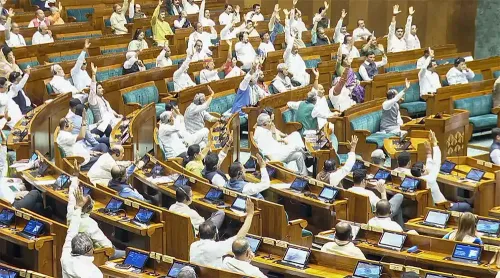
A decade in prison, a fine of at least ₹10 crore, and a dedicated fast-track court — that is what awaits anyone who tampers with a public examination under a sweeping amendment passed by the Lok Sabha on Wednesday, 29 July 2026. Union Culture and Tourism Minister Gajendra Singh Shekhawat welcomed the bill's passage as a decisive strike against one of the most corrosive injustices facing India's young job-seekers.
Writing in Hindi, Shekhawat called the Public Examinations (Prevention of Unfair Means) Amendment Bill, 2026 'karoron yuvaon ke sapnon ki suraksha ka sashakt kanoon' — 'a powerful law to protect the dreams of crores of young people.' He credited Prime Minister Narendra Modi with sending an unambiguous message: those who cheat honest candidates will not be spared under any circumstances.
What the amended law puts on the table
The bill sharpens three instruments of deterrence. First, a maximum sentence of ten years — hard time, not a slap on the wrist. Second, a minimum financial penalty of ₹10 crore, designed to bankrupt the organised networks that run paper-leak rackets rather than merely inconvenience them. Third, special fast-track courts to ensure that cases do not disappear into the ordinary backlog of India's overburdened judicial calendar.
The amendment builds on the Public Examinations (Prevention of Unfair Means) Act, 2024, which was itself a response to a wave of high-profile paper leaks and malpractice scandals — most visibly the furore over the NEET-UG examination and multiple SSC papers between 2022 and 2024 — that triggered nationwide protests by aspirants who had spent years preparing for a single shot at a government job.
From street protests to parliamentary floor
The political context matters. Those protests were not abstract — they were lakhs of students who had sacrificed years of preparation, only to watch their opportunity dissolve in a cloud of leaked question papers and syndicate-run impersonation rings. The government's response has moved in layers: technology upgrades in exam delivery, administrative overhauls at bodies such as the National Testing Agency (NTA), and now successive rounds of legislation with steeper penalties.
Shekhawat framed the bill in the language of the government's broader 'Viksit Bharat' vision — a developed India built on transparent recruitment, respect for merit, and the trust of its youth. 'Modi sarkar ka sankalp hai — yuvaon ka vishwas, pratibha ka samman aur pardarshi bharti vyavastha,' he wrote: 'The Modi government's resolve is — the trust of youth, respect for talent, and a transparent recruitment system.'
What comes next: Rajya Sabha and fast-track timelines
The bill's Lok Sabha passage is the first of two hurdles. It must still clear the Rajya Sabha before it can receive Presidential assent and become law. Beyond that, the practical test will be how swiftly the government notifies and operationalises the promised fast-track courts — because legislative intent and courtroom reality are two very different things in India's justice system.
If the courts are set up with the urgency the bill's language implies, the next high-profile exam-fraud arrest could land in a fast-track dock rather than vanishing into years of procedural delay. That, more than any penalty clause, would change the calculus for those who run paper-leak networks for profit.
Point of View
Decade-long sentences) signal deterrence over rehabilitation, a posture that plays well in a polity where exam fraud is viscerally resented. The real test, however, is institutional: fast-track courts require judicial manpower and infrastructure that the government has not always delivered on schedule. Whether this bill reshapes recruitment integrity or remains largely symbolic will depend entirely on implementation speed and prosecutorial will.
NationPress
29 Jul 2026
Frequently Asked Questions
What is the Public Examinations Amendment Bill 2026?
It is an amendment to the Public Examinations (Prevention of Unfair Means) Act, 2024, passed by the Lok Sabha on 29 July 2026, which increases penalties for exam malpractice to up to 10 years in prison and a minimum fine of ₹10 crore, and provides for special fast-track courts.
What is the punishment for paper leak under the new bill?
Under the amended law, those found guilty of exam fraud or paper leaks can face up to 10 years of rigorous imprisonment and a financial penalty of at least ₹10 crore.
Has the exam anti-cheating bill been passed in Rajya Sabha?
As of 29 July 2026, the bill has been passed only by the Lok Sabha. It still needs to be cleared by the Rajya Sabha and receive Presidential assent before it becomes law.
What triggered India's public exam fraud legislation?
A series of high-profile paper leaks and malpractice scandals — including the NEET-UG controversy and multiple SSC paper leaks between 2022 and 2024 — triggered nationwide protests by aspirants and prompted the government to enact and subsequently strengthen anti-cheating laws.
What are fast-track courts for exam fraud cases?
The bill proposes dedicated special fast-track courts to hear exam-fraud cases, aiming to deliver swift verdicts rather than letting cases languish in the regular court backlog.