Shekhawat pays tribute to Maharaja Umaid Singh on death anniversary
Synopsis
Union Culture and Tourism Minister Gajendra Singh Shekhawat honoured Maharaja Umaid Singh, ruler of Jodhpur from 1918 to 1947 and credited architect of modern Marwar, on his death anniversary on 9 June 2026, calling his administrative legacy enduringly relevant to the region.
Key Takeaways
Union Culture and Tourism Minister Gajendra Singh Shekhawat paid tribute to Maharaja Umaid Singh on his death anniversary on 9 June 2026 .
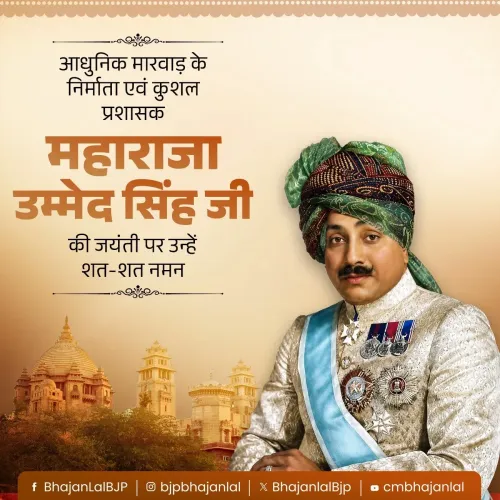
Maharaja Umaid Singh ruled Jodhpur from 1918 to 1947 and is widely credited as the builder of modern Marwar .
His most prominent legacy is Umaid Bhawan Palace , one of the world's largest private residences, now a heritage hotel and museum.
Shekhawat described the maharaja's administrative skill as 'relevant even today' and acknowledged his contribution to the 'glory of the Jodhpur region.' The tribute aligns with a sustained pattern of the Ministry of Culture linking princely-era legacies to contemporary heritage tourism in Rajasthan .
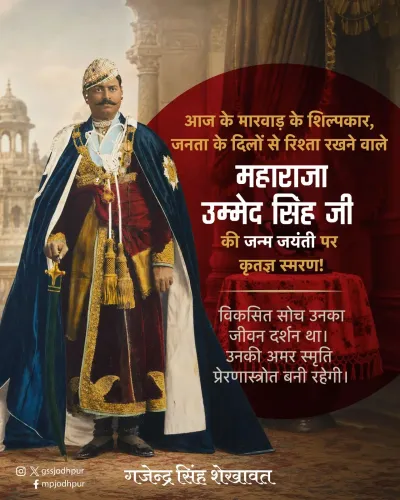
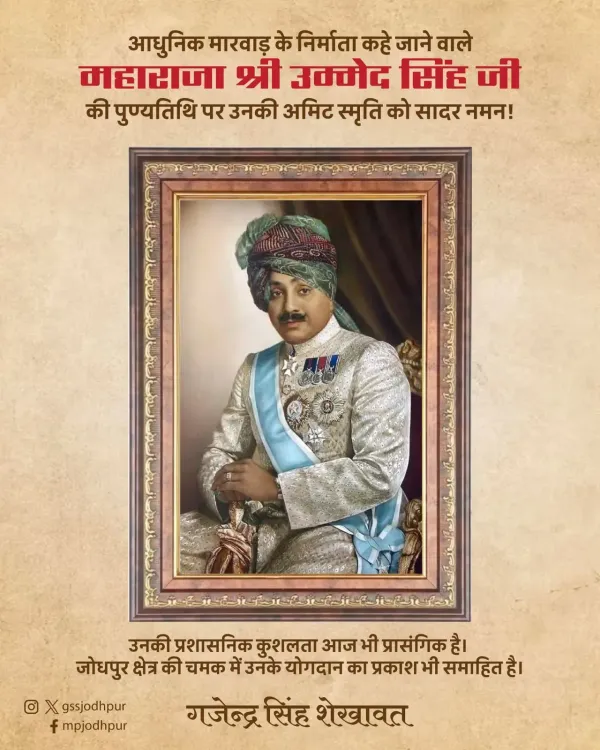
Union Culture and Tourism Minister Gajendra Singh Shekhawat on Tuesday, 9 June 2026 paid tribute to Maharaja Umaid Singh, the ruler widely credited as the architect of modern Marwar, on his death anniversary. Shekhawat, who represents Jodhpur in the Lok Sabha, described the maharaja's administrative acumen as enduringly relevant and honoured his lasting contribution to the region.
Context
Posting in Hindi on X, Shekhawat wrote: 'आधुनिक मारवाड़ के निर्माता कहे जाने वाले महाराजा श्री उम्मेद सिंह जी की पुण्यतिथि पर उनकी अमिट स्मृति को सादर नमन!' — translated as: 'Respectful salutations to the imperishable memory of Maharaja Shri Umaid Singh Ji, called the builder of modern Marwar, on his death anniversary!' He added that the maharaja's administrative skill 'remains relevant even today' and that 'the radiance of his contribution is embedded in the glory of the Jodhpur region.'
Maharaja Umaid Singh ruled the Jodhpur princely state from 1918 to 1947. His reign is most visibly commemorated by the construction of Umaid Bhawan Palace, one of the largest private residences in the world, which today functions partly as a heritage hotel and museum.
Policy Backdrop
The tribute comes from a minister whose portfolio directly covers heritage conservation. The Ministry of Culture has, since the mid-2010s, partnered with the Archaeological Survey of India (ASI) and Rajasthan state agencies to fund conservation and tourism development at royal-era monuments across western India.
Jodhpur and the broader Marwar belt — home to Mehrangarh Fort, Umaid Bhawan, and a cluster of havelis — have been central to Rajasthan's heritage tourism pitch. Invoking princely-era rulers within official cultural outreach has become a consistent feature of the ministry's public communication under Shekhawat.
Stakeholders and Impact
The post resonates with Jodhpur's residents, heritage tourism operators, and cultural organisations that have long drawn civic identity from the Rathore dynasty's legacy. Maharaja Umaid Singh's administrative reforms — including infrastructure development during the severe famine years of the early twentieth century — are credited with modernising the region's governance structures.
For heritage tourists and the hospitality sector centred on Umaid Bhawan Palace, official ministerial recognition of the maharaja's legacy reinforces the cultural narrative that drives footfall to the city. The Rathore lineage remains a potent symbol of regional identity in western Rajasthan.
What's Next
Shekhawat's tribute, delivered in his capacity as both Culture Minister and Jodhpur MP, keeps attention on Rajasthan's royal heritage sites ahead of what observers expect will be a season of state-level commemorative events. The Ministry of Culture may announce heritage site upgrades or conservation grants linked to royal anniversaries in the region. The broader pattern of BJP leaders from Rajasthan invoking princely-state contributions within official cultural outreach suggests such tributes are likely to be followed by tangible policy signals around heritage preservation in Jodhpur and Marwar.
Point of View
A strategy that simultaneously energises local sentiment and frames heritage tourism as a policy success. For Shekhawat, who holds both the Culture Ministry and the Jodhpur seat, such posts serve a dual purpose: they signal cultural stewardship to his constituency while keeping Marwar's royal legacy central to the ministry's public identity. The question worth watching is whether this tribute is followed by a concrete policy announcement — a conservation grant, a site upgrade, or a commemorative event — that translates symbolism into governance.
NationPress
26 Oct 2026
Frequently Asked Questions
Who was Maharaja Umaid Singh of Jodhpur?
Maharaja Umaid Singh ruled the princely state of Jodhpur from 1918 to 1947 and is credited with modernising the Marwar region through administrative reforms and large-scale construction, most notably Umaid Bhawan Palace.
Why is Maharaja Umaid Singh called the builder of modern Marwar?
He is called the builder of modern Marwar because he undertook significant administrative, infrastructural, and architectural development during his reign, including the construction of Umaid Bhawan Palace during a severe famine period to provide employment to local people.
What is Gajendra Singh Shekhawat's connection to Jodhpur?
Gajendra Singh Shekhawat is the Lok Sabha MP from Jodhpur and serves as Union Minister of Culture and Tourism, making him both the political representative and the cultural policy custodian for the region.
What is Umaid Bhawan Palace?
Umaid Bhawan Palace in Jodhpur is one of the largest private residences in the world, built during Maharaja Umaid Singh's reign. It now functions partly as a heritage hotel and a museum dedicated to the Jodhpur royal family.
What is the Ministry of Culture doing for Rajasthan's heritage sites?
The Ministry of Culture has partnered with the Archaeological Survey of India and Rajasthan state agencies to fund conservation and tourism development at royal-era monuments across western India, including sites in Jodhpur and the broader Marwar region.