Shekhawat pays tribute to Maharani Gayatri Devi on birth anniversary
Synopsis
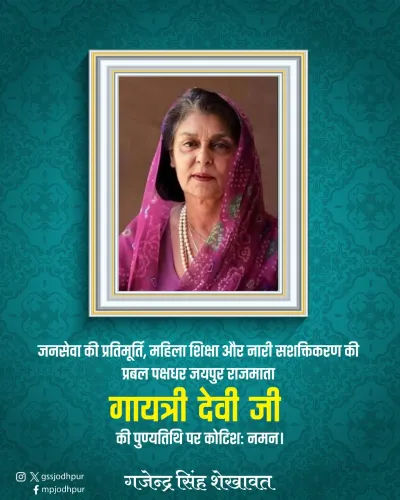
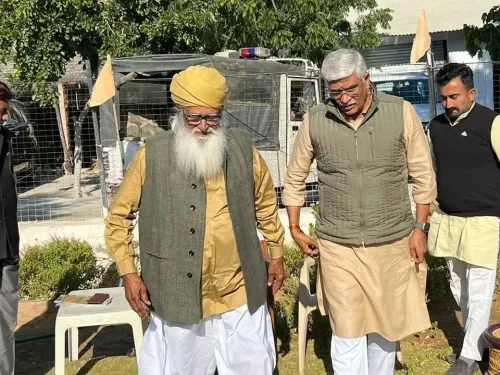
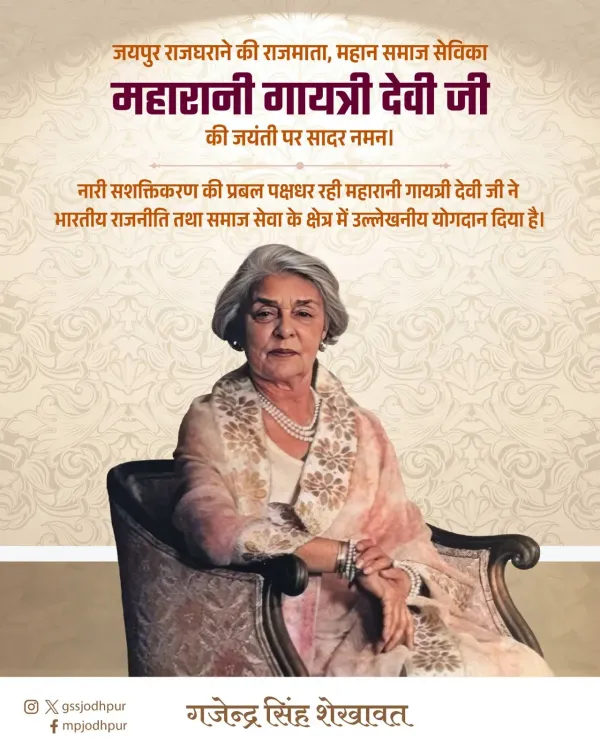
Union Culture and Tourism Minister Gajendra Singh Shekhawat on 23 May 2026 paid tribute to Maharani Gayatri Devi of Jaipur on her birth anniversary, honouring her legacy as a champion of women's empowerment and her contributions to Indian politics and social service.
Key Takeaways
Gajendra Singh Shekhawat , Union Culture and Tourism Minister, paid tribute to Maharani Gayatri Devi on her birth anniversary on 23 May 2026 .
Shekhawat described her as a 'great social worker' and 'strong advocate of women's empowerment' in his post on X.
Maharani Gayatri Devi , born in 1919 , was the third Maharani of Jaipur and served as a Member of Parliament.
The tribute aligns with the Culture Ministry's mandate to document contributions of princely-state figures to modern India.
Her legacy intersects with Rajasthan's heritage tourism sector, which draws millions of visitors to Jaipur's royal sites annually.
Union Culture and Tourism Minister Gajendra Singh Shekhawat on Saturday, 23 May 2026, paid tribute to Maharani Gayatri Devi, the third Maharani of Jaipur and a celebrated social reformer, on the occasion of her birth anniversary.
Context
In his post on X, Shekhawat offered respectful homage — 'saadar naman' (respectful salutation) — to Maharani Gayatri Devi, describing her as 'Jaipur Rajgharane ki Rajmata, mahan samaj sevika' ('the Queen Mother of the Jaipur royal house and a great social worker'). He acknowledged her as a strong advocate of women's empowerment and noted her 'remarkable contributions' to Indian politics and social service.
Maharani Gayatri Devi, born in 1919, was one of the most prominent women in post-independence Indian public life. She served as a Member of Parliament from Jaipur and built a lasting legacy through her advocacy for women's education and political participation.
Policy Backdrop
The tribute fits squarely within the Culture Ministry's broader mandate to document and celebrate the contributions of princely-state figures to modern India. Central ministers from the ruling dispensation regularly mark birth anniversaries of pre- and post-independence royal women to reinforce narratives of social reform and political inclusion.
Maharani Gayatri Devi's championing of women's education and civic participation predates — and in many ways foreshadowed — flagship government programmes such as Beti Bachao Beti Padhao, launched in 2015 to improve the child sex ratio and promote girls' education. Her legacy is frequently cited in policy discourse on women's empowerment in Rajasthan.
Stakeholders and Impact
Women's groups and heritage advocates in Rajasthan regard Gayatri Devi as a foundational figure whose life demonstrated that royal women could shape democratic public life. The Jaipur Rajgharana, the former ruling family of Jaipur, transitioned into democratic politics after 1947 and has remained a culturally significant institution in the state.
For the heritage tourism sector, such ministerial tributes carry added weight. Jaipur's royal palaces, museums, and associated sites draw millions of visitors annually, and the Culture Ministry's visible engagement with the city's royal legacy reinforces Rajasthan's position as a premier heritage tourism destination.
What's Next
Observers will watch whether the birth anniversary prompts any formal state or central government events in Jaipur, or whether the Culture Ministry announces new heritage tourism circuits linked to Rajasthan's royal history. Shekhawat, as the Lok Sabha MP from Jodhpur, has a direct political and cultural stake in how the region's royal heritage is projected nationally and internationally.
Point of View
Lending cultural authority to the ruling party's women's empowerment narrative. By highlighting Gayatri Devi's contributions to both politics and social service, the Culture Ministry subtly positions itself as the custodian of India's princely heritage. For Shekhawat specifically — a Rajasthan MP — such gestures reinforce his political identity in a state where royal legacies still carry electoral resonance. The tribute also keeps Jaipur's heritage profile in the national spotlight, supporting the ministry's tourism promotion agenda.
NationPress
15 Sept 2026
Frequently Asked Questions
Who was Maharani Gayatri Devi of Jaipur?
Maharani Gayatri Devi was the third Maharani of Jaipur, born in 1919. She served as a Member of Parliament from Jaipur and was widely known for advocating women's education, political participation, and social reform in India.
Why did Gajendra Singh Shekhawat pay tribute to Maharani Gayatri Devi?
Shekhawat paid tribute on the occasion of Maharani Gayatri Devi's birth anniversary, recognising her contributions to Indian politics and social service, particularly her advocacy for women's empowerment.
What is Maharani Gayatri Devi's connection to women's empowerment?
Gayatri Devi was a strong proponent of women's education and civic participation, championing causes that predated modern government schemes. She is regarded as a foundational figure in the discourse on women's empowerment in Rajasthan.
What is the Jaipur Rajgharana?
The Jaipur Rajgharana is the former ruling family of Jaipur state in Rajasthan. After Indian independence in 1947, the family transitioned into democratic politics and has remained a culturally influential institution in the state.
How does the Culture Ministry engage with Rajasthan's royal heritage?
The Culture Ministry, under Shekhawat, documents and promotes the contributions of princely-state figures to modern India. This engagement supports heritage tourism in Rajasthan, where royal palaces and museums draw millions of visitors each year.