Shekhawat: India fastest-growing economy and poverty reducer
Synopsis
Union Minister Gajendra Singh Shekhawat posted on X claiming India is both the fastest-growing major economy and the fastest reducer of poverty, arguing that ground-level welfare delivery has replaced mere sloganeering — a framing backed by NITI Aayog MPI data and schemes covering over 80 crore people.
Key Takeaways
Union Minister Gajendra Singh Shekhawat posted on 3 November 2026 calling India both the fastest-growing major economy and the fastest poverty reducer.
He argued the shift is from 'slogans to ground-level action' — a direct contrast with pre-2014 governance narratives.
NITI Aayog's Multidimensional Poverty Index baseline (2021) documented a significant fall in poverty headcount between 2015-16 and 2019-21 .
The Pradhan Mantri Garib Kalyan Anna Yojana , launched in 2020 , provides free foodgrains to over 80 crore people.
The next NITI Aayog MPI update and the annual Economic Survey poverty chapter will be key data checkpoints for this claim.
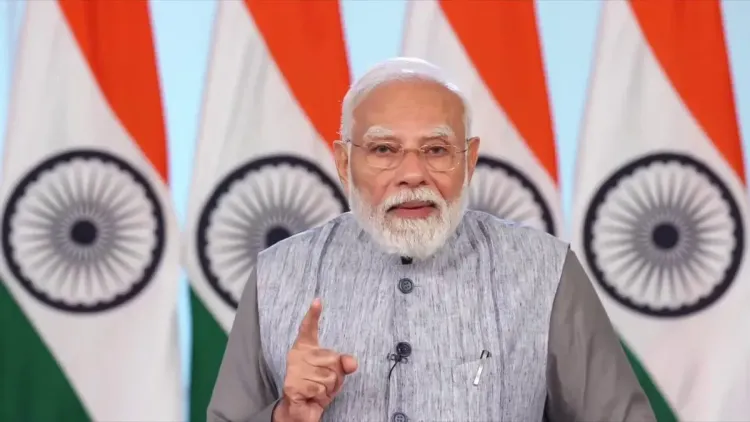
India is moving fast on two fronts simultaneously — and Union Culture and Tourism Minister Gajendra Singh Shekhawat wants the world to notice both. On Tuesday, 3 November 2026, the senior BJP leader and Lok Sabha MP from Jodhpur, Rajasthan, posted a sharp dual claim on X: that India is at once the fastest-growing major economy and the fastest reducer of poverty — a combination he argued marks a decisive break from decades of promise without delivery.
Posting in a mix of Hindi and English, Shekhawat wrote: 'पहले गरीबी से लड़ाई सिर्फ नारों में होती थी, आज भारत ज़मीनी स्तर पर गरीबी को मात दे रहा है!' — 'Earlier, the fight against poverty existed only in slogans; today India is defeating poverty at the ground level.' The message paired an upward-trending growth chart emoji with a downward-trending poverty curve, framing them as two sides of the same policy success story.The dual-headline India has been building toward
The growth-plus-poverty-reduction argument has been a consistent thread in official Indian government communications since 2014. The logic runs like this: high GDP expansion alone means little if its gains stay concentrated; the true test is whether the bottom of the pyramid feels the difference. Shekhawat's post is the latest articulation of that argument — and it draws on a body of official data that has been building for several years.
The government's policy think tank, NITI Aayog, established a baseline Multidimensional Poverty Index in 2021, documenting a sharp fall in the poverty headcount between 2015-16 and 2019-21. The MPI tracks not just income but a basket of household deprivations — nutrition, sanitation, education, cooking fuel — making it a broader lens than a simple income cutoff. Successive updates have pointed to continued improvement, and periodic IMF growth rankings have placed India at or near the top of major-economy growth tables.
Garib Kalyan to MPI: the welfare architecture behind the claim
The structural pillar most frequently cited in this narrative is the Pradhan Mantri Garib Kalyan Anna Yojana, launched in 2020, which extended free foodgrain coverage to over 80 crore people. Direct-benefit transfers, Jan Dhan bank accounts, and housing and sanitation schemes form the wider scaffolding that official data uses to argue that poverty reduction has shifted from rhetorical to measurable and material.
Shekhawat's framing — growth speed paired with poverty-reduction speed — is a deliberate political and economic argument: that the two are not in tension but are being achieved together, and that this is what distinguishes the current policy era from earlier decades when high growth coexisted with stubborn deprivation.
What the next data milestone will settle
The next significant test of this narrative will come with the forthcoming NITI Aayog MPI update and the annual Economic Survey's poverty and inequality chapter. Economists and opposition voices have consistently argued that consumption surveys and inequality metrics need to be updated and made fully public to validate the full picture. The data, when it arrives, will either reinforce the dual-headline story — or complicate it.
For now, Shekhawat has staked the frame clearly: India's speed is not just about GDP, it is about lifting people. The numbers that follow will do the real arguing.
Point of View
The argument moves onto harder-to-dismiss terrain: multidimensional household data, not just national accounts. The political risk is that the next full consumption survey or MPI update will either validate the dual narrative compellingly — or expose a gap between the framing and lived reality. That data moment is the one opposition economists are waiting for.
NationPress
3 Nov 2026
Frequently Asked Questions
What did Gajendra Singh Shekhawat say about India's economy?
Shekhawat posted on X on 3 November 2026 claiming India is simultaneously the fastest-growing major economy and the fastest reducer of poverty, arguing that today the fight against poverty is happening at the ground level, not just in slogans.
What is the NITI Aayog Multidimensional Poverty Index?
The NITI Aayog Multidimensional Poverty Index (MPI) measures poverty beyond income, tracking household deprivations in nutrition, sanitation, education, and cooking fuel. Its 2021 baseline report documented a significant reduction in the poverty headcount between 2015-16 and 2019-21.
How many people does Pradhan Mantri Garib Kalyan Anna Yojana cover?
The Pradhan Mantri Garib Kalyan Anna Yojana, launched in 2020, provides free foodgrains to over 80 crore (800 million) people in India.
Is India really the fastest-growing major economy?
India has consistently ranked at or near the top of major-economy growth tables according to periodic IMF rankings. However, the exact current ranking cited in Shekhawat's November 2026 post cannot be independently verified from publicly available data prior to that date.
When will the next NITI Aayog poverty data be released?
The next NITI Aayog MPI update and the annual Economic Survey's poverty and inequality chapter are the key upcoming data releases that will test the government's poverty-reduction claims. Exact release dates have not been officially announced.