Shekhawat Urges Natural Lifestyle on World Environment Day
Synopsis
Union Culture and Tourism Minister Gajendra Singh Shekhawat marked World Environment Day on 5 June 2026 by urging Indians to embrace a natural lifestyle and renew their commitment to a clean environment and sustainable development, underscoring a cross-ministerial emphasis on sustainability in tourism and culture.
Key Takeaways
Union Culture and Tourism Minister Gajendra Singh Shekhawat posted a World Environment Day message on 5 June 2026 .
He urged citizens to adopt a natural lifestyle and reaffirm commitment to a pure environment and sustainable development.
World Environment Day was established by the UN General Assembly in 1972 and is observed annually on 5 June .
India adopted the UN Sustainable Development Goals in 2015 , integrating environmental protection with development targets.
The statement reflects a cross-ministerial pattern of sustainability messaging, with the Culture and Tourism Ministry directly linked to heritage site and eco-tourism management.
Future policy action may include eco-tourism guidelines or sustainability frameworks for heritage sites under the ministry's purview.
Union Culture and Tourism Minister Gajendra Singh Shekhawat on Friday, 5 June 2026 marked World Environment Day by calling on citizens to embrace a natural lifestyle and renew their commitment to a clean environment and sustainable development.
Context
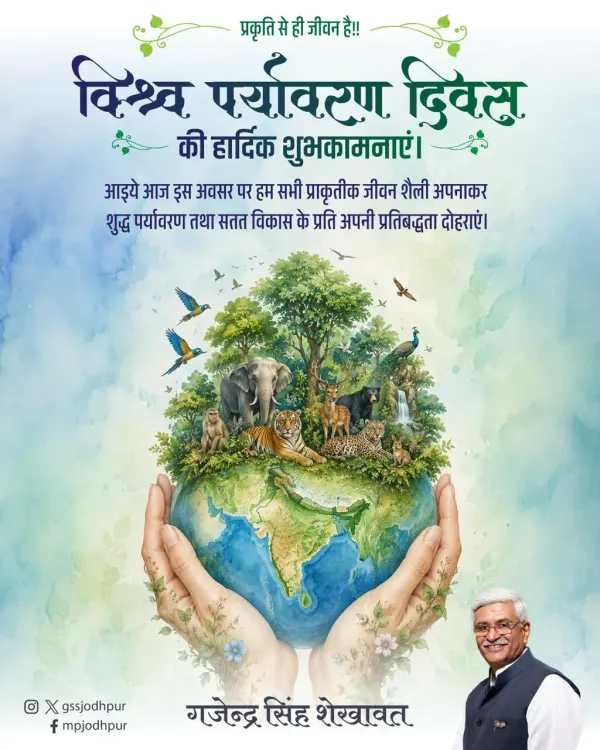
Posting in Hindi on the occasion, Shekhawat wrote: 'प्रकृति से ही जीवन है!!' ('Life itself comes from nature!!'), extending warm greetings for World Environment Day. He urged everyone to adopt a natural way of living and reaffirm their pledge toward a pure environment and sustainable progress.
World Environment Day is observed every year on 5 June, established by the UN General Assembly in 1972 to raise global awareness about environmental protection. It remains one of the largest platforms for public outreach on ecological issues worldwide.
Policy Backdrop
India adopted the UN Sustainable Development Goals in 2015, embedding environmental protection within broader economic and social development frameworks. The Swachh Bharat Mission, launched in 2014, extended that emphasis to ground-level practices including waste management and sustainable living.
Shekhawat's statement reflects a wider pattern of ministers from non-environment portfolios issuing substantive World Environment Day messages, signalling a cross-ministerial approach to sustainability. The Culture and Tourism Ministry sits at a natural intersection with environmental goals, given the dependence of heritage sites and tourism circuits on ecological health.
Stakeholders and Impact
The tourism sector and local communities around India's natural and heritage destinations stand to benefit most directly from stronger environmental commitments. Eco-tourism has increasingly been promoted as a vehicle for conservation that also supports livelihoods in rural and forest-adjacent regions.
A push toward natural lifestyles, as articulated by the minister, aligns with longstanding policy efforts to reduce the carbon and waste footprint of both domestic and inbound tourism. Cultural sites managed under the ministry's ambit — including UNESCO World Heritage Sites across India — face particular pressure from visitor footfall and climate-linked degradation.
What's Next
Observers will watch whether the Culture and Tourism Ministry translates the sentiment into concrete eco-tourism guidelines or sustainability frameworks for heritage site management. Any forthcoming scheme linking cultural tourism with environmental standards would give institutional weight to the minister's World Environment Day call.
With India's tourism sector expanding, embedding sustainability norms early in policy design could set a durable precedent for how the country balances visitor growth with conservation imperatives.
Point of View
Making its environmental posture consequential. The cross-ministerial chorus on sustainability reflects a deliberate government communications strategy that frames every portfolio as a stakeholder in India's climate commitments. For the tourism sector specifically, such signals from the ministry can precede regulatory shifts on visitor management and eco-certification. The statement is unlikely to move policy on its own, but it keeps the ministry's sustainability credentials visible ahead of any forthcoming eco-tourism framework.
NationPress
21 Oct 2026
Frequently Asked Questions
When is World Environment Day celebrated?
World Environment Day is celebrated every year on 5 June . It was established by the UN General Assembly in 1972 to raise awareness about environmental protection globally.
What did Gajendra Singh Shekhawat say on World Environment Day 2026?
Gajendra Singh Shekhawat wished citizens a happy World Environment Day and urged everyone to adopt a natural lifestyle, pledging commitment to a clean environment and sustainable development.
What is Gajendra Singh Shekhawat's current role?
Gajendra Singh Shekhawat is the Union Minister of Culture and Tourism , a senior BJP leader and Lok Sabha MP from Jodhpur, Rajasthan .
How does the Culture and Tourism Ministry relate to environmental issues in India?
The Culture and Tourism Ministry oversees heritage sites and tourism circuits that are directly affected by environmental conditions. Eco-tourism promotion and sustainable visitor management at cultural landmarks are key areas where the ministry's policies intersect with environmental goals.
What is India's policy on sustainable development?
India adopted the UN Sustainable Development Goals in 2015 and launched the Swachh Bharat Mission in 2014 , both of which embed environmental protection and sustainable living within national policy frameworks.