Shekhawat Spotlights Kashmir's Vagu Mat Craft Revival
Synopsis
Union Culture and Tourism Minister Gajendra Singh Shekhawat used the Mann Ki Baat occasion to highlight Srinagar's Ghulam Hussain and his daughter Tanjila, who are reviving Kashmir's traditional Vagu mat — woven from reed and paddy straw — as a symbol of artisan resilience and cultural continuity.
Key Takeaways
Union Minister Gajendra Singh Shekhawat shared the story of Kashmir's traditional Vagu mat craft on 27 July 2026 in the context of Mann Ki Baat .
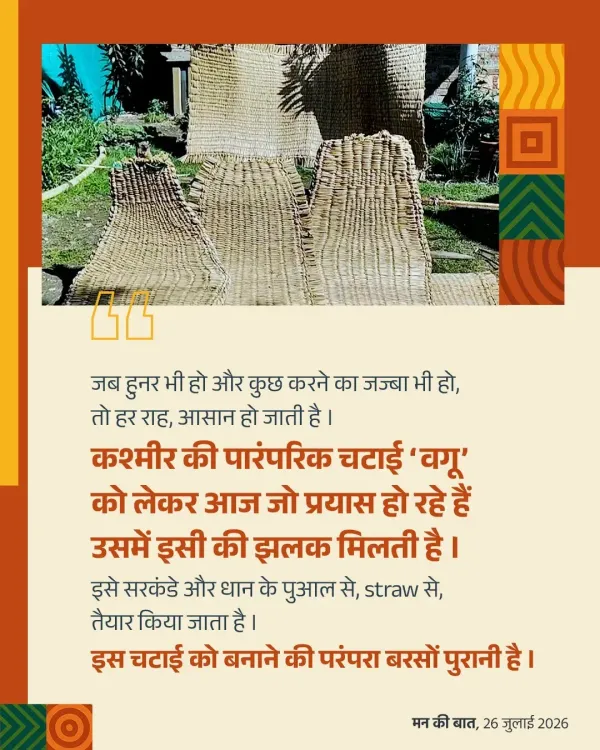
The Vagu mat is woven from sarkanda (reed grass) and paddy straw , a practice with a multi-generational heritage in the Kashmir Valley .
Ghulam Hussain and his daughter Tanjila , both from Srinagar , have committed to reviving the Vagu craft tradition.
The post was tagged #MannKiBaat , linking it to Prime Minister Modi's monthly platform that regularly spotlights grassroots cultural initiatives.
The ministerial spotlight aligns with the central government's broader policy of promoting Jammu and Kashmir's intangible cultural heritage alongside regional tourism development.
Possible follow-up support could include GI tag applications , handicraft cluster schemes, or features in upcoming Mann Ki Baat episodes.
Union Culture and Tourism Minister Gajendra Singh Shekhawat on Sunday, 27 July 2026, highlighted the revival of Kashmir's traditional 'Vagu' mat craft, sharing the story of Srinagar-based artisan Ghulam Hussain and his daughter Tanjila, who have committed to breathing new life into this age-old weaving tradition. The post, shared in the context of Mann Ki Baat, drew attention to a grassroots effort to preserve an intangible cultural heritage of Jammu and Kashmir.
Context
The minister's post, written in Hindi, reflects on the power of skill and resolve: 'जब हुनर भी हो और कुछ करने का जज्बा भी हो, तो हर राह आसान हो जाती है' ('When there is skill and the spirit to do something, every path becomes easy'). He used this as a frame to introduce the story of Vagu, a traditional Kashmiri mat woven from sarkanda (reed grass) and paddy straw. The craft carries a lineage spanning several generations, rooted in the agrarian and artisan communities of the Kashmir Valley.
Shekhawat noted that Ghulam Hussain and his daughter Tanjila, both from Srinagar, have taken a collective resolve to revive the Vagu craft tradition. Their effort represents a family-led initiative to sustain a practice that risks fading in the face of modern alternatives.
Policy Backdrop
Mann Ki Baat, Prime Minister Narendra Modi's monthly radio address running since 2014, has consistently served as a platform to spotlight citizen-led cultural and entrepreneurial initiatives from across India. Episodes have repeatedly featured stories of regional handicraft revival, positioning ordinary artisans as national exemplars of self-reliance and cultural continuity.
The Ministry of Culture under Shekhawat has aligned itself with the broader policy emphasis on promoting intangible cultural heritage alongside tourism development in Jammu and Kashmir. Handicraft preservation in the region has been a recurring theme, with Geographical Indication (GI) tags and cluster-development schemes forming part of the central government's toolkit for artisan support.
Stakeholders and Impact
The primary stakeholders in the Vagu revival effort are traditional artisan communities in the Kashmir Valley, for whom such crafts represent both livelihood and cultural identity. When senior ministers amplify grassroots stories on high-visibility platforms, it can generate demand, attract institutional support, and encourage younger generations within artisan families to continue the practice.
Srinagar, as the largest city in Jammu and Kashmir and a historic centre of traditional weaving, provides an established ecosystem of craft knowledge. The Vagu mat — produced from locally available natural materials like reed and straw — also carries potential as an eco-friendly, sustainable product in both domestic and export markets.
What's Next
The ministerial spotlight on Vagu craft could precede formal announcements from the Ministry of Culture or the Ministry of Textiles regarding handicraft cluster support, GI tag applications, or inclusion in upcoming Mann Ki Baat episodes. Such recognition at the national level typically opens pathways to government craft fairs, export promotion councils, and skill development programmes for artisans.
As the central government continues to position Jammu and Kashmir's cultural heritage as a pillar of its tourism and development narrative for the region, stories like that of Ghulam Hussain and Tanjila are likely to feature more prominently in both policy communication and cultural diplomacy efforts.
Point of View
Development, and pride in the region's heritage. By naming specific artisans, the messaging moves beyond abstract policy into relatable narrative, making it harder to dismiss as political optics. This also signals that the Ministry of Culture sees handicraft revival not merely as welfare but as a pillar of the government's identity politics around J&K. The recurring pattern suggests that formal institutional support — GI tags, cluster funding, export linkages — may follow such public spotlights.
NationPress
26 Jul 2026
Frequently Asked Questions
What is the Vagu mat and where does it come from?
The Vagu is a traditional Kashmiri mat handwoven from sarkanda (reed grass) and paddy straw. It is a craft with a multi-generational heritage rooted in artisan communities of the Kashmir Valley, particularly around Srinagar.
Who are Ghulam Hussain and Tanjila?
Ghulam Hussain is a traditional artisan from Srinagar, Jammu and Kashmir, and Tanjila is his daughter. Together, they have committed to reviving the Vagu mat-weaving tradition, as highlighted by Union Minister Gajendra Singh Shekhawat.
What is Mann Ki Baat and why is it relevant here?
Mann Ki Baat is Prime Minister Narendra Modi's monthly radio address, running since 2014, which regularly features stories of citizen-led cultural, entrepreneurial, and social initiatives from across India. Shekhawat's post was tagged with #MannKiBaat, linking the Vagu revival story to this national platform.
What is the central government doing to support Kashmiri handicrafts?
The Ministry of Culture, under Gajendra Singh Shekhawat, has emphasised intangible cultural heritage preservation alongside tourism promotion in Jammu and Kashmir. Broader policy tools include Geographical Indication (GI) tags, handicraft cluster development schemes, and skill development programmes for artisans.
Why is the revival of traditional crafts like Vagu significant?
Reviving crafts like Vagu preserves intangible cultural heritage, sustains artisan livelihoods, and promotes eco-friendly, locally sourced products. Ministerial attention can unlock institutional support, market access, and recognition that helps younger artisan generations continue the tradition.