Shiv Sena (UBT) defends public protests, slams RSS chief Bhagwat's agitation remarks
Synopsis
Uddhav Thackeray's Shiv Sena has turned RSS chief Mohan Bhagwat's Vijayadashami caution against public protests into a full-scale ideological counter-offensive — arguing that the Sangh's own history of backing regime change makes its critique of democratic agitations not just hypocritical, but an implicit admission that 2014 was a mistake.
Key Takeaways
Shiv Sena (UBT) published a sharp editorial in 'Samaana' on 22 October targeting RSS chief Mohan Bhagwat's remarks on public protests.
The editorial argued that popular movements against the ruling dispensation are 'entirely democratic' and not acts of anarchy.
It interpreted Bhagwat's 'changing regimes solves nothing' statement as an implicit admission that the 2014 political transition was a failure.
The party listed 12 years of alleged governance failures including inflation, unemployment, institutional erosion, and 'corporate favouritism.' The editorial questioned the Sangh's consistency by recalling its own role in the 1977 regime change and the Anna Hazare movement.
Shiv Sena (UBT) urged Bhagwat not to lend credibility to a model it called a 'threat to India's democratic fabric.'
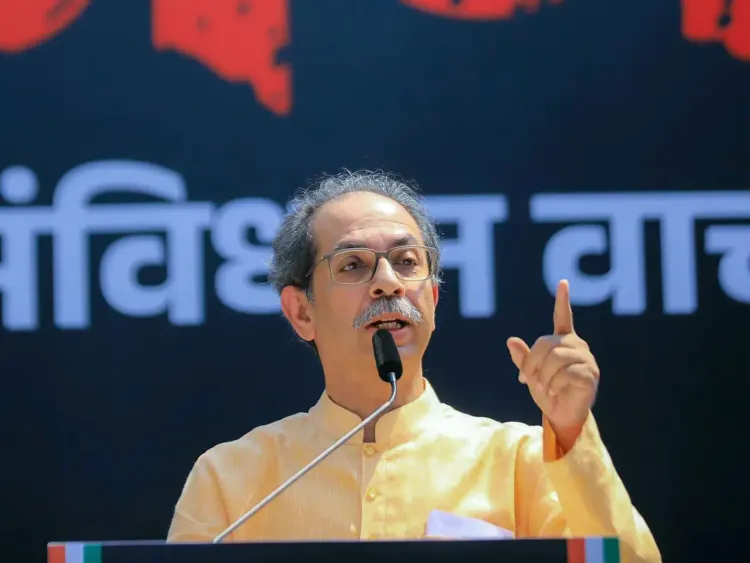
Shiv Sena (Uddhav Balasaheb Thackeray) on Thursday, 22 October sharply criticised Rashtriya Swayamsevak Sangh (RSS) chief Mohan Bhagwat over his recent remarks expressing concern about public agitations, both globally and within India. In an editorial published in the party's mouthpiece 'Samaana', the Thackeray camp argued that popular protests against the ruling dispensation are entirely democratic in character — not acts of anarchy — and accused the RSS leadership of inadvertently shoring up a government it described as a 'crisis for India.'
What Bhagwat Said and Why Samaana Pushed Back
Bhagwat, speaking at the Vijayadashami rally, had claimed that protests risk becoming tools of political selfishness and can breed societal division. He had cited unrest in countries including France, Italy, Belgium, Nepal, Sri Lanka, and Bangladesh as cautionary examples. The Samaana editorial countered that Bhagwat's broad critique of agitations conveniently overlooked legitimate public anger directed at authoritarian governance, arguing he failed to distinguish between manufactured unrest and organic democratic dissent.
Interpreting Bhagwat's Remarks as Implicit Self-Criticism
The editorial went further, reading Bhagwat's assertion — that merely changing regimes does not resolve fundamental problems — as an implicit concession that the political transition of 2014 under Prime Minister Narendra Modi had proven a 'wasted effort.' The Thackeray camp questioned whether the Sangh now regrets its role in reshaping the political order, invoking the RSS family's active participation in the regime change of 1977 as a historical parallel. 'Would the Sangh apologise to the nation for bringing an allegedly ruinous regime to power?' the editorial asked pointedly.
A Catalogue of National Grievances
Holding the RSS-backed dispensation responsible for 'pushing the country into distress,' the Samaana editorial listed what it described as severe national failings over the past 12 years: soaring inflation, rising unemployment, growing youth depression, commercialisation, and what it termed 'corporate favouritism and the handing of national wealth to favoured industrialists.' The editorial also pointed to the erosion of democratic institutions, the alleged subjugation of the judiciary and the Election Commission, the undermining of Parliament, incidents linked to national security, student protests over paper leaks, and agrarian distress.
The Democratic Case for Protest
Drawing on India's own history, the editorial posed a series of rhetorical questions: 'Would India have gained freedom or republic status if the masses had not joined the independence struggle? Were the agitation for the Ram Mandir or the RSS-inspired Anna Hazare movement considered acts of anarchy?' The Thackeray-led party concluded that protests are a vital democratic instrument for checking 'the unbridled power of rulers,' and urged Bhagwat not to lend legitimacy to a governance model that it described as a 'threat to India's democratic fabric.' 'Public movements against oppressive governance are firmly rooted in democratic principles,' the editorial asserted.
The editorial marks an escalation of the ongoing ideological contest between the Shiv Sena (UBT) and the broader Sangh Parivar, and is likely to intensify debate over the RSS's political positioning ahead of upcoming state elections.
Point of View
Or concede that its current caution about agitations is selectively applied. The deeper question the editorial raises — whether the Sangh has quietly distanced itself from a dispensation it helped build — is one mainstream political coverage has largely sidestepped. Whether Bhagwat's remarks represent genuine introspection or tactical repositioning ahead of electoral cycles remains an open, and consequential, question.
NationPress
22 Oct 2026
Frequently Asked Questions
What did Shiv Sena (UBT) say in the Samaana editorial about protests?
The Samaana editorial, published on 22 October, argued that public movements against the ruling dispensation are entirely democratic and not acts of anarchy. It called protests an essential democratic check on the unbridled power of rulers.
What did Mohan Bhagwat say at the Vijayadashami rally that triggered the editorial?
RSS chief Mohan Bhagwat claimed at the Vijayadashami rally that protests can become tools of political selfishness and breed societal division. He cited unrest in France, Italy, Belgium, Nepal, Sri Lanka, and Bangladesh as cautionary examples of agitation turning destabilising.
How did the Samaana editorial interpret Bhagwat's remark that changing regimes does not solve problems?
The editorial read it as an implicit admission that the 2014 political transition under Prime Minister Narendra Modi was a wasted effort. It questioned whether the RSS now regrets its historical role in reshaping India's political landscape.
What governance failures does Shiv Sena (UBT) blame on the RSS-backed dispensation?
The editorial cited soaring inflation, rising unemployment, youth depression, corporate favouritism, alleged erosion of the judiciary and Election Commission, undermining of Parliament, national security incidents, student protests over paper leaks, and agrarian distress over the past 12 years.
Why did the editorial invoke the 1977 regime change and the Anna Hazare movement?
To highlight what the Thackeray camp called hypocrisy: the RSS actively participated in the 1977 regime change and supported the Anna Hazare agitation, both protest-driven upheavals. The editorial questioned why similar popular movements today are being cast as threats to social stability.