Shivraj calls for strong district-level farm teams
Synopsis
Union Agriculture Minister Shivraj Singh Chouhan has called for the creation of strong district-level agriculture teams, underscoring his focus on grassroots delivery of central farm welfare schemes such as PM-KISAN and crop insurance.
Key Takeaways
Union Agriculture Minister Shivraj Singh Chouhan on 29 September 2026 called for strong agriculture teams at the district level.
The call targets last-mile delivery of central farm schemes including PM-KISAN and Pradhan Mantri Fasal Bima Yojana .
Chouhan's approach mirrors his governance model as four-term Chief Minister of Madhya Pradesh , where district-level farmer outreach was a signature feature.
The statement comes during the final phase of the kharif harvest cycle , when district coordination for procurement and insurance claims is critical.
Follow-up action depends on state agriculture departments translating the call into concrete staffing and coordination plans.
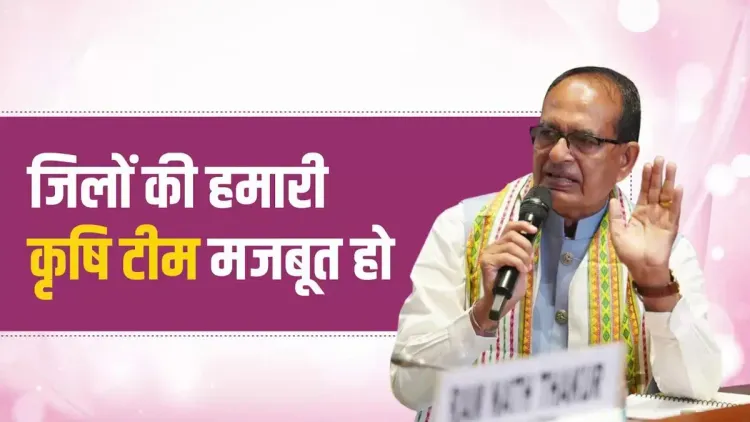
A push to put muscle at the grassroots: Union Agriculture Minister Shivraj Singh Chouhan on Tuesday, 29 September 2026, called for the formation of strong agricultural teams at the district level, signalling a renewed focus on local implementation of central farm schemes.
In a post on X, Chouhan wrote in Hindi, 'Jile mein hamari ek mazboot krishi team bane' — 'A strong agriculture team of ours must be formed in the district.' The statement, though brief, carries the full weight of an ongoing administrative priority: getting central government schemes from files in Delhi to fields across India.
Why district teams are the missing link
India's flagship farm welfare programmes — from PM-KISAN direct-benefit transfers to the Pradhan Mantri Fasal Bima Yojana crop insurance scheme — are designed at the Union level but live or die at the district level. Weak on-ground coordination has been a persistent gap: farmers miss enrolment windows, grievances pile up unresolved, and scheme benefits leak before reaching intended beneficiaries.
Chouhan, who governed Madhya Pradesh for four terms and built a reputation as an administrator attuned to rural realities, has repeatedly stressed local-level delivery mechanisms since taking charge of the agriculture ministry. The call for district teams is consistent with that approach — treating the taluka and the tehsil, not the secretariat, as the real unit of delivery.
Chouhan's pattern: governance from the block up
As Chief Minister of Madhya Pradesh, Chouhan institutionalised farmer-centric outreach through mechanisms like Kisan Sammelans and direct district-level engagements. That model of visible, decentralised accountability appears to be the template he is now seeking to replicate nationally. A well-staffed, coordinated district agriculture team could dramatically improve the last-mile delivery of soil health cards, fertiliser subsidy disbursal, and crop-loss assessment — all areas where field-level gaps have historically blunted policy intent.
The call also comes at a moment when India's kharif harvest cycle is in its final leg, making district-level readiness for procurement support and insurance claims filing especially consequential for crores of farmers.
The metric that matters now is simple: how fast state agriculture departments respond with concrete staffing and coordination plans. Words from the ministry set the direction — district teams on the ground will set the outcome.
Point of View
Visible delivery — the same model that defined his long run in Madhya Pradesh. By pushing accountability down to the district, the ministry is tacitly acknowledging that scheme design in Delhi is not enough; structural gaps at the last mile remain the central challenge. If state governments respond with real staffing and empowerment of district teams, it could meaningfully improve farmer uptake of welfare schemes ahead of the rabi season. The move also positions Chouhan as an implementer, not just a policymaker — a distinction that will matter to his political brand.
NationPress
29 Sept 2026
Frequently Asked Questions
What did Shivraj Singh Chouhan say about district agriculture teams?
Chouhan called for the formation of strong agriculture teams at the district level, emphasising the need for robust on-ground implementation of central farm schemes.
What is the role of district teams in PM-KISAN delivery?
District agriculture teams are critical for enrolling eligible farmers, resolving grievances, and ensuring that PM-KISAN direct-benefit transfers reach intended beneficiaries without leakage.
Why is district-level agriculture governance important in India?
India's farm welfare programmes are designed centrally but delivered locally; weak district coordination leads to missed enrolment windows, delayed insurance claims, and poor scheme uptake among farmers.
What was Shivraj Singh Chouhan's farming-sector record in Madhya Pradesh?
As four-term Chief Minister of Madhya Pradesh, Chouhan institutionalised farmer outreach through Kisan Sammelans and decentralised district-level engagement, a model he is now seeking to replicate nationally.
Which central agricultural schemes benefit from stronger district teams?
Schemes such as PM-KISAN, the Pradhan Mantri Fasal Bima Yojana crop insurance programme, soil health card distribution, and fertiliser subsidy disbursal all depend heavily on efficient district-level coordination.