Shivraj Singh Chouhan Pays Tribute to Swami Sahajanand Saraswati
Synopsis
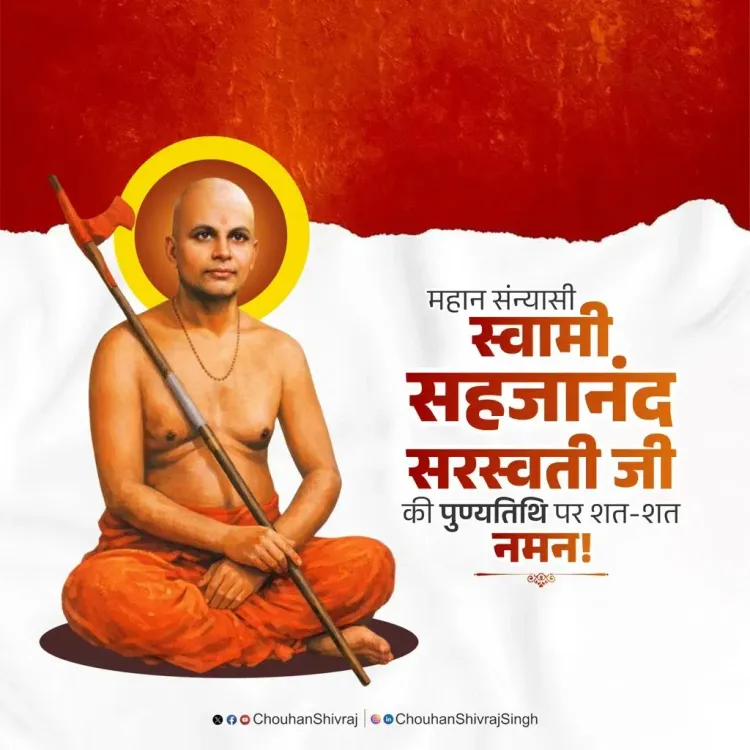
Union Agriculture Minister Shivraj Singh Chouhan paid tribute to Swami Sahajanand Saraswati on his death anniversary on 25 June 2026, honouring the pre-independence peasant leader, philosopher, and founder of the All India Kisan Sabha as an enduring inspiration for farmer welfare and national progress.
Key Takeaways
Union Agriculture Minister Shivraj Singh Chouhan posted a tribute to Swami Sahajanand Saraswati on his death anniversary on 25 June 2026 .
Saraswati is described as a great social reformer, philosopher, and protector of farmer interests, and a Dandi Sanyasi of the Dashanami Sampradaya of Adi Shankaracharya.
Saraswati founded the All India Kisan Sabha in 1936 to lead peasant struggles against zamindari exploitation, forced labour, and colonial land policies.
Chouhan expressed that Saraswati's life and ideals would continue to inspire work for the progress of the nation, society, and farmers.
BJP ministers regularly invoke pre-independence peasant leaders to frame current agricultural programmes as continuations of the freedom-era kisan movement.
Union Agriculture Minister Shivraj Singh Chouhan on Thursday, 25 June 2026 paid tribute to Swami Sahajanand Saraswati on his death anniversary, honouring the peasant leader as a great social reformer, philosopher, and protector of farmer interests.
In his post, Chouhan wrote: 'महान समाज सुधारक, दार्शनिक, किसान हितों के रक्षक' ('great social reformer, philosopher, protector of farmer interests'), describing Sahajanand Saraswati as a Dandi Sanyasi of the Dashanami monastic order of the Adi Shankaracharya Sampradaya. He expressed that Saraswati's exemplary life and noble thoughts would continue to inspire work for the progress of the nation, society, and farmers.
Context
Swami Sahajanand Saraswati (1889–1950) was an ascetic-turned-agrarian activist who became one of pre-independence India's most prominent voices for peasant rights. A Dandi Sanyasi — a renunciate carrying a staff, initiated into the Dashanami Sampradaya founded by Adi Shankaracharya in the 8th century — Saraswati combined spiritual authority with grassroots political mobilisation. His death anniversary serves as an annual occasion for political leaders across the spectrum to reaffirm commitments to farmer welfare.
Policy Backdrop
In 1936, Swami Sahajanand Saraswati founded the All India Kisan Sabha, a landmark organisation that led peasant struggles for rent reduction, abolition of forced labour, and land rights under colonial rule. The Sabha gave organised political voice to millions of farmers at a time when zamindari exploitation was widespread. His legacy is frequently invoked in Indian policy discourse as the intellectual and moral foundation of farmer-centric governance.
BJP ministers have consistently issued public tributes to pre-independence peasant leaders on their anniversaries, framing contemporary agricultural programmes as a continuation of the freedom-era kisan movement. Chouhan, as Agriculture Minister and a former four-term Chief Minister of Madhya Pradesh, has been among the most vocal proponents of this narrative, connecting historical agrarian struggles to schemes under the current central government.
Stakeholders and Impact
The tribute carries resonance for India's farming community, which remains central to both electoral and policy calculations. Swami Sahajanand Saraswati's work addressed the structural vulnerabilities of small and marginal farmers — concerns that remain live in contemporary debates over minimum support prices, crop insurance, and rural credit. By invoking his memory, Chouhan signals continuity between historical peasant movements and present-day agricultural policy priorities.
The Dashanami Sampradaya and its associated akhadas retain significant religious and social authority in northern and central India. Acknowledging Saraswati's monastic identity alongside his political legacy broadens the tribute's appeal across both agrarian and spiritual constituencies.
What's Next
Tributes of this nature from senior cabinet ministers often precede or accompany parliamentary references to agricultural budget allocations and farmer welfare schemes in BJP-ruled states. With discussions around upcoming agricultural expenditure on the horizon, Chouhan's invocation of Sahajanand Saraswati's legacy may set the rhetorical tone for the government's farmer-outreach messaging in the weeks ahead. The broader pattern suggests such commemorations serve as ideological anchors for policy communication directed at rural India.
Point of View
The tribute appeals simultaneously to rural voters and to religious constituencies associated with the Shankaracharya tradition. As Agriculture Minister, Chouhan is effectively positioning the current government as the ideological heir to a century-old agrarian struggle — a framing that carries electoral weight in states with large farming populations. Such commemorations also serve as soft-power signals ahead of budget cycles and state-level farmer welfare announcements.
NationPress
25 Jun 2026
Frequently Asked Questions
Who was Swami Sahajanand Saraswati?
Swami Sahajanand Saraswati (1889–1950) was an Indian independence activist, philosopher, and peasant leader who founded the All India Kisan Sabha in 1936 to organise farmers against zamindari exploitation and colonial land policies. He was a Dandi Sanyasi of the Dashanami Sampradaya established by Adi Shankaracharya.
Why did Shivraj Singh Chouhan pay tribute to Swami Sahajanand Saraswati?
Chouhan paid tribute on Saraswati's death anniversary on 25 June 2026, honouring him as a great social reformer, philosopher, and protector of farmer interests whose life and ideals continue to inspire work for national and agrarian progress.
What is the All India Kisan Sabha?
The All India Kisan Sabha was founded by Swami Sahajanand Saraswati in 1936 as an organisation to lead peasant struggles for rent reduction, abolition of forced labour, and land rights during colonial rule in India.
What is the Dashanami Sampradaya?
The Dashanami Sampradaya is a monastic order established by the 8th-century philosopher Adi Shankaracharya. Dandi Sanyasis, who carry a staff as a mark of renunciation, are among the initiated ascetics of this tradition.
What is Shivraj Singh Chouhan's current role?
Shivraj Singh Chouhan is the Union Minister of Agriculture and Farmers Welfare and Rural Development in the Government of India. He is a senior BJP leader and former four-term Chief Minister of Madhya Pradesh.