Shivraj Singh Chouhan Salutes ICAR on 98th Foundation Day
Synopsis
Union Agriculture Minister Shivraj Singh Chouhan marked ICAR's 98th Foundation Day on 16 July 2026 by saluting the body's nearly century-long contribution to defeating hunger, converting scarcity into self-reliance, and showing Indian farmers the path to prosperity.
Key Takeaways
Shivraj Singh Chouhan posted a tribute to ICAR on its 98th Foundation Day on 16 July 2026 .
ICAR was founded in 1929 as the Imperial Council of Agricultural Research and is now the apex autonomous body for agricultural research under the Ministry of Agriculture.
The minister credited ICAR with defeating hunger, converting scarcity to self-reliance, turning crisis into solutions, and guiding farmers towards prosperity.
The tribute was framed within the Atmanirbhar Bharat narrative, connecting public agricultural science to national self-sufficiency.
ICAR is approaching its centenary in 2029 , making the 98th foundation day a significant milestone in its institutional journey.
The minister's remarks signal continued political emphasis on the publicly funded agricultural research budget ahead of the next Union Budget session.
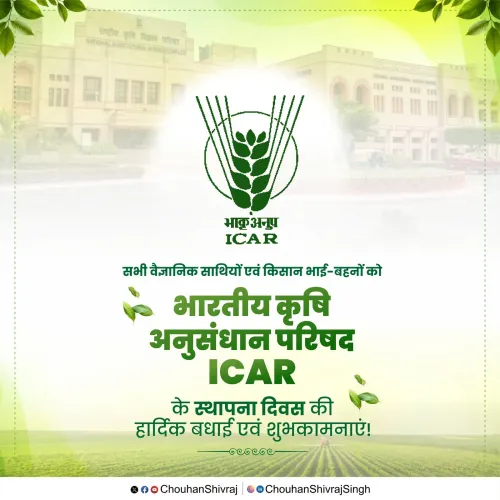
Union Agriculture Minister Shivraj Singh Chouhan on Thursday, 16 July 2026 paid tribute to the Indian Council of Agricultural Research (ICAR) on the occasion of its 98th Foundation Day, honouring nearly a century of scientific work that he said transformed India from scarcity to self-sufficiency.
Posting on X, the minister offered a salute — framed in the language of devotion and perseverance — to what he called a 98-year 'tapasya' (penance or dedicated endeavour). 'ICAR ne 98 varshon ki yatra mein chamatkar kiya hai' — 'ICAR has performed a miracle in its 98-year journey,' he wrote, adding that this dedication had 'defeated hunger,' 'converted scarcity into self-reliance,' 'turned crisis into solution,' and 'shown farmers the path to prosperity.'
Context
ICAR was established in 1929 as the Imperial Council of Agricultural Research, with a mandate to organise systematic agricultural research across British India. After Independence, it was reconstituted as an autonomous body under the Ministry of Agriculture and Farmers Welfare, growing into a network of research institutes, universities, and extension centres spread across the country. Its 98th Foundation Day marks a milestone in that unbroken institutional journey.
Minister Chouhan's tribute invokes the arc from post-Independence food shortages to India's current status as one of the world's largest producers of food grains, oilseeds, and horticulture produce — a transformation in which publicly funded agricultural science played a central role.
Policy Backdrop
Successive Indian governments have positioned agricultural research as foundational to food-grain self-sufficiency. ICAR institutes supplied the improved seed varieties and agronomic protocols that powered the Green Revolution of the 1960s and 1970s, and later contributed to the White Revolution in dairy and the expansion of pulse and oilseed production. National programmes such as the National Food Security Mission continue to draw on ICAR-developed technologies for crop improvement and pest management.
Chouhan's framing of ICAR's legacy within the language of Atmanirbhar Bharat — self-reliant India — aligns with the current government's broader emphasis on domestic capability in agriculture, from seed development to climate-resilient farming practices. The minister's use of the word 'tapasya' deliberately elevates scientific labour to the register of national service.
Stakeholders and Impact
Indian farmers are the primary beneficiaries cited in the minister's tribute. Over nearly a century, ICAR's research network has delivered improved crop varieties, soil-health advisories, pest-management protocols, and extension models that have directly influenced farm incomes and food availability for hundreds of millions of people. Agricultural researchers and scientists across ICAR's institutes are the immediate audience of the minister's salute.
The tribute also carries institutional significance: ministerial recognition of ICAR's centenary run-up signals continued political support for the public agricultural research budget at a time when the sector faces new pressures from climate change, groundwater depletion, and shifting dietary demands.
What's Next
With ICAR approaching its centenary in 2029, attention will turn to the organisation's forthcoming five-year research agenda and any new crop varieties or climate-smart technologies unveiled in the lead-up to that landmark. Parliamentary discussion on the agricultural research budget in the next Union Budget session will be a key indicator of how the government translates this rhetorical tribute into financial commitment.
The foundation-day event also sets the stage for announcements on new varietal releases, research partnerships, and extension outreach — areas that will define ICAR's relevance as it heads into its second century of service to Indian agriculture.
Point of View
The minister anchors India's food-security success story firmly within the ruling dispensation's ideological framework. The timing, two years before ICAR's centenary, is deliberate: it builds institutional momentum and positions the government as a custodian of a century of agricultural science. At a moment when farm distress and climate stress dominate agrarian discourse, the tribute serves to remind stakeholders — farmers, researchers, and policymakers alike — that the state's investment in public agricultural research remains a political priority. Whether that rhetorical commitment translates into a larger research budget will be the real test of intent.
NationPress
16 Jul 2026
Frequently Asked Questions
What is ICAR's 98th Foundation Day?
ICAR's 98th Foundation Day marks 98 years since the Indian Council of Agricultural Research was established in 1929 as the Imperial Council of Agricultural Research to organise systematic farming research in India.
What did Shivraj Singh Chouhan say about ICAR on its foundation day?
Shivraj Singh Chouhan said ICAR had 'performed a miracle in its 98-year journey,' crediting it with defeating hunger, converting scarcity into self-reliance, turning crisis into solutions, and showing farmers the path to prosperity.
What does ICAR do for Indian farmers?
ICAR develops improved crop varieties, soil-health protocols, pest-management solutions, and extension models that directly benefit Indian farmers and underpin national food-security programmes such as the National Food Security Mission .
When was ICAR established?
ICAR was established in 1929 as the Imperial Council of Agricultural Research during the British era and was later reconstituted as an autonomous body under India's Ministry of Agriculture and Farmers Welfare after Independence.
When is ICAR's centenary?
ICAR will complete 100 years in 2029 , making the 98th Foundation Day in 2026 a significant milestone in the run-up to its centenary celebrations.