Shivraj warns: 'This is India, not Bangladesh'

Synopsis
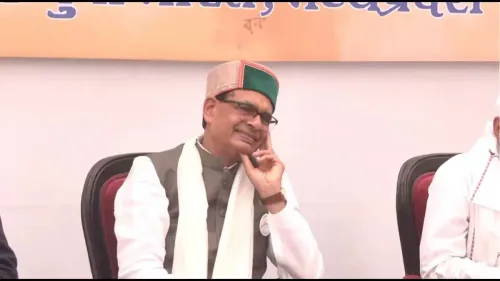
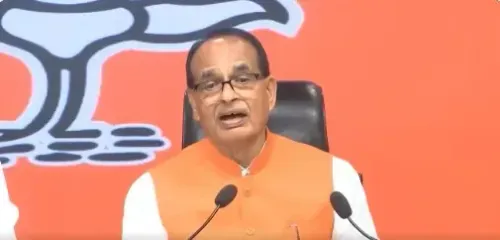
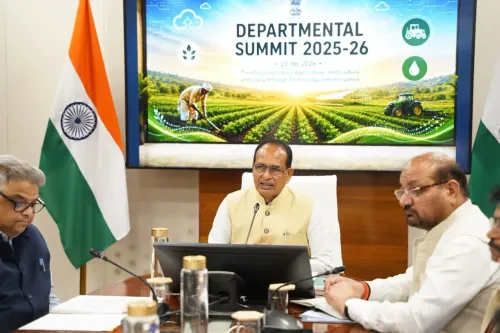
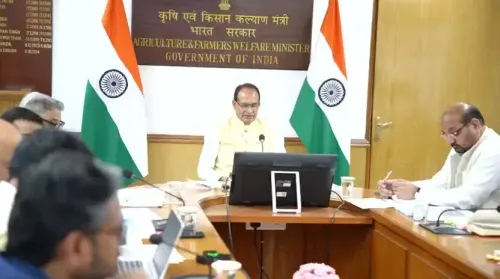
Union Agriculture Minister Shivraj Singh Chouhan posted a sharp political warning on October 17, 2026, saying anti-national forces chanting 'regime change' will find India is not Bangladesh, and affirming that PM Modi commands the hearts of crores of Indians.
Key Takeaways
Shivraj Singh Chouhan posted on 17 October 2026 warning against 'regime change' slogans by what he termed anti-national elements.
He explicitly invoked Bangladesh — which saw PM Sheikh Hasina's ouster in August 2024 — as a contrast to India's political stability.
Chouhan asserted that Prime Minister Narendra Modi commands the trust and affection of crores of Indian citizens.
The post fits a broader BJP pattern of invoking Bangladesh's political turmoil to reinforce the narrative of domestic continuity under Modi.
As a four-term former Chief Minister of Madhya Pradesh and senior cabinet minister, Chouhan's message carries significant weight within the ruling party's political communication.
A sharp political warning arrived on Saturday when Union Agriculture Minister Shivraj Singh Chouhan took to X on 17 October 2026 to directly confront what he called anti-national forces using the phrase 'regime change' to destabilise India — invoking the spectre of Bangladesh's 2024 political upheaval as a cautionary contrast.
Posting in Hindi, Chouhan was unambiguous: 'आज कल देशविरोधी तत्व रिजीम चेंज जैसे नारे देकर सत्ता परिवर्तन के प्रपंच रच रहे हैं, लेकिन यह बांग्लादेश नहीं, भारत है।' — 'These days, anti-national elements are engineering conspiracies of power change under slogans like 'regime change', but this is not Bangladesh, this is India.' He concluded by asserting that Prime Minister Narendra Modi reigns in the hearts of India's crores of citizens.The Bangladesh ghost in India's political discourse
The Bangladesh reference is pointed and deliberate. In August 2024, Prime Minister Sheikh Hasina was ousted after weeks of student-led street protests that rapidly escalated into a full government transition — one of the most dramatic political collapses in South Asia in recent memory. For BJP leaders, that episode became a recurring reference point in domestic political messaging.
Chouhan's post fits squarely into a pattern that intensified after that Dhaka transition: ruling-party leaders drawing an explicit contrast between Bangladesh's volatility and India's political continuity under Modi. The implicit argument — that India's democratic stability is not a given, but something that requires active public vigilance — is a message calibrated for the BJP's core support base.
Chouhan's voice and the weight it carries
Shivraj Singh Chouhan is no ordinary party spokesperson. A four-term former Chief Minister of Madhya Pradesh, he brings credibility as a mass leader with deep rural roots — the same constituencies he now serves as Union Minister for Agriculture and Rural Development. When he sounds an alarm about political conspiracies, it resonates beyond Delhi drawing rooms.
The phrase 'regime change' — left untranslated and rendered in English within his Hindi post — signals that Chouhan is targeting a specific discourse, one circulating in urban, English-speaking political circles and on social media. By naming it directly, he elevates it as a threat worth a public counter.
Combative messaging ahead of electoral cycles
The timing matters. With state assembly elections on the horizon and opposition parties intensifying their campaigns, ruling-party leaders have reason to reinforce the narrative of a stable, popularly mandated central government against what they characterise as destabilisation attempts. Chouhan's post is part of that larger defensive architecture — pre-emptive, populist, and aimed squarely at consolidating the base.
Whether the 'regime change' rhetoric originates from a specific domestic movement, an opposition figure, or broader social media commentary is not established from the post itself. What is clear is that a senior cabinet minister has placed it on record as a national-security-adjacent concern — and that alone guarantees it a life in the political conversation.
The message from one of the BJP's most battle-hardened communicators is blunt: India's democratic verdict is not Bangladesh's street protest. The crores who voted have spoken, and no slogan changes that arithmetic.
Point of View
The BJP frames any future opposition momentum as externally inspired instability rather than legitimate domestic dissent. The Bangladesh analogy is strategically potent — it carries an emotional charge of chaos and loss of sovereignty that resonates across India's security-conscious electorate. This kind of pre-emptive messaging, deployed by a senior mass leader rather than a party IT-cell account, suggests the ruling party perceives real pressure building and is moving to neutralise it early. The electoral calendar will ultimately reveal whether the threat was as organised as Chouhan implies.
NationPress
17 Oct 2026
Frequently Asked Questions
What did Shivraj Singh Chouhan say about 'regime change' in India?
Chouhan warned on 17 October 2026 that anti-national elements are engineering conspiracies using 'regime change' slogans, but asserted that India is not Bangladesh and that PM Modi commands the hearts of crores of Indians.
Why did Chouhan compare India to Bangladesh?
Bangladesh experienced a rapid government transition in August 2024 when PM Sheikh Hasina was ousted after student-led protests. Chouhan used that episode to contrast political stability in India under PM Modi.
Who is Shivraj Singh Chouhan?
Shivraj Singh Chouhan is the Union Minister of Agriculture and Farmers Welfare and Rural Development, a senior BJP leader, and a former four-term Chief Minister of Madhya Pradesh.
What is 'regime change' in the context of Indian politics?
In this context, 'regime change' refers to slogans or movements calling for forcible or unconstitutional removal of the elected government — which Chouhan characterised as a conspiracy by anti-national forces.
Why is the BJP invoking Bangladesh in its political messaging?
BJP leaders have periodically referenced Bangladesh's 2024 political upheaval to argue that India's democratic stability under PM Modi must be protected against forces seeking to replicate such a scenario domestically.