SIDBI opens 71 branches in 2 years to accelerate MSME credit access
Synopsis
SIDBI has quietly built one of its most aggressive credit delivery networks in years — 71 new branches in just over two years, a 36.8% surge in direct lending, and a new emergency guarantee scheme envisaging ₹2,55,000 crore in additional credit. The data, disclosed in Parliament, suggests the government is treating MSME credit access as a structural priority, not just a budget talking point.
Key Takeaways
SIDBI opened 71 new branches between 1 April 2024 and 29 July 2026 to serve major MSME clusters.
Direct credit outstanding grew 36.8% year-on-year to ₹51,687 crore as of 31 March 2026 .
Refinance portfolio rose 16.9% to ₹4,50,571 crore over the same period.
ECLGS 5.0 , launched in May 2026 , envisages additional credit of ₹2,55,000 crore with 100% guarantee coverage for MSMEs.
New initiatives include co-lending with NBFCs and RRBs , the Prayaas Scheme for women micro-entrepreneurs, and the GST Sahay app for digital invoice-based credit.
The Small Industries Development Bank of India (SIDBI) has opened 71 new branches across the country between 1 April 2024 and 29 July 2026 to expand direct credit access to Micro, Small and Medium Enterprises (MSMEs), Parliament was informed on Tuesday, 4 August 2026. The disclosure was made by Minister of State for Finance Pankaj Chaudhary in a written reply to a question in the Rajya Sabha, outlining a series of measures undertaken over the past five years to strengthen credit flow to the MSME sector.
Branch Expansion and Direct Credit Growth
The newly opened branches are strategically positioned to serve major MSME clusters and provide direct lending support. As of 31 March 2026, SIDBI's direct credit outstanding portfolio stood at ₹51,687 crore, up from ₹37,781 crore as of 31 March 2025 — a year-on-year growth of 36.8 per cent. This sharp acceleration signals that the branch expansion is already translating into measurable lending activity on the ground.
Refinance Portfolio and Lending Institution Support
Beyond direct lending, SIDBI provides refinance assistance to Primary Lending Institutions (PLIs) to amplify their own credit flows to MSMEs. The refinance outstanding portfolio reached ₹4,50,571 crore as of 31 March 2026, compared with ₹3,85,327 crore a year earlier — a year-on-year increase of 16.9 per cent. This dual-track approach — direct lending alongside refinance — is designed to reach MSMEs through multiple channels simultaneously.
Co-lending, RRB Partnerships and Digital Credit Tools
SIDBI has also launched a co-lending product in partnership with Non-Banking Financial Companies (NBFCs) to extend affordable credit to smaller MSMEs, particularly first-time borrowers. During FY 2025-26, the bank extended co-lending arrangements to Regional Rural Banks (RRBs), broadening financial access in underserved and geographically remote areas. On the digital front, the GST Sahay app enables 'on tap' invoice-based small-value credit to micro enterprises using trade data and digital frameworks. The Prayaas Scheme was separately launched to facilitate affordable credit for informal micro-entrepreneurs, with a particular focus on women and economically weaker sections.
ECLGS 5.0: Emergency Credit for MSMEs
The government introduced Emergency Credit Line Guarantee Scheme (ECLGS) 5.0 in May 2026, allowing eligible MSMEs to access additional credit of up to 20 per cent of their peak fund-based working capital outstanding during the fourth quarter of FY 2025-26. The scheme offers 100 per cent guarantee coverage to Member Lending Institutions (MLIs) against defaults on such additional credit. Scheduled passenger airlines are eligible for additional credit up to 100 per cent of total peak credit outstanding, with a guarantee coverage of 90 per cent. Across all eligible categories — MSMEs, non-MSMEs, and airlines — the scheme envisages an additional credit flow of ₹2,55,000 crore.
What This Means for India's MSME Sector
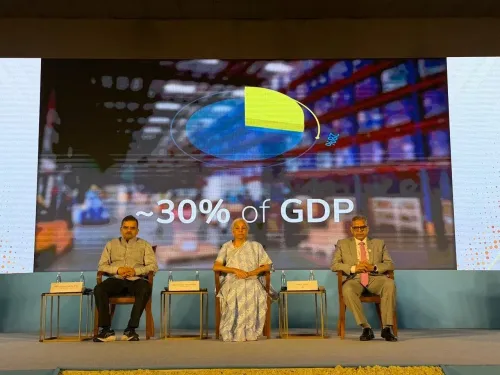
India's MSME sector employs an estimated 11 crore people and contributes roughly 30 per cent of GDP, yet access to formal credit has historically been a structural constraint. The combined push — branch expansion, co-lending, digital tools, and guarantee-backed emergency credit — represents one of the most comprehensive MSME credit interventions in recent years. Whether the momentum holds will depend on the pace of disbursement under ECLGS 5.0 and the depth of RRB partnerships in the quarters ahead.
Point of View
But the more telling number is the refinance figure — ₹4,50,571 crore — which dwarfs direct lending and reflects how much of India's MSME credit still flows through intermediaries rather than dedicated development finance. The 71-branch push is directionally right, but MSME credit gaps are most acute in Tier-3 towns and rural clusters where even new branches may not reach informal borrowers. The real test of ECLGS 5.0 will be take-up speed: previous ECLGS tranches saw slow drawdown in their early months. Unless the RRB co-lending arrangements gain traction quickly, the ₹2,55,000 crore headline could remain aspirational.
NationPress
19 Sept 2026
Frequently Asked Questions
How many new SIDBI branches were opened and when?
SIDBI opened 71 new branches between 1 April 2024 and 29 July 2026 to expand its reach to major MSME clusters across India. The information was disclosed by Minister of State for Finance Pankaj Chaudhary in a written reply to the Rajya Sabha on 4 August 2026.
What is SIDBI's current direct credit outstanding portfolio?
As of 31 March 2026 , SIDBI's direct credit outstanding stood at ₹51,687 crore , up from ₹37,781 crore a year earlier — a year-on-year growth of 36.8 per cent . This reflects accelerated direct lending to MSMEs following the branch expansion drive.
What is ECLGS 5.0 and who is eligible?
ECLGS 5.0 , introduced in May 2026 , allows eligible MSMEs to avail additional credit of up to 20 per cent of their peak fund-based working capital in Q4 FY 2025-26, backed by 100% guarantee coverage for lenders. The scheme envisages a total additional credit flow of ₹2,55,000 crore across MSMEs, non-MSMEs, and scheduled passenger airlines.
What is the Prayaas Scheme launched by SIDBI?
The Prayaas Scheme is a SIDBI initiative designed to provide affordable credit to informal micro-entrepreneurs, with a specific focus on women and economically weaker sections. It aims to bring unserved and underserved micro businesses into the formal credit system.
How is SIDBI using digital tools to reach micro enterprises?
SIDBI has deployed the GST Sahay app , which enables 'on tap' invoice-based small-value credit to micro enterprises using trade data and digital frameworks. The bank has also launched co-lending arrangements with NBFCs and Regional Rural Banks (RRBs) to deepen credit access in remote and underserved areas.