FM Sitharaman highlights Rs 5,000 cr SIDBI boost for MSMEs
Synopsis
Union Finance Minister Nirmala Sitharaman, speaking in Mumbai on 25 May 2026, highlighted the Union Cabinet's January 2026 approval of Rs 5,000 crore equity support to SIDBI, aimed at strengthening its balance sheet and adding 25 lakh new MSME beneficiaries by 2028. MSMEs employ over 32 crore people and contribute 31% of India's GDP.
Key Takeaways
Union Finance Minister Nirmala Sitharaman spoke on MSME support in Mumbai on 25 May 2026 .
The Union Cabinet approved Rs 5,000 crore in additional equity support to SIDBI in January 2026 .
The infusion is targeted at adding 25 lakh new MSME beneficiaries by the year 2028 .
MSMEs account for approximately 35% of manufacturing, 48% of exports, and 31% of GDP.
The sector engages more than 7.47 crore entrepreneurs and employs over 32 crore people across India.
SIDBI , established in 1990 , is the apex development and refinancing institution for the MSME sector.
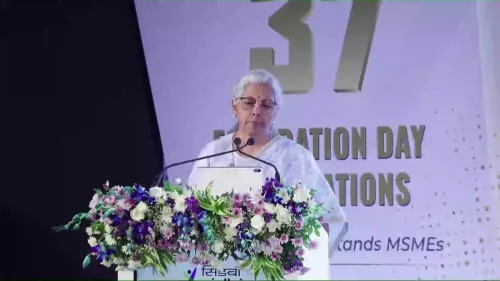
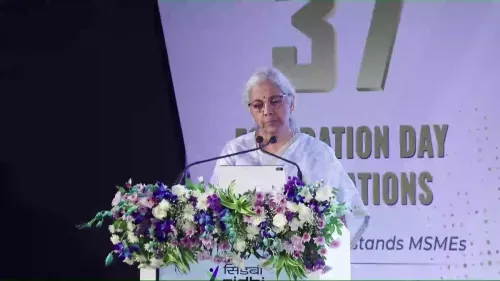
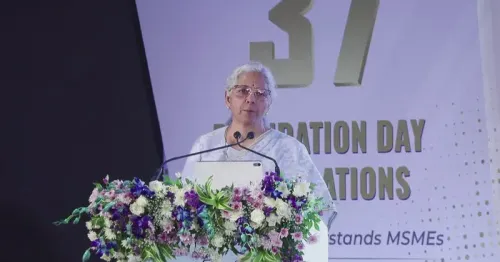
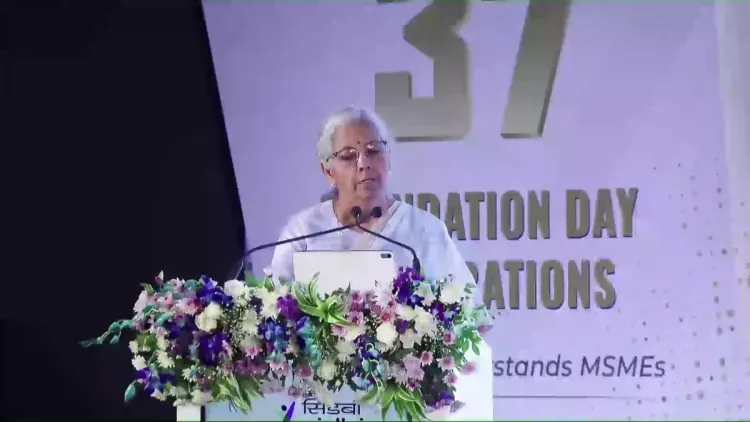
Union Finance Minister Nirmala Sitharaman on Monday, 25 May 2026, speaking in Mumbai, underscored the central government's commitment to the MSME sector, citing the Union Cabinet's January 2026 approval of an additional equity support of Rs 5,000 crore to the Small Industries Development Bank of India (SIDBI) as a key measure to deepen credit outreach to small businesses.
Context
In her remarks, the Finance Minister noted that MSMEs contribute approximately 35% of India's manufacturing output, 48% of its exports, and 31% of GDP, with more than 7.47 crore entrepreneurs operating in the sector and over 32 crore people employed across it. The figures place the sector among the most significant pillars of the Indian economy by both output and employment.
Sitharaman stated that the Rs 5,000 crore equity infusion would enable SIDBI to strengthen its balance sheet and add 25 lakh new MSME beneficiaries by the year 2028. The announcement was made as part of what appears to be a series of remarks, indicated by the '1/n' notation in the original post.
Policy Backdrop
SIDBI, established in 1990 as the apex refinancing and development institution for micro, small and medium enterprises, has periodically received capital support from the central government to expand its lending capacity. The current infusion follows a longer pattern of balance-sheet strengthening of development finance institutions aimed at increasing credit flow to underserved small businesses.
The MSME sector's legal and institutional framework has evolved over decades, anchored by the Micro, Small and Medium Enterprises Development Act, 2006, and complemented by instruments such as the Credit Guarantee Fund Trust for Micro and Small Enterprises (CGTMSE), set up in 2000 to enable collateral-free lending. The Rs 5,000 crore equity support to SIDBI sits within this broader architecture of state-backed credit facilitation.
Stakeholders and Impact
The primary beneficiaries of the SIDBI capitalisation are MSME entrepreneurs, particularly those in manufacturing and export-oriented segments who have historically faced constraints in accessing formal credit. With 32 crore workers employed in the sector, any improvement in credit availability carries significant implications for livelihoods at scale.
Small manufacturers and exporters stand to gain from expanded refinancing lines that SIDBI can offer to partner lending institutions once its balance sheet is reinforced. The target of 25 lakh new beneficiaries by 2028 provides a concrete metric against which the programme's outreach can be measured.
What's Next
Attention will now turn to the operational guidelines that SIDBI issues to translate the equity infusion into ground-level credit disbursement, and to whether follow-up measures are announced in the next Union Budget. Progress against the 25 lakh beneficiary target by 2028 will serve as a key indicator of whether the capitalisation achieves its intended scale. Further remarks from the Finance Minister in this series — signalled by the '1/n' notation — may provide additional detail on the government's MSME strategy.
Point of View
Embedding it within the government's broader push to raise manufacturing's share in GDP and formalise small enterprises. Citing employment and export statistics alongside a concrete 2028 beneficiary target signals an effort to hold the policy to measurable outcomes — a shift from the more aspirational language that has often accompanied MSME announcements. The infusion also continues a well-established pattern of using development finance institutions as the primary lever for credit deepening, rather than direct subsidy, which suits a fiscal consolidation narrative. How quickly SIDBI translates equity into disbursements will determine whether the headline figure converts into ground-level impact before the next electoral cycle.
NationPress
9 Oct 2026
Frequently Asked Questions
What is the Rs 5,000 crore SIDBI equity support announced by the government?
The Union Cabinet approved an additional equity infusion of Rs 5,000 crore into the Small Industries Development Bank of India (SIDBI) in January 2026 to strengthen its balance sheet and extend credit outreach to 25 lakh new MSME beneficiaries by 2028.
What is SIDBI and what does it do for MSMEs?
SIDBI, the Small Industries Development Bank of India, was established in 1990 as the apex institution for refinancing and developing the micro, small and medium enterprise sector. It channels funds to MSMEs through partner banks and financial institutions.
How much do MSMEs contribute to India's GDP and exports?
According to figures cited by Finance Minister Nirmala Sitharaman, MSMEs contribute approximately 31% of India's GDP, 35% of manufacturing output, and 48% of the country's total exports.
How many people are employed in India's MSME sector?
The MSME sector employs over 32 crore people in India, making it one of the largest sources of employment after agriculture, with more than 7.47 crore entrepreneurs operating within it.
When will the 25 lakh new MSME beneficiaries target be met?
The government has set 2028 as the target year by which SIDBI, supported by the Rs 5,000 crore equity infusion, is expected to add 25 lakh new MSME beneficiaries to its reach.