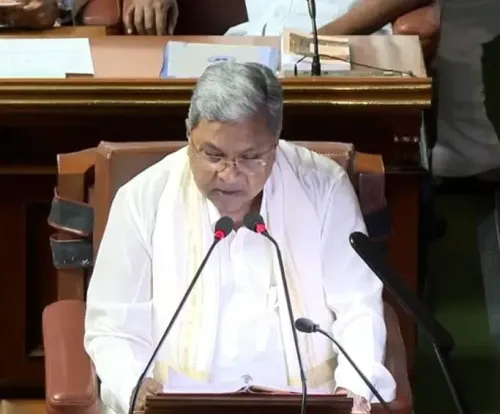
CM Siddaramaiah champions SCSP-TSP as tools of real social justice
Synopsis
Karnataka Chief Minister Siddaramaiah has invoked the Scheduled Caste Sub-Plan and Tribal Sub-Plan as proof that social justice requires dedicated resource allocation, not just political rhetoric, for Dalit and Adivasi communities to see real development gains.
Key Takeaways
Siddaramaiah posted on 10 June 2026 reaffirming the SCSP-TSP framework as the foundation of resource-backed social justice in Karnataka .
The Tribal Sub-Plan was introduced nationally in 1974-75 and the Special Component Plan for SCs in 1979-80 to mandate proportional fund allocation.
Karnataka enacted the SCSP-TSP Act in 2013 , giving statutory force to earmarking of plan funds for Dalit and Adivasi communities.
Funds under the framework are directed at education, housing, livelihoods and development for historically disadvantaged groups.
National audits have repeatedly flagged under-utilisation and diversion of sub-plan funds, making Karnataka's legal framework a significant policy distinction.
The next Karnataka annual budget and mid-term utilisation review will test whether allocations match the Chief Minister's stated commitments.
Karnataka Chief Minister Siddaramaiah on Wednesday, 10 June 2026 reaffirmed his government's commitment to resource-backed social justice, highlighting the Scheduled Caste Sub-Plan (SCSP) and Tribal Sub-Plan (TSP) as essential mechanisms for channelling state funds to Dalit and Adivasi communities.
Context
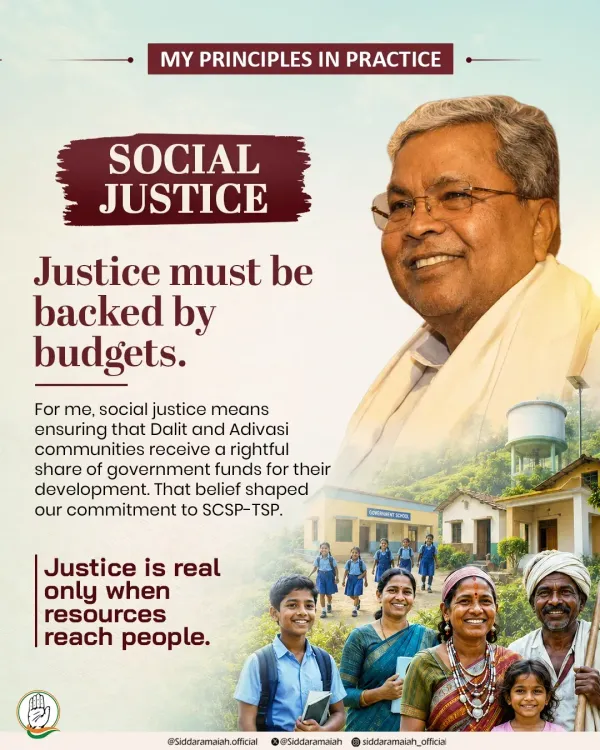
Posting under the hashtag #MyPrinciplesInPractice, Siddaramaiah wrote: 'Social justice must be more than words. It must be backed by real resources.' He pointed to the SCSP-TSP framework as the mechanism through which Dalit and Adivasi communities receive a 'rightful share of government funds for education, housing, livelihoods and development.' The post is part of a recurring series in which the Chief Minister articulates the governing philosophy behind his administration's welfare agenda.
Policy Backdrop
The Tribal Sub-Plan was introduced nationally in 1974-75 during the Fifth Five Year Plan to address persistent development gaps in tribal areas. The Special Component Plan for Scheduled Castes followed in 1979-80, mandating proportional budgetary allocation tied to the SC population share. Karnataka strengthened this architecture in 2013 by enacting the Karnataka Scheduled Castes Sub-Allocation and Tribal Sub-Allocation (Planning, Development and Utilisation) Act, giving statutory force to what had previously been an administrative directive. This made Karnataka one of the few states with a dedicated law backing the SCSP-TSP framework.
The broader national pattern shows significant variation across states in adherence to these norms. Recurring audits have flagged under-utilisation and diversion of earmarked funds, making the statutory backing in Karnataka a notable departure from purely discretionary approaches elsewhere.
Stakeholders and Impact
Dalit and Adivasi communities are the direct beneficiaries of the SCSP-TSP model, which links demographic share to guaranteed budget lines across departments covering education, housing, and livelihoods. The SC/ST welfare departments of the Government of Karnataka are responsible for implementation, utilisation certificates, and compliance reporting through annual plan budgets. For communities historically excluded from mainstream development spending, the sub-plan mechanism represents a shift from symbolic policy commitments to quantifiable resource transfers.
Siddaramaiah, a senior Indian National Congress leader, has consistently positioned welfare delivery and social justice as the ideological core of his administration. His articulation — 'Justice becomes meaningful only when it reaches people's lives' — frames the SCSP-TSP not as a technocratic budget instrument but as a moral obligation of the state.
What's Next
Karnataka's next annual budget presentation will be a key moment to assess whether SCSP-TSP allocations are maintained or expanded in line with the Chief Minister's stated principles. The state planning department's mid-term review of utilisation certificates will also indicate how effectively earmarked funds are reaching intended beneficiaries on the ground. Observers of sub-national welfare policy will watch whether Karnataka's statutory model influences other states to move beyond discretionary compliance.
Point of View
Anchoring his administration's identity in quantifiable welfare delivery rather than aspirational rhetoric. By invoking the SCSP-TSP statutory framework, he draws a contrast with states where sub-plan funds remain discretionary and frequently diverted. The timing, under the hashtag 'MyPrinciplesInPractice', suggests a sustained communication strategy aimed at consolidating his base among SC and ST voters ahead of future electoral cycles. For the broader Indian welfare policy debate, it reinforces the argument that legal earmarking — not administrative goodwill — is the more durable guarantee of social justice.
NationPress
26 Oct 2026
Frequently Asked Questions
What is the Scheduled Caste Sub-Plan (SCSP) in Karnataka?
The Scheduled Caste Sub-Plan is a budgetary mechanism that earmarks government plan funds proportional to the SC population share for education, housing and livelihoods of Dalit communities. Karnataka gave it statutory backing through the SCSP-TSP Act of 2013.
What is the Tribal Sub-Plan (TSP) and when was it introduced?
The Tribal Sub-Plan was introduced nationally in 1974-75 during the Fifth Five Year Plan to ensure dedicated resource allocation for development in tribal areas. It runs parallel to the SCSP and together they form Karnataka's statutory welfare earmarking framework.
Why did Siddaramaiah post about SCSP-TSP on 10 June 2026?
Siddaramaiah posted as part of his ongoing 'MyPrinciplesInPractice' series, articulating the governing philosophy behind his welfare agenda and emphasising that social justice requires real resource allocation, not just policy statements.
Does Karnataka have a law for SCSP-TSP implementation?
Yes. Karnataka enacted the Karnataka Scheduled Castes Sub-Allocation and Tribal Sub-Allocation (Planning, Development and Utilisation) Act in 2013, making it one of the few states with a dedicated statute mandating SCSP-TSP compliance.
What happens if SCSP-TSP funds are not used properly?
National audits have repeatedly flagged under-utilisation and diversion of sub-plan funds across states. Karnataka's statutory framework is designed to improve accountability, with utilisation certificates reviewed by the state planning department.