CM Siddaramaiah Recalls Founding Kannada Kavalu Samithi in 1983
Synopsis
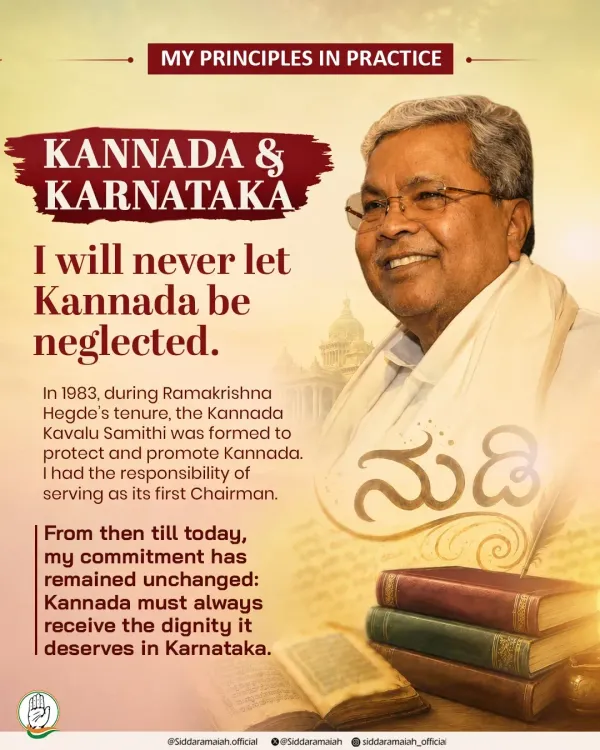
Karnataka Chief Minister Siddaramaiah has publicly reaffirmed his lifelong commitment to protecting Kannada, recalling that he served as the first Chairman of the Kannada Kavalu Samithi formed in 1983 under then CM Ramakrishna Hegde. He states his position on the language has remained unchanged over four decades.
Key Takeaways
Siddaramaiah declared protecting Kannada a 'lifelong commitment' in a post on June 14, 2026 .
The Kannada Kavalu Samithi was formed in 1983 during Ramakrishna Hegde 's tenure as Karnataka Chief Minister.
Siddaramaiah served as the first Chairman of the Kannada Kavalu Samithi at its inception.
The commitment spans more than four decades and crosses party lines, as Hegde led a Janata Party government while Siddaramaiah is a Congress leader.
The statement signals potential momentum for stricter Kannada-language enforcement in Karnataka government and private establishments.
Karnataka Chief Minister Siddaramaiah on Sunday, June 14, 2026, reaffirmed his decades-long commitment to protecting the Kannada language, recalling that he served as the first Chairman of the Kannada Kavalu Samithi when it was formed in 1983 under then Chief Minister Ramakrishna Hegde.
Context
In his post, Siddaramaiah wrote: 'Protecting Kannada has been a lifelong commitment.' He noted that the Kannada Kavalu Samithi was constituted in 1983 during Ramakrishna Hegde's tenure to protect and promote Kannada, and that he bore the responsibility of serving as its first Chairman. 'From then till today, my stand has remained unchanged: Kannada must never be neglected in Karnataka,' he stated.
The post, tagged #MyPrinciplesInPractice and #Kannada, positions the Chief Minister's current advocacy as a continuation of a political identity forged more than four decades ago — notably under a government led by a rival party, the Janata Party.
Policy Backdrop
The Kannada Kavalu Samithi was established in 1983 as a formal mechanism to safeguard Kannada interests in administration, education, and public life in Karnataka. Its formation reflected a broader consensus across party lines that the state's official language required institutional protection.
Karnataka has seen recurring political and civil-society efforts to assert the primacy of Kannada — from mandatory use in official communications to signage regulations affecting private establishments. Language-protection initiatives in the state mirror similar federal-cultural dynamics seen across other Indian states with strong regional linguistic identities.
Stakeholders and Impact
The statement is directed at Kannada speakers and language activists who form a significant constituency in Karnataka politics. By invoking his role under Hegde's government — a cross-party credential — Siddaramaiah signals that his commitment to the language transcends partisan considerations.
For the broader Kannada movement, the Chief Minister's public reaffirmation carries institutional weight, potentially lending momentum to ongoing demands for stricter enforcement of Kannada in government offices and private sector workplaces.
What's Next
Observers will watch whether this statement is followed by fresh executive orders or legislative action on mandatory Kannada use in official communications and private establishments. Any new assembly legislation on language policy in Karnataka would be seen as a direct extension of the commitment Siddaramaiah has now publicly renewed.
With language politics remaining a live issue in the state, the Chief Minister's invocation of a 43-year personal record on the matter is likely to set the tone for the ruling Congress government's cultural policy agenda in the months ahead.
Point of View
Lifelong credential rather than an electoral promise. By anchoring his Kannada commitment to the Hegde era, he insulates himself from charges of political opportunism and appeals to a cross-ideological base of language activists. The post fits a broader pattern among Karnataka's senior politicians of using cultural identity as a durable political asset, particularly when legislative or administrative action on language policy is anticipated. It also subtly raises the bar for rivals to match his institutional record on the issue.
NationPress
13 Sept 2026
Frequently Asked Questions
What is the Kannada Kavalu Samithi?
The Kannada Kavalu Samithi is a committee established in 1983 during then Karnataka Chief Minister Ramakrishna Hegde 's tenure to protect and promote the Kannada language in the state.
What role did Siddaramaiah play in the Kannada Kavalu Samithi?
Siddaramaiah served as the first Chairman of the Kannada Kavalu Samithi when it was formed in 1983 , a position he has cited as evidence of his long-standing commitment to the Kannada language.
Why is Siddaramaiah talking about Kannada language protection?
Siddaramaiah reaffirmed his Kannada commitment on June 14, 2026 , invoking his 1983 chairmanship to signal that his advocacy for the language predates his current role as Chief Minister and spans more than four decades.
Who was Ramakrishna Hegde?
Ramakrishna Hegde was a former Chief Minister of Karnataka who led a Janata Party government in the 1980s . It was during his tenure that the Kannada Kavalu Samithi was formed in 1983 .
What is Karnataka's policy on the Kannada language?
Karnataka has long pursued policies asserting the primacy of Kannada in official communications, education, and public signage. Enforcement of mandatory Kannada use in government offices and private establishments remains an active policy debate in the state.