Sitharaman Visits Meghalaya's Black Clay Pottery Artisans
Synopsis
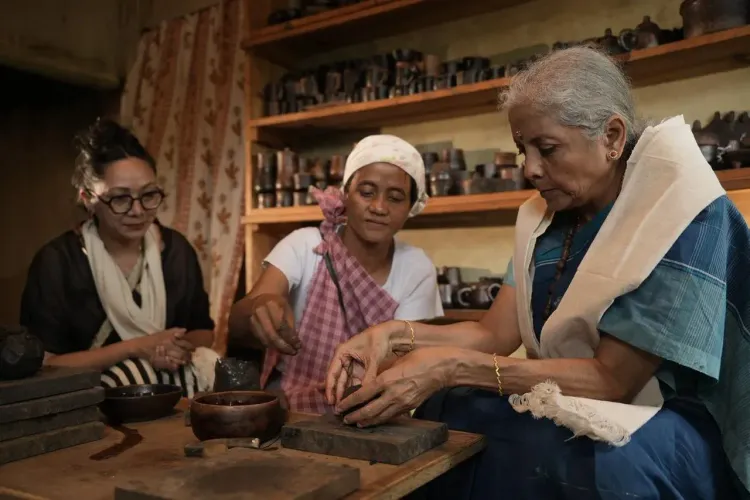
Union Finance Minister Nirmala Sitharaman visited Larnai village in West Jaintia Hills, Meghalaya, on 20 June 2026, interacting with artisans of the GI-tagged Black Clay Pottery tradition and participating in a live demonstration of the ancient craft.
Key Takeaways
Nirmala Sitharaman visited Larnai village, West Jaintia Hills, Meghalaya on 20 June 2026 .
She interacted with artisans preserving the GI-tagged Black Clay Pottery tradition of the region.
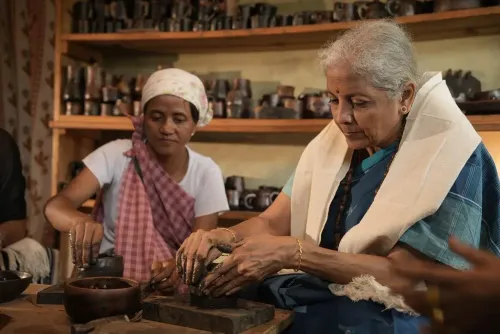
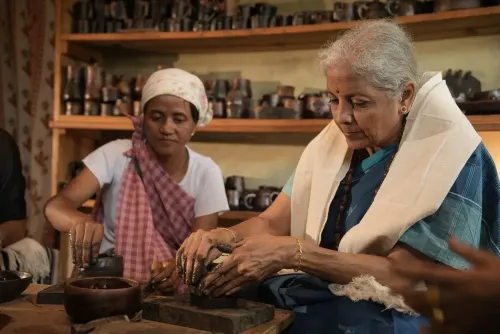
The Finance Minister participated in a live demonstration covering clay preparation, hand-moulding, engraving, and traditional firing.
The craft is rooted in the indigenous knowledge of the Pnar community and has been passed down through generations.
GI protection for the pottery is grounded in the Geographical Indications of Goods (Registration and Protection) Act, 1999 .
The visit aligns with a broader federal push to link cultural preservation with rural livelihood support in northeastern states.
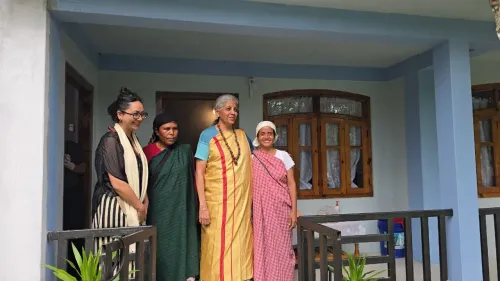
Union Finance Minister Nirmala Sitharaman visited Larnai village in West Jaintia Hills, Meghalaya, on Saturday, 20 June 2026, where she interacted with local artisans preserving the district's GI-tagged Black Clay Pottery tradition and participated in a live demonstration of the craft.
Context
The Black Clay Pottery of West Jaintia Hills is a Geographical Indication-tagged craft rooted in the knowledge systems of the indigenous Pnar community. Passed down through generations, the tradition encompasses clay preparation, hand-moulding, surface engraving, and traditional firing — skills that artisans at Larnai village continue to practise largely as their forebears did. Sitharaman observed each stage of the process during her visit, engaging directly with the craftspeople at work.
Policy Backdrop
The legal basis for protecting such crafts lies in the Geographical Indications of Goods (Registration and Protection) Act, 1999, which enables region-specific traditional products to be registered and shielded from imitation. GI recognition for Black Clay Pottery formally acknowledges the craft's geographic and cultural specificity, giving artisans a degree of market protection. Central government programmes have increasingly pursued GI registration for tribal and rural crafts across northeastern states, framing cultural preservation as inseparable from rural livelihood support.
Ministerial visits to artisan clusters in the Northeast have become a recurring feature of this approach, often highlighting linkages between heritage schemes and programmes under the Ministry of Textiles. The One District One Product initiative has similarly spotlighted handicrafts from tribal districts, positioning them within a broader rural-economy framework.
Stakeholders and Impact
The primary stakeholders are the traditional artisans of Larnai village and the wider indigenous communities of West Jaintia Hills who depend on the craft for both livelihood and cultural identity. GI status provides a competitive marker in domestic and export markets, but sustained economic benefit depends on institutional support — training, credit access, and market linkages — that goes beyond the tag itself. Visibility generated by a senior ministerial visit can attract both government scheme funding and private-sector interest in heritage craft products.
For Meghalaya more broadly, such engagements signal continued federal attention to the northeastern cultural economy, which encompasses a range of crafts, weaves, and artisanal traditions at varying stages of formal recognition.
What's Next
Observers will watch whether the visit translates into concrete budgetary or scheme-based commitments for artisan clusters in West Jaintia Hills — whether through the upcoming parliamentary session, state development plans, or Ministry of Textiles allocations. Further GI tag applications from other Meghalaya districts are also anticipated as the state works to formalise recognition of its diverse tribal crafts. The interaction underscores an emerging pattern in which senior finance ministry officials publicly champion cultural-economy assets, a signal that heritage preservation is being woven into mainstream economic policy conversations.
Point of View
A practice that builds political capital in tribal constituencies while signalling federal intent to back cultural industries. Whether this translates into measurable budgetary support for West Jaintia Hills artisans will be the real test of the engagement. The optics of India's top finance official learning pottery techniques also carry a soft-power dimension, reinforcing the government's 'vocal for local' messaging on indigenous crafts.
NationPress
19 Sept 2026
Frequently Asked Questions
What is the Black Clay Pottery of Meghalaya?
Black Clay Pottery is a GI-tagged traditional craft from West Jaintia Hills, Meghalaya, practised by the indigenous Pnar community. It involves hand-moulding, engraving, and traditional firing of locally sourced clay, and has been passed down through generations as a marker of cultural identity.
Why did Nirmala Sitharaman visit Larnai village?
Nirmala Sitharaman visited Larnai village in West Jaintia Hills on 20 June 2026 to interact with artisans preserving the GI-tagged Black Clay Pottery tradition and to participate in a live demonstration of the craft's production process.
What does a GI tag mean for Black Clay Pottery artisans?
A Geographical Indication tag, protected under the GI Act of 1999, gives the pottery legal recognition as a region-specific product, offering artisans some protection against imitation and a competitive marker in domestic and export markets.
Which district in Meghalaya is known for Black Clay Pottery?
West Jaintia Hills district in Meghalaya is the home of the Black Clay Pottery tradition, with Larnai village being a key centre where artisans continue to practise the craft.
How does the government support tribal crafts in Northeast India?
The central government supports tribal crafts through GI registration, schemes under the Ministry of Textiles, and the One District One Product initiative, which highlights handicrafts from tribal districts and links cultural preservation to rural livelihood programmes.