Sitharaman invokes Sengol and Aadheenams in Chennai address
Synopsis
Union Finance Minister Nirmala Sitharaman, speaking in Chennai, highlighted PM Modi's recognition of Tamil Nadu's Aadheenams and recalled the historic 2023 installation of the Sengol in the new Parliament building — linking India's 1947 transfer of power to its new legislative home.
Key Takeaways
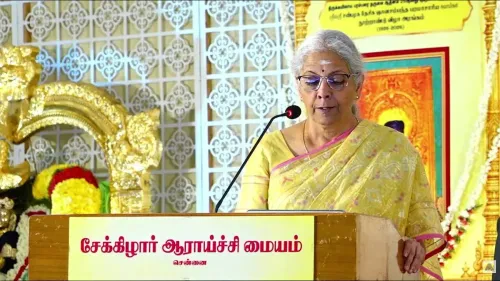
Union Finance Minister Nirmala Sitharaman made these remarks at a public address in Chennai .
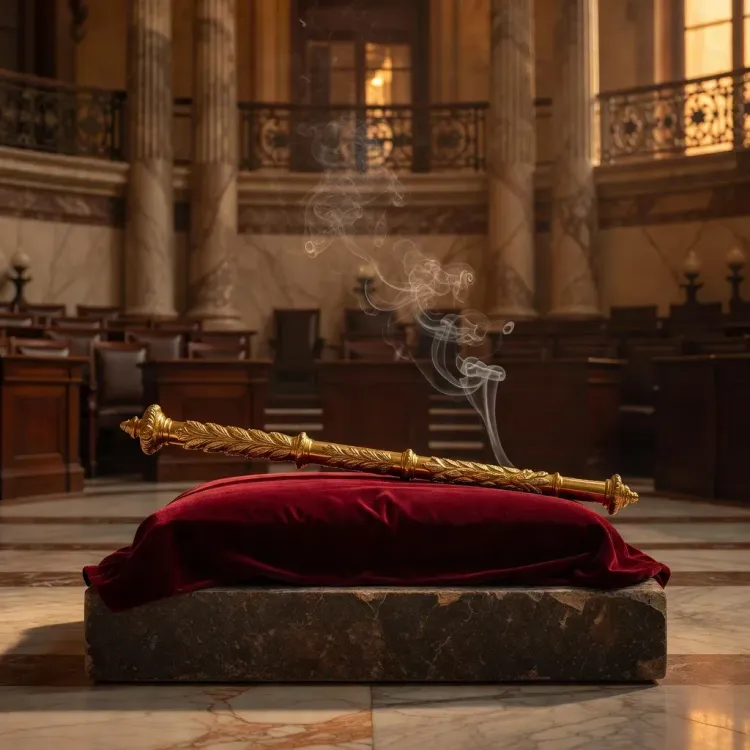
The Sengol , a ceremonial sceptre first presented at Indian independence in 1947 , was installed in the new Parliament building on 28 May 2023 .
The installation was performed in the presence of Tamil Nadu Aadheenams , who also conducted the original 1947 rituals.
PM Narendra Modi was credited by Sitharaman with continuing to honour the Aadheenams as symbols of the Saiva tradition.
The remarks form part of a broader BJP effort to link South Indian Saivite heritage with India's national and constitutional identity.
Speaking in Chennai, Union Finance Minister Nirmala Sitharaman drew a direct line from India's moment of independence to the present day — anchoring it in the sacred sceptre that now stands inside Parliament and the Tamil Saivite monks who blessed it both times.
The Sengol's journey from 1947 to the new Parliament
The Sengol — a ceremonial sceptre symbolising the righteous transfer of power — was first presented at the time of Indian independence in 1947. For decades it remained largely out of public view, its significance dimmed by the passage of time. That changed on 28 May 2023, when Prime Minister Narendra Modi installed the Sengol in the new Parliament building during its inauguration, with the Aadheenams — the traditional Saivite monastic heads of Tamil Nadu — present to perform the accompanying rituals, mirroring what was done at the original handover.
Sitharaman underscored the weight of that moment: the same living tradition that witnessed the birth of independent India was called upon again to consecrate its new legislative home. 'We must recall how the Sengol, presented at the time of independence, was after many years placed in our Parliament following rituals performed in the presence of Adheenams,' she said.
Aadheenams as enduring symbols of the Saiva tradition
The Aadheenams are among the oldest surviving institutional custodians of the Shaiva Siddhanta tradition in Tamil Nadu — monastic lineages that have preserved scripture, ritual, and temple governance across centuries. Sitharaman's remarks position them not merely as religious bodies but as living constitutional witnesses: institutions whose blessing carries civilisational authority that the government chose to invoke at the inauguration of a new democratic chamber.
Her comments in Chennai form part of a pattern of BJP leaders publicly honouring South Indian Saivite institutions as expressions of India's deeper cultural continuity — a deliberate effort to weave regional religious heritage into the national narrative.
PM Modi's continued recognition of Tamil religious heritage
Sitharaman was explicit in crediting Prime Minister Modi with sustaining this relationship. 'Hon'ble PM Shri Narendra Modi has continued to honour the Aadheenams, which remain enduring symbols of the Saiva tradition in Tamil Nadu,' she said. The framing casts the Sengol installation not as a one-off event but as part of an ongoing governmental acknowledgment of Tamil cultural and spiritual institutions at the highest levels of the Indian state.
For Tamil Nadu — a state where questions of cultural identity, linguistic pride, and the relationship between regional heritage and national politics run deep — the symbolism is pointed. The Sengol's presence in Parliament is being actively cited as evidence that the traditions of the South are not peripheral to India's constitutional story, but foundational to it.
Whether that framing lands as genuine recognition or political messaging will continue to be debated. What is not in dispute is the image: Tamil Aadheenam pontiffs, custodians of a tradition older than the republic itself, standing inside India's new Parliament as the Sengol was installed.
Point of View
Invoking the Aadheenams in this context serves a dual purpose: it signals respect for Tamil religious institutions in a politically competitive state, while embedding the party's governance within a civilisational continuity narrative. The risk is that audiences attuned to the politics of Tamil identity may read the framing as instrumentalisation rather than genuine recognition — a tension the party will need to navigate as it deepens its outreach in the South.
NationPress
15 Sept 2026
Frequently Asked Questions
What is the Sengol and why was it placed in Parliament?
The Sengol is a ceremonial sceptre that was presented to India's first leaders at the time of independence in 1947 as a symbol of righteous transfer of power. On 28 May 2023, PM Modi installed it in the new Parliament building during its inauguration, with Tamil Aadheenam pontiffs performing the accompanying rituals.
Who are the Aadheenams?
The Aadheenams are traditional Saivite monastic institutions in Tamil Nadu that serve as custodians of the Shaiva Siddhanta tradition. They have preserved scripture, ritual, and temple governance for centuries and were present at both the 1947 Sengol ceremony and the 2023 Parliament installation.
What did Nirmala Sitharaman say about the Sengol in Chennai?
Speaking in Chennai, Sitharaman recalled how the Sengol, first presented at independence, was installed in the new Parliament after many years, with rituals performed in the presence of Adheenams. She also credited PM Modi with continuing to honour the Aadheenams as enduring symbols of Tamil Saiva tradition.
When was the new Parliament building inaugurated?
The new Parliament building was inaugurated on 28 May 2023 by Prime Minister Narendra Modi. The Sengol was installed during this ceremony with Tamil Aadheenam pontiffs present.
Why is the Sengol significant for Tamil Nadu?
The Sengol's origins lie in the Tamil Saivite tradition, and the Aadheenams who blessed it in 1947 are based in Tamil Nadu. Its installation in Parliament is being cited as recognition that Tamil cultural and spiritual heritage is foundational to India's constitutional story.