Sitharaman Receives ₹428 Cr Dividend from Exim Bank

Synopsis
Union Finance Minister Nirmala Sitharaman received a ₹428 crore dividend cheque for FY 2025-26 from Export-Import Bank of India MD Harsha Bangari on 15 July 2026, channelling institutional surplus into the central government's non-tax revenue.
Key Takeaways
Nirmala Sitharaman received a dividend cheque of ₹428 crore from Exim Bank for FY 2025-26 on 15 July 2026 .
The cheque was presented by Harsha Bangari , Managing Director of the Export-Import Bank of India .
Exim Bank is a wholly government-owned institution established by Parliament in 1982 to finance India's international trade.
Dividend remittances from public sector financial institutions form part of the central government's non-tax revenue, supporting fiscal deficit management.
The transfer reflects Exim Bank's operational profitability alongside its trade finance and export promotion mandate.
The dividend will be accounted for in Union Budget receipts for FY 2026-27 .
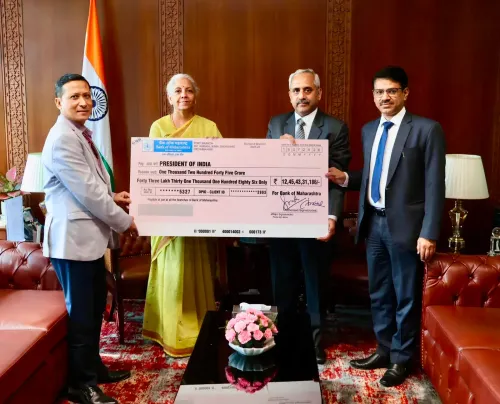
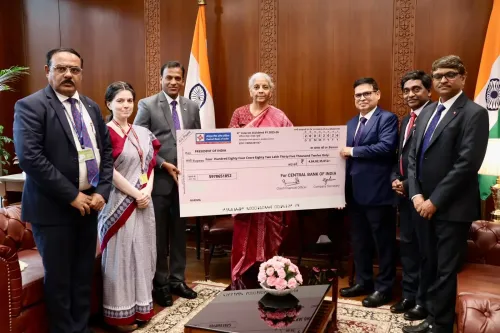
Union Finance Minister Nirmala Sitharaman on Wednesday, 15 July 2026 received a dividend cheque of ₹428 crore for FY 2025-26 from Harsha Bangari, Managing Director of the Export-Import Bank of India (Exim Bank), marking another annual transfer of institutional surplus to the central exchequer.
Context
The handover of the dividend cheque formalises the transfer of Exim Bank's distributable profits for the financial year ending March 2026 to the government, which holds the institution as a wholly owned entity. Such dividend remittances from public sector financial institutions are a recognised component of the central government's non-tax revenue stream. The ceremony, typically conducted between the institution's chief executive and the Finance Minister, signals the bank's financial health and its ability to generate surplus while continuing to extend trade credit.
Policy Backdrop
Exim Bank was established under an Act of Parliament in 1982 with a mandate to finance and promote India's international trade through export credit, guarantees, and lines of credit to foreign governments and buyers. As a government-owned specialised lender, it operates at the intersection of trade policy and development finance, channelling support to Indian exporters across sectors including manufacturing, infrastructure, and services. Dividends and surplus transfers from such institutions are reflected in successive Union Budget documents under non-tax revenue receipts, contributing to the government's overall fiscal arithmetic.
Dividend flows from public sector undertakings and financial institutions have been a consistent tool for the government to recycle institutional profits back into budgetary resources. In recent years, the government has placed greater emphasis on improving returns from its ownership stakes in public sector entities, making such transfers a closely watched metric in fiscal management circles.
Stakeholders and Impact
The ₹428 crore dividend directly bolsters the central government's non-tax revenue for FY 2026-27, providing a modest but meaningful contribution toward meeting fiscal deficit targets. For Exim Bank, the ability to remit a dividend while sustaining its lending programmes reflects adequate capital generation and operational profitability. Indian exporters, who rely on Exim Bank for competitive credit lines and guarantees in overseas markets, have a stake in the institution's financial strength, as a well-capitalised bank can sustain and expand its support programmes.
Harsha Bangari, who has led Exim Bank as Managing Director, has overseen the institution's efforts to scale up lines of credit to partner countries and deepen engagement with Indian exporters in sectors ranging from defence to pharmaceuticals. The dividend remittance underscores the bank's dual role: advancing India's export promotion agenda while functioning as a commercially viable institution that returns value to its sole shareholder, the Government of India.
What's Next
The ₹428 crore dividend will be accounted for in the Union Budget receipts for FY 2026-27, where non-tax revenues from public sector entities are consolidated. Analysts and budget watchers will track whether Exim Bank's capital adequacy and profitability enable continued or enhanced dividend payouts in subsequent years. Any announcements on fresh capital infusion into the bank, expansion of its lines of credit to partner nations, or changes to its lending programmes are expected to follow periodic reviews by the Finance Ministry. The transaction also sets the tone for similar dividend transfers from other government-owned financial institutions as the fiscal year progresses.
Point of View
Such non-tax revenue flows, aggregated across multiple public sector entities, play a quiet but material role in keeping the fiscal deficit on a credible path. The public handover of the cheque also serves a signalling function, reinforcing government messaging around the commercial viability and accountability of its financial institutions.
NationPress
15 Jul 2026
Frequently Asked Questions
What is the Exim Bank dividend received by Nirmala Sitharaman?
Union Finance Minister Nirmala Sitharaman received a dividend cheque of ₹428 crore for FY 2025-26 from Exim Bank MD Harsha Bangari on 15 July 2026, representing the bank's surplus transfer to the central government.
What is the Export-Import Bank of India?
The Export-Import Bank of India, or Exim Bank, is a wholly government-owned specialised financial institution established by an Act of Parliament in 1982 to finance and promote India's international trade through export credit, guarantees, and lines of credit.
Why does Exim Bank pay a dividend to the government?
As a wholly government-owned entity, Exim Bank transfers a portion of its annual profits to the central government as a dividend, which forms part of the government's non-tax revenue and helps support fiscal management.
Who is Harsha Bangari?
Harsha Bangari is the Managing Director of the Export-Import Bank of India, responsible for overseeing the institution's lending programmes, lines of credit to foreign governments, and support to Indian exporters.
How does Exim Bank's dividend affect the Union Budget?
The dividend received from Exim Bank is counted under non-tax revenue receipts in the Union Budget, contributing modestly to the government's overall revenue and helping to manage the fiscal deficit target for FY 2026-27.