Sonowal Launches LPPI and Indigenous VTS at JNPA
Synopsis
Union Minister Sarbananda Sonowal launched the Logistics Port Performance Index (LPPI) and an indigenously developed Vessel Traffic Service at JNPA on 29 May 2026, pairing performance benchmarking with real-time traffic management to sharpen India's port competitiveness and advance the National Logistics Policy's cost-reduction targets.
Key Takeaways
Logistics Port Performance Index (LPPI) launched to benchmark terminal efficiency and transparency across Indian ports.
An indigenously developed Vessel Traffic Service (VTS) inaugurated at JNPA , India's largest container port near Mumbai .
Both initiatives were announced by Union Minister Sarbananda Sonowal on 29 May 2026 .
The launches build on a decade-long policy stack: Sagarmala (2015) , Maritime India Vision 2030 (2021) , PM Gati Shakti (2021) , and the National Logistics Policy (2022) .
India's logistics costs are estimated at around 14 per cent of GDP ; the LPPI is designed as an accountability tool to help drive those costs down.
The indigenous VTS reduces dependence on imported maritime traffic management technology, aligning with self-reliance goals.
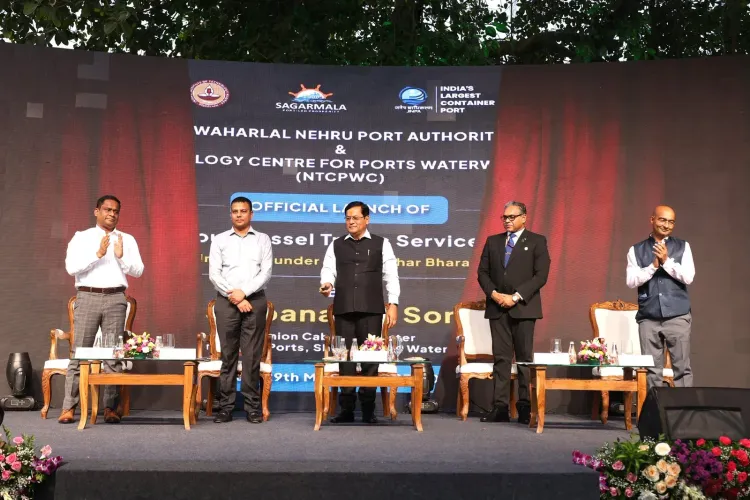
Union Minister of Ports, Shipping and Waterways Sarbananda Sonowal on Friday, 29 May 2026 launched the Logistics Port Performance Index (LPPI) alongside a set of digital reforms aimed at boosting terminal efficiency and transparency at Indian ports. The minister also inaugurated an indigenously developed Vessel Traffic Service (VTS) system at Jawaharlal Nehru Port Authority (JNPA), India's largest container port located near Mumbai.
Context
Announcing the twin launches, Minister Sonowal said the steps were intended to 'build on this success and boost our global competitiveness.' The LPPI is a new benchmarking tool designed to measure terminal efficiency, transparency, and the global competitiveness of Indian ports, providing a data-driven yardstick for performance assessment across the port ecosystem. The indigenous VTS at JNPA will enable real-time maritime traffic management, enhancing both safety and operational efficiency at the port.
JNPA handles over half of India's container traffic and is a critical node in the country's external trade infrastructure. The simultaneous rollout of a performance index and a home-grown traffic management system signals a dual push — accountability through metrics and operational resilience through domestic technology.
Policy Backdrop
The launches sit within a layered policy architecture built over the past decade. The Sagarmala Project, launched in 2015, set the foundation for port-led development along India's coastline. Maritime India Vision 2030, released in 2021, established targets for port capacity expansion and digitalisation, while the PM Gati Shakti National Master Plan, notified in the same year, integrated ports with multimodal logistics networks.
The National Logistics Policy of 2022 added a sharper economic imperative: reducing India's logistics costs, estimated at around 14 per cent of GDP, to improve manufacturing and export competitiveness. The LPPI can be read as an operational instrument to track progress against that very goal, bringing measurable accountability to port-level performance.
Stakeholders and Impact
Port operators, exporters, and global shipping lines stand to benefit directly from both initiatives. A standardised performance index creates competitive pressure on terminals to improve turnaround times and reduce dwell times — costs that are ultimately borne by exporters and consumers. Transparency in port metrics also strengthens India's case as a reliable trade partner for international shipping lines evaluating routing decisions.
The indigenous VTS at JNPA reduces dependence on imported maritime traffic management systems, aligning with the government's broader push for self-reliance in critical infrastructure technology. For port workers and vessel operators, real-time traffic management translates into safer berthing operations and fewer delays.
What's Next
The immediate question is whether the LPPI framework will be extended to other major Indian ports beyond JNPA, and how frequently rankings will be published to drive sustained improvement. Policymakers and trade bodies will watch for measurable changes in vessel turnaround times as an early indicator of impact.
The deployment of indigenous VTS systems at additional ports could follow if the JNPA installation demonstrates operational gains. Any parliamentary or budgetary follow-through on digital port reforms in the coming sessions will indicate how central these tools are to the government's medium-term maritime strategy.
Point of View
The ambitious targets of Maritime India Vision 2030 and the National Logistics Policy risk remaining aspirational. By anchoring the launches at JNPA — the country's busiest container gateway — the ministry is signalling that reform must be demonstrated at scale, not piloted at peripheral ports. The indigenous VTS also carries a strategic subtext, positioning domestic technology development as integral to critical maritime infrastructure rather than an afterthought.
NationPress
20 Oct 2026
Frequently Asked Questions
What is the Logistics Port Performance Index (LPPI)?
The LPPI is a new benchmarking tool launched by the Union Ministry of Ports, Shipping and Waterways to measure terminal efficiency, transparency, and global competitiveness of Indian ports, providing a data-driven performance yardstick for the port sector.
What is the Vessel Traffic Service (VTS) launched at JNPA?
The VTS is an indigenously developed maritime traffic management system inaugurated at Jawaharlal Nehru Port Authority (JNPA) near Mumbai. It enables real-time monitoring and management of vessel movements, improving safety and operational efficiency at the port.
What is JNPA and why is it significant?
JNPA, or Jawaharlal Nehru Port Authority, is India's largest container port located near Mumbai. It handles over half of the country's container traffic, making it the most critical node in India's external trade infrastructure.
How does the LPPI relate to India's National Logistics Policy?
The National Logistics Policy of 2022 set a goal of reducing India's logistics costs from around 14 per cent of GDP to improve trade competitiveness. The LPPI serves as an operational accountability tool to track port-level progress toward that objective.
Will the LPPI and indigenous VTS be extended to other Indian ports?
The government has not yet announced a specific rollout timeline for other ports, but policymakers and trade stakeholders are watching for extension of LPPI rankings and VTS deployment beyond JNPA as a key next step in India's port modernisation drive.