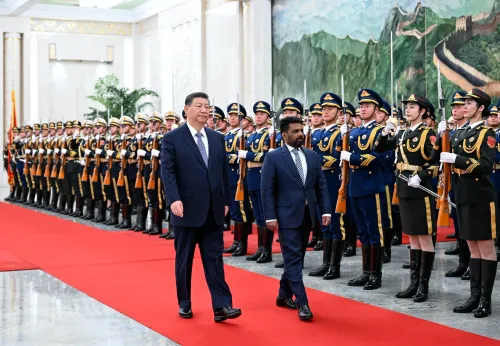
Sri Lanka must deepen economic ties with India: Daily FT
Synopsis
A Colombo newspaper argues that Sri Lanka's real challenge is not its $3.3 billion trade deficit with India but whether that trade builds skills and industry. Its proposed answer is for Sri Lankan firms to become certified suppliers to India's $85.9 billion auto-component sector.
Key Takeaways
An article in Colombo's Daily FT argues that Sri Lanka must strengthen its economic partnership with India .
IMF October 2026 projections put India's nominal GDP at about $4.06 trillion , with 7 per cent real growth.
Sri Lanka's exports to India were about $1.04 billion in 2025 , against imports of $4.33 billion , a deficit of about $3.3 billion .
The CEAT–Kelani tyre venture is cited as a successful model of Indo-Lankan industrial partnership.
India's auto-component industry recorded about $85.9 billion in turnover in 2025–26 , including $24 billion in exports.
Sri Lanka must build a stronger economic partnership with India to drive its own development, according to an article in Colombo's Daily FT newspaper. The piece argues that India's industrial expansion is reshaping South Asia, which makes closer ties with its northern neighbour essential for the island nation. It calls on Sri Lanka to move beyond conventional trade and into industrial partnerships with Indian companies.
The article also challenges a recurring theme in Sri Lankan foreign policy debates. It notes that Sri Lanka has historically absorbed external influences without becoming an extension of India. Even so, it says, current policy thinking often views economic proximity through anxieties about sovereignty and unequal power.
India's Economic Weight in Numbers
The article states that India's economic prominence is measurable. It cites the International Monetary Fund's October 2026 projections, which place India's nominal gross domestic product at approximately $4.06 trillion, with real growth projected at 7 per cent.
In purchasing power parity terms, India's economy approaches $19.2 trillion, accounting for approximately 8.6 per cent of global output. On that basis, the article concludes that India is not merely South Asia's dominant economy but an increasingly consequential centre of international economic activity.
The Bilateral Trade Gap
The piece cites official figures showing that Sri Lanka's exports to India reached approximately $1.04 billion in 2025. Imports from India amounted to $4.33 billion over the same period, leaving a merchandise trade deficit of approximately $3.3 billion.
The article does not treat this gap as a sign of weakness. It argues that a trade deficit does not inherently indicate economic fragility, particularly when imported machinery and intermediate goods support domestic production. In its view, the more consequential question is whether trade creates skilled employment, technological capabilities and competitive industries.
The Case for Industrial Partnerships
The article's central recommendation is that Sri Lanka should go beyond buying and selling goods and forge industrial partnerships with Indian firms. It points to the CEAT–Kelani venture, which manufactures tyres in Sri Lanka, as evidence that this model can succeed.
It identifies the automotive sector as a wider opportunity. According to the Automotive Component Manufacturers Association of India, India's auto-component industry generated approximately $85.9 billion in turnover during 2025–26, including $24 billion in exports.
Where Sri Lanka Fits In
The article notes that Sri Lanka already manufactures rubber products, electrical assemblies and specialised automotive components. It says the country should not try to replicate India's industrial scale. Instead, Sri Lankan enterprises could become qualified suppliers within Indian manufacturing networks.
That shift, the article suggests, would depend on three things: product certification, technological partnerships and efficient logistics. Together, these would allow Sri Lankan firms to plug into supply chains that are already large and growing.
The argument adds to a broader debate in Colombo over how closely the island's economic future should be tied to India's growth. How policymakers balance sovereignty concerns against integration with supply chains is likely to shape Sri Lanka's industrial strategy in the years ahead.
Point of View
But staying out of India's manufacturing networks carries its own cost: being left behind. For New Delhi, a more confident and prosperous Sri Lanka also supports India's Neighbourhood First approach, which is why the CEAT–Kelani model should be expanded rather than treated as an exception.
NationPress
29 Nov 2026
Frequently Asked Questions
Why does the Daily FT article say Sri Lanka should strengthen ties with India?
The article argues that India's industrial expansion is reshaping South Asia, so a stronger economic partnership is crucial for Sri Lanka's development. It recommends industrial partnerships with Indian companies rather than relying on trade alone.
What is Sri Lanka's trade deficit with India?
According to official figures cited in the article, Sri Lanka's merchandise trade deficit with India was approximately $3.3 billion in 2025. Exports were about $1.04 billion, while imports were $4.33 billion.
How big is India's economy according to the IMF?
IMF projections from October 2026 place India's nominal GDP at approximately $4.06 trillion, with real growth projected at 7 per cent. In purchasing power parity terms, the economy approaches $19.2 trillion, about 8.6 per cent of global output.
What is the CEAT–Kelani venture?
It is a joint venture that manufactures tyres in Sri Lanka. The article cites it as a successful example of Indo-Lankan industrial partnership.
How could Sri Lanka benefit from India's auto-component industry?
The article suggests Sri Lankan firms could become qualified suppliers within Indian manufacturing networks through certification, technological partnerships and efficient logistics. India's auto-component sector had about $85.9 billion in turnover in 2025–26, according to ACMA.