Stalin Meets Cadre Kasi, Salutes DMK's Living Ideology
Synopsis
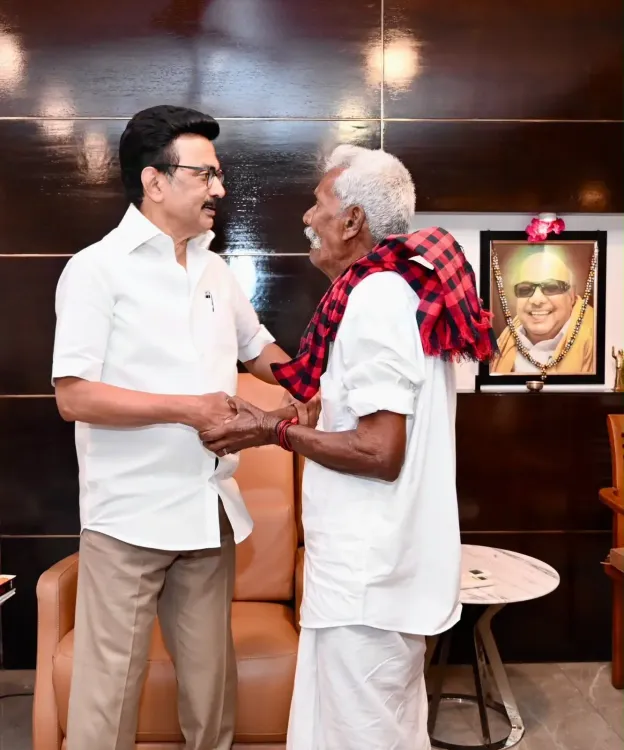
DMK president M. K. Stalin shared a heartfelt tribute to veteran cadre Kasi on 5 November 2026, calling him a model of lived Dravidian ideology — shaped by Periyar's ideas, Murasoli's lessons, and a joyful embrace of inter-caste marriage — and challenging every party member to learn from such lives.
Key Takeaways
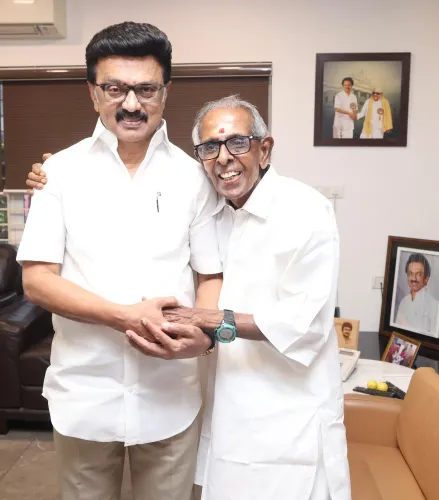
Stalin met and paid tribute to a veteran cadre named Kasi on 5 November 2026 .
Stalin praised Kasi for being inspired by Thanthai Periyar's rationalist, anti-caste philosophy and for treating Murasoli as his political school.
Kasi's wholehearted acceptance and celebration of an inter-caste, self-respect marriage in his family was highlighted as exemplary practice of DMK principles.
Stalin invoked Kalaignar M.
Karunanidhi's memory, saying he saw the late leader's smile in Kasi's eyes.
The post was an internal call to all DMK workers — from president to newest recruit — to live ideology rather than merely proclaim it.
The DMK's promotion of self-respect and inter-caste marriages as social reform dates to the movement's founding years in the 1950s .
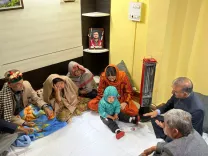
A party is only as strong as the people who live its principles — not just recite them. DMK president M. K. Stalin made exactly that point on Thursday, 5 November 2026, when he shared a moving account of meeting a veteran party worker named Kasi, calling the encounter a reminder that the Dravida Munnetra Kazhagam is built not on flag-bearers but on people who carry its ideology in their daily lives.
Writing in Tamil on X, Stalin drew a vivid distinction: 'வெறும் கொடியேந்தி நிற்பவர்களல்ல; கொள்கையேந்தி வாழ்பவர்கள்தான் தி.மு.க.வினர்!' — 'DMK members are not those who merely hold the flag; they are those who live the ideology.' In Kasi, he said, he found the embodiment of that standard.
Periyar's Thought, Murasoli's Lessons, and One Man's Choices
Stalin described Kasi as someone drawn to the rationalist philosophy of Thanthai Periyar — E. V. Ramasamy, the founder of the Self-Respect Movement whose anti-caste ideas became the ideological bedrock of the DMK. Kasi treated Murasoli, the party's official newspaper launched as a vehicle for political education, as his 'political school' — a detail Stalin highlighted with evident pride.
The specific act that moved the DMK president most: Kasi had not only accepted but celebrated an inter-caste, self-respect marriage in his own family. 'In his eyes I saw Kalaignar's smile,' Stalin wrote — invoking the late M. Karunanidhi, the towering DMK patriarch whose decades of leadership wove social reform into the party's everyday culture. The reference is deliberate. Karunanidhi championed self-respect marriages as practical social transformation, not mere electoral symbolism, since the movement's earliest years under C. N. Annadurai in the 1950s.
The Message Inside the Tribute
This was not simply a farewell note to a party elder. Stalin used the meeting to issue an internal call to conscience. 'Principles are not only to be spoken on stages; they are to be lived,' he wrote, adding that the DMK has 'lakhs of Kasis' — cadres who prove the ideology through action rather than oratory. He made the lesson universal within the party hierarchy, stating that everyone — from party president to the newest youth worker, from senior pioneers to those entering the field for the first time — has something to learn from lives like Kasi's.
The post is tagged #DMKForever and #Udanpirappu — the Tamil word for 'fraternity' or 'born-of-the-same-womb kinship' — and mentions @krithika_writes, suggesting a personal connection to the story being shared.
Why This Moment Resonates Beyond the Party
The DMK has long positioned itself as a movement where ideology and lived practice are inseparable. Stalin's tribute to Kasi reinforces that internal culture at a moment when the party manages both state governance in Tamil Nadu and a prominent role in national opposition politics. The message — that caste eradication must happen in homes and families, not just in manifestos — echoes a Periyarist tradition that stretches back over a century.
Even after sending Kasi on his way, Stalin wrote, 'the conversation continues in my heart.' That closing line is not sentiment for its own sake. It is a signal to every DMK worker watching: the standard is not what you say at a rally. It is how you live when no one is looking.
Point of View
He reinforces the DMK's foundational claim that Dravidian politics is a way of life, not an electoral operation. The invocation of Karunanidhi's smile is a deliberate intergenerational link — connecting a grassroots act of caste defiance today to the decades of social-reform governance associated with Kalaignar's era. At a time when the party balances state power with national opposition responsibilities, the message recalibrates the base: the movement's credibility rests on what happens in family halls, not press conferences. It also signals that the DMK intends to keep Periyarist social reform — particularly caste eradication — at the ideological centre of its identity.
NationPress
5 Nov 2026
Frequently Asked Questions
Who is Kasi in M. K. Stalin's post?
Kasi is a veteran DMK cadre whom Stalin met and praised for embodying Dravidian ideology in his personal life — particularly for celebrating an inter-caste, self-respect marriage in his family. His specific identity is not part of widely documented public records.
What is a self-respect marriage in Tamil Nadu?
A self-respect marriage is a ceremony conducted without traditional Brahminical rituals, rooted in the Self-Respect Movement founded by Periyar in the 1920s. It allows couples — including inter-caste couples — to marry with mutual consent before friends and family, without a priest. The DMK has championed and legally recognised such marriages.
What is Murasoli and why does Stalin mention it?
Murasoli is the official newspaper of the DMK, long used as a tool for ideological education within the party. Stalin mentions it to highlight that Kasi treated the publication as his 'political school,' showing deep commitment to party principles beyond mere membership.
Why does Stalin refer to Karunanidhi's smile?
By saying he saw 'Kalaignar's smile' in Kasi's eyes, Stalin draws a symbolic link between the veteran cadre's lived values and the legacy of the late DMK patriarch M. Karunanidhi, who championed social reform including self-respect marriages throughout his decades of leadership.
What does #Udanpirappu mean in the context of this post?
'Udanpirappu' is a Tamil word meaning fraternity or the bond of those born of the same kin. In DMK usage it evokes the idea of a shared Dravidian brotherhood, reinforcing the emotional and ideological solidarity Stalin is expressing in his tribute to Kasi.