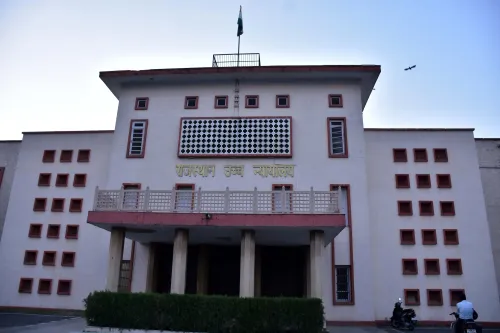
Rajasthan HC upholds SUFA terror module charges, dismisses accused's appeals

Synopsis
The Rajasthan High Court has refused to discharge accused persons in the SUFA terror module case, ruling that NIA's evidence — including a seized explosives cache, alleged ISIS-linked radicalisation videos, and a purported Jaipur bomb plot — is sufficient to proceed to trial. With 3 accused still absconding and a division bench citing the gravity of the allegations, the case now moves to full evidentiary proceedings.
Key Takeaways
The Rajasthan High Court dismissed appeals by accused in the SUFA terror module case on 27 October , upholding the trial court's order to frame charges.
The division bench comprised Chief Justice Sanjay K.
Agrawal and Justice Sameer Jain .
The case stems from the recovery of approximately 3 kg of explosive material from a vehicle in Chittorgarh on 30 March 2022 .
The NIA named 11 accused ; 8 have been arrested and 3 remain absconding .
The agency alleged the group planned to transport IEDs to Jaipur and carry out terrorist activities, with alleged links to ISIS radicalisation.
The court clarified that framing of charges does not establish guilt — evidence will be tested during the full trial.
The Rajasthan High Court has dismissed appeals filed by accused persons in the SUFA terror module case, upholding the trial court's order to frame charges and allowing criminal proceedings to continue. A division bench comprising Chief Justice Sanjay K. Agrawal and Justice Sameer Jain ruled on 27 October that the material on record warranted a trial, noting the gravity of allegations involving the procurement of explosives and an alleged terrorist conspiracy targeting Jaipur.
Background: The 2022 Chittorgarh Seizure
The case originated on 30 March 2022, when police from Nimbahera Sadar police station in Chittorgarh district intercepted a vehicle during a routine checkpoint operation at Wander Square. Officers reportedly recovered approximately 3 kilograms of explosive material from the car, along with watches, batteries, wires, bulbs, and other items.
The National Investigation Agency (NIA) subsequently took over the investigation and named 11 individuals as accused. Of these, 8 have been arrested while 3 remain absconding.
What the NIA Alleged
According to the NIA, approximately 70 youths in Ratlam had formed an organisation called SUFA. The agency alleged that the group sought to radicalise young individuals by exposing them to videos associated with the Islamic State of Iraq and Syria (ISIS).
The NIA further alleged that a secret meeting was held on 25 March 2022, during which a conspiracy was hatched to procure improvised explosive devices (IEDs), transport them to Jaipur, and carry out terrorist activities in the city. The alleged operation was reportedly intended to be recorded on video, and recordings linked to the conspiracy were subsequently recovered during the investigation.
Defence Arguments
Counsel representing the accused contended that several of their clients were not present in the vehicle when the explosives were recovered and that no incriminating materials had been seized directly from them. The defence also challenged the evidentiary value of call detail records, location data, alleged travel tickets, and electronic evidence, arguing that these did not establish a legally sufficient connection between the accused and the alleged crime.
The lawyers urged the High Court to discharge the accused, contending that the trial court had framed charges without adequate evidence.
Court's Observations
The bench clarified that at the charge-framing stage, a court is required only to assess whether available material establishes a prima facie case or creates grave suspicion — not to adjudicate on the credibility or authenticity of evidence, which is a matter for the trial. The court specifically noted the seriousness of the allegations concerning the proposed transportation of explosive devices to a major city such as Jaipur.
By dismissing the appeals, the High Court upheld the trial court's decision, allowing proceedings to continue. The bench emphasised that framing of charges does not, by itself, establish the guilt of the accused — all allegations will be tested through the full judicial process.
What Comes Next
With charges now formally upheld, the trial before the designated court is expected to move to the evidence stage. The three absconding accused remain the subject of ongoing efforts. The case is being closely watched as one of several NIA-investigated alleged radicalisation networks in Rajasthan and Madhya Pradesh.
Point of View
Contested as it is, clears the low bar of prima facie suspicion required at the charge-framing stage. The defence's attack on electronic and circumstantial evidence foreshadows a gruelling trial, and the three absconding accused represent a live security question the judicial process cannot resolve on its own. More broadly, the SUFA case sits within a cluster of NIA investigations into alleged radicalisation networks in smaller Rajasthan and Madhya Pradesh towns — a pattern that has received less national attention than high-profile urban plots but raises pointed questions about monitoring mechanisms in tier-2 and tier-3 cities.
NationPress
28 Oct 2026
Frequently Asked Questions
What is the SUFA terror module case?
The SUFA case involves an alleged terror network of approximately 70 youths from Ratlam who, according to the NIA, formed an organisation called SUFA and were allegedly radicalised using ISIS-linked videos. The case came to light on 30 March 2022, when police in Chittorgarh seized around 3 kg of explosives from a vehicle, triggering an NIA investigation that named 11 accused.
What did the Rajasthan High Court decide?
The Rajasthan High Court dismissed appeals filed by the accused and upheld the trial court's order to frame charges, ruling that prima facie material and the gravity of the allegations warranted a full trial. The court clarified that the decision to frame charges does not amount to a finding of guilt.
What was the alleged plan uncovered by the NIA?
The NIA alleged that a secret meeting on 25 March 2022 saw conspirators plan to procure IEDs, transport them to Jaipur, and carry out terrorist attacks in the city. The operation was reportedly also intended to be recorded on video, and recordings linked to the alleged conspiracy were subsequently recovered.
How many accused have been arrested in the case?
Of the 11 individuals named by the NIA as accused, 8 have been arrested. Three accused persons remain absconding as of the date of the High Court ruling.
What happens next in the SUFA case?
With the High Court upholding the charge-framing order, the trial will now proceed to the evidence stage before the designated court. All allegations — including the defence's challenges to electronic evidence, call records, and location data — will be examined in full during the trial proceedings.