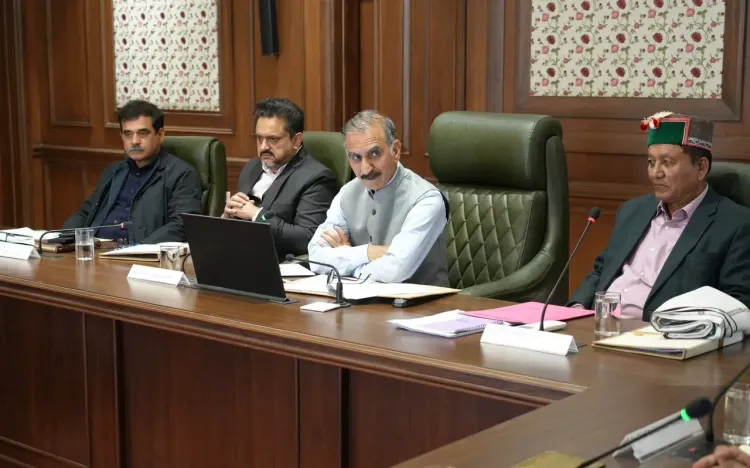
CM Sukhu chairs 12th HP Wildlife Board meet in Shimla
Synopsis
Chief Minister Sukhvinder Singh Sukhu chaired the 12th HP State Wildlife Board meeting in Shimla, deliberating on ITBP forest land transfer in Lahaul-Spiti, monkey population data, the Kangra zoo timeline, and releasing wildlife postcard series and a water-testing manual.
Key Takeaways
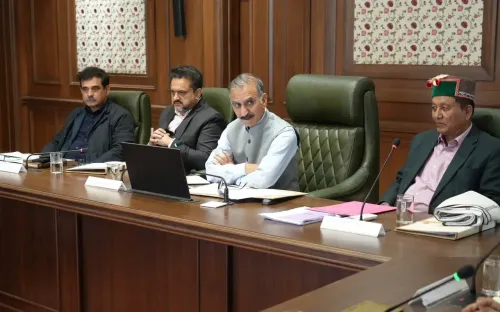
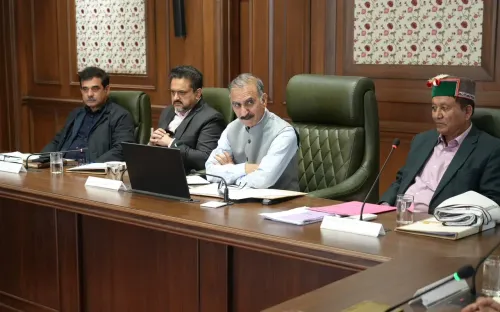
CM Sukhu chaired the 12th Himachal Pradesh State Wildlife Board meeting in Shimla on 24 October 2026 .
A proposal to transfer 1.78.20 hectares of forest land to ITBP's 17th Battalion for BOP Lalung in Kaza, Lahaul-Spiti was discussed.
Officials were directed to compile panchayat-wise monkey population data to address human-wildlife conflict.
Construction of the Durgesh Aranya Prani Udyan zoo at Bankhandi, Dehra (Kangra) was reviewed and fast-tracking was ordered.
Two wildlife postcard series — 'Himachal's Wild Icons' and 'Himachal's Wild Heritage' — and a technical water-testing manual by Dr.
Sanjay Sood were released at the meeting.
Balancing a snow-leopard habitat against a border outpost is precisely the kind of impossible equation that lands on a state wildlife board's table — and on Saturday, 24 October 2026, Himachal Pradesh Chief Minister Sukhvinder Singh Sukhu chaired the 12th meeting of the Himachal Pradesh State Wildlife Board in Shimla, working through that equation and several others.
The Chief Minister shared the key outcomes on X, outlining a wide agenda that wove together national security, habitat protection, human-wildlife conflict and public education — a snapshot of just how many competing pressures press down on one of India's most ecologically sensitive states.
ITBP's border post and the 1.78-hectare forest question
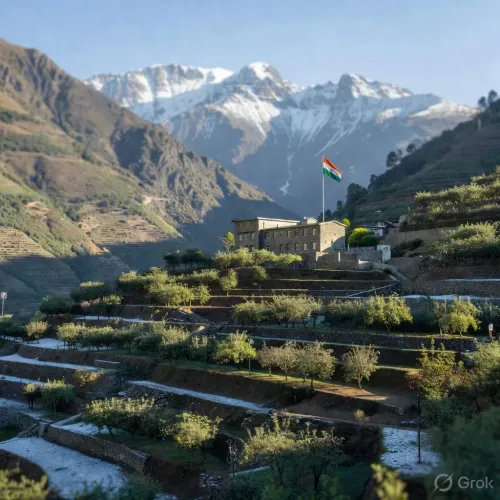
The meeting's most consequential item involved a proposal to transfer 1.78.20 hectares of forest land to the ITBP's 17th Battalion for the establishment of BOP Lalung at Muhal Lalung and Dhar Chokula, Kaza in Lahaul-Spiti district. The district shares a long frontier with China, making strategic infrastructure there a recurring necessity — and a recurring tension with alpine ecosystems that host species found nowhere else on earth.
Such diversion proposals travel through the Forest Conservation Act, 1980 framework, with the state wildlife board playing an advisory role before any central clearance. Sukhu noted that the board stressed maintaining equilibrium among industrial development, border infrastructure, road connectivity, non-forestry use of forest land, and wildlife conservation. That phrase — balance — carried real weight in a district where ibex, snow leopard and the trans-Himalayan plateau meet an active geopolitical frontier.
Monkey menace: panchayat-by-panchayat count ordered
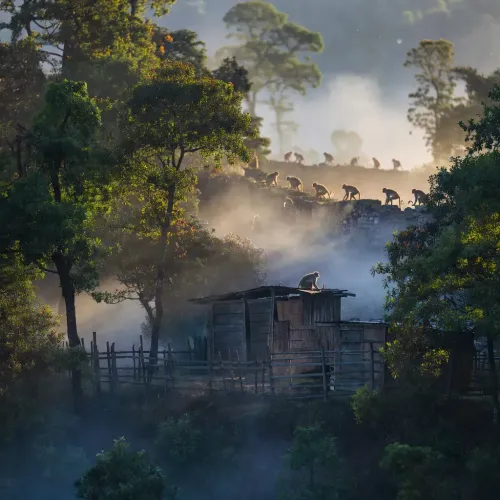
Closer to the valley floors, a far more everyday conflict dominates: rhesus macaques. Crop-raiding and property damage by monkey populations have plagued Himachal Pradesh's farming communities for over two decades, generating repeated state-level interventions. Sukhu directed officials to compile panchayat-wise population data on monkeys — a granular mapping exercise that would give administrators a factual baseline before designing any management response. Getting the numbers right before acting is the unglamorous precondition for any policy that actually works.
Durgesh Aranya Prani Udyan: construction pace put on notice
The Chief Minister also reviewed progress on the Durgesh Aranya Prani Udyan, an under-construction zoo at Bankhandi, Dehra in Kangra district. Designed as a facility for ex-situ conservation, environmental education, and wildlife tourism, the project was directed to accelerate its construction timeline. No completion date was announced at the meeting, but Sukhu's on-record instruction to speed up signals that the state considers the facility overdue.
Wildlife postcards and a water-testing manual released
On a warmer note, the meeting also saw the release of two postcard series — 'Himachal's Wild Icons' and 'Himachal's Wild Heritage' — aimed at promoting public awareness of the state's biodiversity. Alongside these, a technical book titled 'Simplified Procedures for Analysis of Physicochemical Tests in Water Samples', authored by Dr. Sanjay Sood, was also unveiled. The publication speaks to a quieter but equally urgent challenge in mountain states: monitoring the water quality of glacial streams and rivers under pressure from both climate change and human activity.
From a strategic border post in Kaza to a postcard of a snow leopard in a schoolchild's hands — this single meeting mapped the full, demanding breadth of governing a Himalayan state in the twenty-first century. The real test now is whether the board's deliberations translate into cleared proposals and completed projects before the next annual review lands on the table.
Point of View
And the political cost of getting that balance wrong. Sukhu's decision to personally chair the session — and to publicly itemise its outcomes — signals that the Congress government wants to be seen as proactive on both environment and security ahead of a political cycle where any delay in border infrastructure is a liability. The panchayat-level monkey census order is a small but significant procedural shift: it grounds an emotionally charged rural grievance in verifiable data before policy is designed, which is how durable solutions begin. The Durgesh Aranya Prani Udyan deadline pressure, meanwhile, hints at a state that knows tourism infrastructure in Kangra is an economic asset it cannot afford to leave incomplete.
NationPress
24 Oct 2026
Frequently Asked Questions
What was decided at the HP State Wildlife Board meeting on 24 October 2026?
The board discussed a forest land transfer to ITBP for a border outpost in Lahaul-Spiti, ordered panchayat-wise monkey population data, reviewed the Kangra zoo's construction progress, and released two wildlife postcard series and a water-testing book.
Why does ITBP need forest land in Lahaul-Spiti?
ITBP's 17th Battalion sought 1.78.20 hectares in Muhal Lalung and Dhar Chokula, Kaza, to establish BOP Lalung — a border outpost in a strategic high-altitude district that shares a frontier with China.
What is the Durgesh Aranya Prani Udyan?
It is a zoo under construction at Bankhandi in Dehra, Kangra district, intended for ex-situ wildlife conservation, public education, and eco-tourism in Himachal Pradesh.
Why is Himachal Pradesh collecting panchayat-wise monkey population data?
Rhesus macaques have caused crop and property damage across the state for decades; granular panchayat-level counts will provide a factual baseline to design effective wildlife conflict-management policies.
What books or publications were released at the HP Wildlife Board meeting?
Two postcard series — 'Himachal's Wild Icons' and 'Himachal's Wild Heritage' — and a technical book 'Simplified Procedures for Analysis of Physicochemical Tests in Water Samples' by Dr. Sanjay Sood were launched at the meeting.