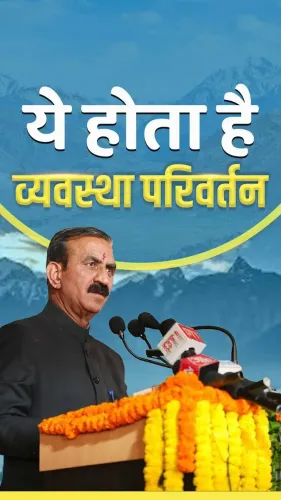
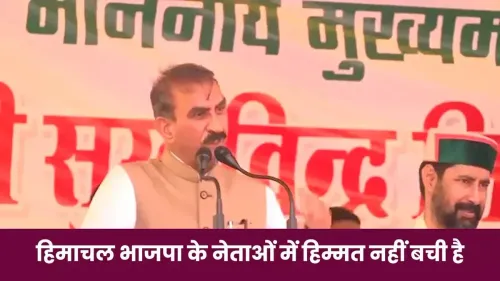
CM Sukhu Slams HP BJP Over Forest Land, MGNREGA, Disaster Aid
Synopsis
Chief Minister Sukhvinder Singh Sukhu challenged Himachal Pradesh's BJP on 24 May 2026, accusing it of failing to raise forest-land rights, MGNREGA entitlements, and a ₹1,500-crore disaster-relief package, while highlighting his government's OPS restoration and welfare record as reasons voters favour Congress.
Key Takeaways
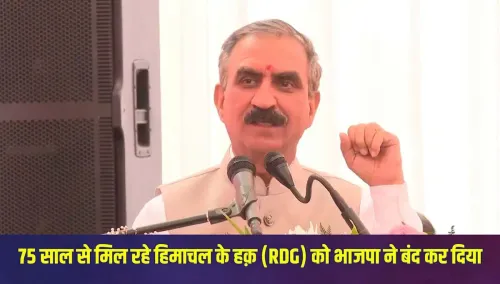
CM Sukhu publicly questioned why Himachal voters should support the BJP, citing its silence on forest-land rights (one bigha) , MGNREGA , and the RDG scheme.
He alleged the state BJP failed to advocate for a ₹1,500-crore disaster-relief package announced by the Prime Minister for disaster-affected families.
The Old Pension Scheme (OPS) was restored in the Congress government's first cabinet meeting in December 2022 , benefiting state government employees.
Sukhu cited progress in education, health, and farmer welfare as evidence of a 'working government.' The statement is part of a broader Congress strategy to frame governance delivery as an electoral contrast ahead of Himachal Pradesh assembly elections due by late 2027 .
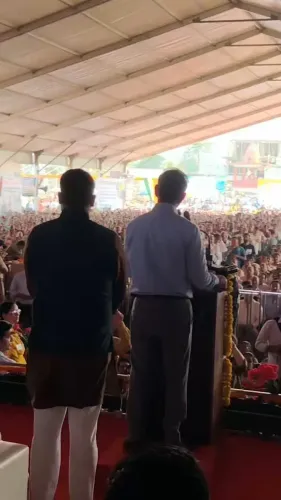
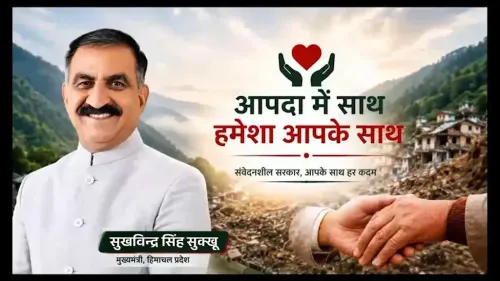
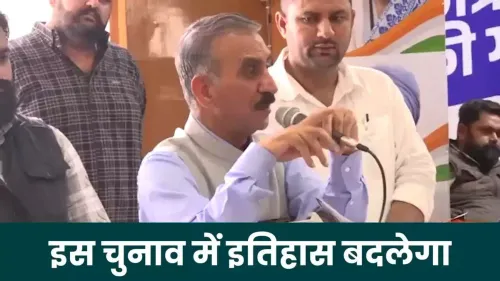
Himachal Pradesh Chief Minister Sukhvinder Singh Sukhu on Sunday, 24 May 2026, publicly challenged the state's Bharatiya Janata Party leadership, accusing its legislators of failing to raise critical issues — including forest-land rights, MGNREGA entitlements, and a ₹1,500-crore disaster-relief package — on behalf of the people of Himachal Pradesh.
Context
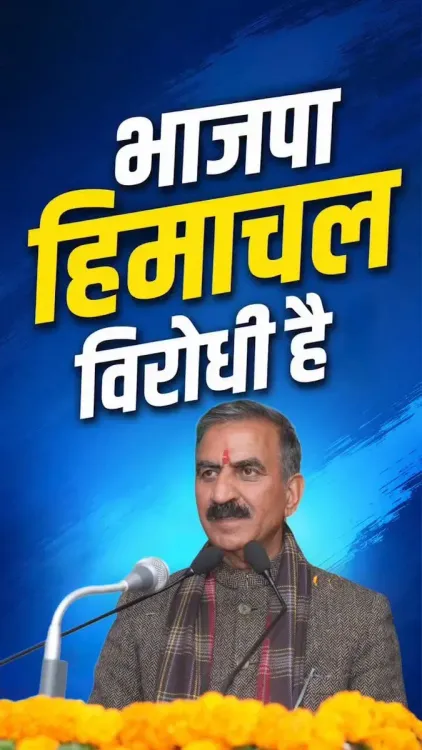
Posting in Hindi on X, CM Sukhu posed a pointed rhetorical question: 'ऐसे में हिमाचल के लोग भाजपा को वोट क्यों दें?' ('In such a situation, why should the people of Himachal vote for the BJP?'). He listed three specific grievances — the right to one bigha of forest land, rural employment under MGNREGA, and the RDG scheme — as issues on which BJP leaders in the state had stayed silent. The post also references a ₹1,500-crore disaster-relief package announced by the Prime Minister for disaster-affected families, which Sukhu alleged the state BJP failed to pursue effectively.
The statement comes as the Indian National Congress government in Shimla looks to sharpen its electoral contrast with the BJP ahead of the next assembly cycle. Himachal Pradesh has historically alternated between Congress and BJP governments every five years, making the incumbent party's record a constant subject of political scrutiny.
Policy Backdrop
Sukhu's post draws a direct line between his government's governance record and voter preference. He highlighted the restoration of the Old Pension Scheme (OPS) — a defined-benefit pension system abolished nationally in 2004 — as a landmark decision taken in the Congress government's very first cabinet meeting after assuming office in December 2022. The move was widely seen as a significant commitment to state government employees.
The OPS restoration has emerged as a signature welfare differentiator for Congress-ruled states since 2022. MGNREGA, which guarantees 100 days of wage employment annually to rural households, and forest-land rights for tribal and rural communities are perennial pressure points in hill-state politics, where livelihoods depend heavily on state and central welfare delivery.
The Chief Minister also cited continued work in education, health, and farmer welfare as evidence of his government's commitment to ordinary citizens — framing these as the reasons voters are choosing the Congress.
Stakeholders and Impact
State government employees who benefit from OPS restoration, rural workers dependent on MGNREGA wages, and disaster-affected families awaiting rehabilitation funds are the three primary constituencies invoked in Sukhu's statement. Each group represents a significant vote bank in Himachal Pradesh's predominantly rural and semi-urban electorate.
The BJP, as the principal opposition in the state and the ruling party at the Centre, is placed in a dual bind by the framing: it is simultaneously accused of failing to leverage its central-government connections to deliver relief funds, and of neglecting grassroots advocacy on land and employment rights. The BJP has not yet issued a formal response to these specific charges.
What's Next
The next Himachal Pradesh assembly elections are due by late 2027, and the Congress government's ability to demonstrate tangible delivery on welfare schemes — particularly the disbursement of disaster-relief funds and resolution of forest-land claims — will be closely watched. Supplementary budget allocations and Centre-state coordination on the ₹1,500-crore relief package are expected to remain flashpoints in the coming legislative sessions. Sukhu's increasingly combative posture toward the state BJP signals that the Congress intends to make governance delivery the central plank of its re-election campaign.
Point of View
MGNREGA, disaster relief — to paint the BJP as an ineffective advocate for Himachal's citizens despite holding power at the Centre. The OPS anchor is deliberate: it remains the Congress's most tangible welfare win in the state and a direct contrast to the national government's position. This fits a broader Congress pattern in opposition-governed states of turning Centre-state coordination failures into electoral narratives. The sharper-than-usual rhetoric in May 2026 suggests the party is beginning to build its re-election case well ahead of the 2027 cycle.
NationPress
6 Oct 2026
Frequently Asked Questions
What issues did CM Sukhu raise against Himachal Pradesh BJP?
CM Sukhu accused Himachal BJP leaders of failing to raise three key issues: the right to one bigha of forest land, MGNREGA entitlements for rural workers, and a ₹1,500-crore disaster-relief package announced by the Prime Minister for disaster-affected families.
What is the Old Pension Scheme and did Himachal Pradesh restore it?
The Old Pension Scheme (OPS) is a defined-benefit pension system that was discontinued nationally in 2004. The Sukhu-led Congress government in Himachal Pradesh restored OPS in its very first cabinet meeting after taking office in December 2022.
When are the next Himachal Pradesh assembly elections?
The next Himachal Pradesh assembly elections are due by late 2027. The state has historically alternated between Congress and BJP governments every five years.
What is MGNREGA and why is it relevant to Himachal Pradesh?
MGNREGA, the Mahatma Gandhi National Rural Employment Guarantee Act, guarantees 100 days of wage employment per year to rural households. It is a critical livelihood support in Himachal Pradesh's largely rural economy, and CM Sukhu alleged the state BJP did not effectively advocate for workers' entitlements under the scheme.
Why is CM Sukhu questioning BJP's role in the ₹1,500-crore disaster relief?
Sukhu alleged that despite the Prime Minister announcing a ₹1,500-crore package for disaster-affected families in Himachal Pradesh, the state BJP leadership did not actively push for its implementation or disbursement, leaving vulnerable families without adequate support.