HP CM Sukhu: Post-Retirement Security Trumps Poll Results

Synopsis
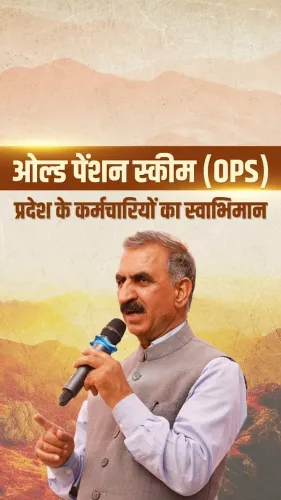
Chief Minister Sukhvinder Singh Sukhu of Himachal Pradesh has stated that providing post-retirement social security to government employees is far more important than electoral results, reaffirming his government's March 2023 restoration of the Old Pension Scheme for state civil servants.
Key Takeaways
CM Thakur Sukhvinder Singh Sukhu stated on 24 October 2026 that post-retirement social security for government employees ranks above electoral considerations.
The Himachal Pradesh government formally notified the restoration of the Old Pension Scheme (OPS) in March 2023 for employees appointed on or after 15 May 2003 .
The OPS restoration reversed the earlier shift to the contributory New Pension Scheme (NPS) , which tied retirement income to market-linked returns.
Several Congress-governed states after 2022 have moved similarly, framing defined-benefit pensions as a long-standing employee demand.
The funding sustainability of the OPS commitment remains a subject of ongoing scrutiny in state finance policy debates.
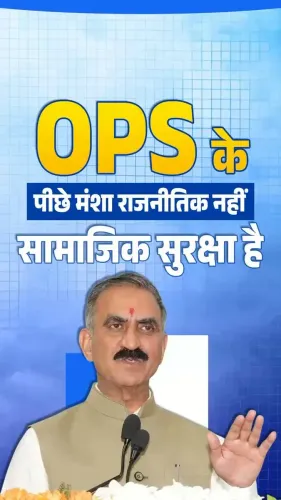
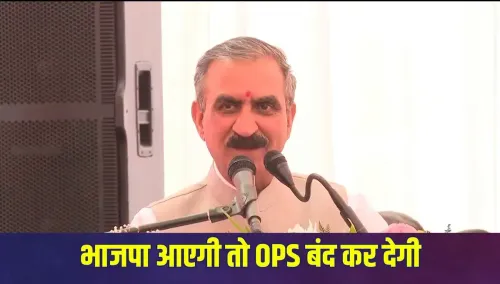
Social security for retiring government employees matters more than electoral outcomes — that is the direct, unambiguous declaration Chief Minister Thakur Sukhvinder Singh Sukhu of Himachal Pradesh placed on record on Saturday, 24 October 2026, in a pointed post from the Chief Minister's Office of Himachal Pradesh on X.
In his own words: 'सरकारी सेवा में अपने जीवन का बहुमूल्य समय देने वाले कर्मचारियों को सेवानिवृत्ति के बाद सामाजिक सुरक्षा देना हमारे लिए चुनावी नतीजों से कहीं अधिक महत्वपूर्ण है' — 'Providing social security after retirement to employees who have devoted the most valuable years of their lives to government service is far more important to us than electoral results.' The statement is pointed. It does not describe a new scheme. It frames a governing priority.The Old Pension Commitment That Started It
The statement draws its weight from a concrete decision already made. In March 2023, the Sukhu government formally notified the restoration of the Old Pension Scheme (OPS) for state government employees appointed on or after 15 May 2003 — the cohort that had been absorbed into the contributory New Pension Scheme (NPS) under a previous policy shift. With that notification, defined-benefit, government-guaranteed pensions were reinstated for a significant section of Himachal Pradesh's civil service.
The NPS, introduced nationally in the early 2000s, tied retirement income to market-linked returns — a shift that state employee unions had resisted for two decades, arguing it transferred investment risk onto workers who had served under an expectation of guaranteed post-retirement income. The OPS restoration directly answered that grievance.
A Congress-State Pattern, Stated as Principle
Himachal Pradesh's move was not isolated. After the 2022 assembly election cycle, several Congress-governed states moved to reinstate defined-benefit pension arrangements for government staff, consistently citing long-standing employee demands and the argument that stable retirement income underpins public service dignity. What makes the CM's October 2026 remark notable is its register: rather than announcing a fresh measure, CM Sukhu is articulating OPS-style welfare as a value — one that ranks above short-term political calculus.
That framing matters. It signals the government's intent to defend the fiscal commitment even as questions about the long-term funding sustainability of defined-benefit pensions remain a live debate in state finance circles across India.
Retired civil servants who spent careers in Himachal Pradesh's departments — from revenue to forest to health — are the human face of this declaration. For them, the difference between OPS and NPS is not abstract: it is whether their monthly income after service is fixed or fluctuates with equity markets. Sukhu's statement says the state has chosen the former, and has no intention of reversing course regardless of what the ballot box delivers next.
Whether the state budget documents and finance department orders can sustain that promise over the long arc of fiscal cycles is the question worth watching.
Point of View
He is trying to insulate the policy from the charge that it was merely a pre-election promise that could be walked back. It fits a broader Congress strategy of using OPS restoration as a durable governance identity marker in states where public-sector employment is socially and politically significant. The harder long-term question the statement sidesteps is fiscal — defined-benefit pension liabilities compound over decades, and state finance departments will eventually have to reconcile the commitment with budget arithmetic. For now, the political signal is clear: Sukhu is betting that being seen as a protector of government workers' dignity is worth the fiscal risk.
NationPress
24 Oct 2026
Frequently Asked Questions
What is the Old Pension Scheme in Himachal Pradesh?
The Old Pension Scheme (OPS) in Himachal Pradesh provides a guaranteed, defined-benefit pension to retired government employees. The Sukhu government restored OPS in March 2023 for employees appointed on or after 15 May 2003, reversing their enrolment in the contributory New Pension Scheme.
Why did CM Sukhu make a statement about post-retirement social security?
CM Sukhu stated that providing social security to retired government employees is more important than electoral outcomes, framing the OPS restoration as a principled governance commitment rather than a vote-seeking measure.
What is the difference between the Old Pension Scheme and the New Pension Scheme?
The Old Pension Scheme guarantees a fixed monthly pension funded by the government, while the New Pension Scheme is contributory and market-linked, meaning the retirement income depends on investment returns and is not guaranteed.
Which other states have restored the Old Pension Scheme?
Several Congress-governed states after the 2022 election cycle moved to reinstate defined-benefit pension arrangements for government employees, citing long-standing staff demands and the principle of stable post-retirement income.
What are the concerns about restoring the Old Pension Scheme?
Economists and state finance departments have raised concerns about the long-term fiscal burden of defined-benefit pensions, as the liabilities accumulate over decades and require sustained government funding without market-linked offsets.