Why Did the Supreme Court Overturn the Bombay HC's Decision to Jail a Housing Society Director?
Synopsis
In a significant ruling, the Supreme Court has reversed the Bombay High Court's decision to imprison a housing society director for one week due to her claims involving a 'dog feeders' mafia. The apex court highlighted the importance of sincere apologies in contempt cases, showcasing a crucial balance between judicial authority and individual accountability.
Key Takeaways
The Supreme Court emphasized the importance of sincere apologies in contempt cases.
The decision highlights the balance between judicial authority and individual accountability.
The ruling could influence future interpretations of contempt laws.
Judicial magnanimity is encouraged when genuine remorse is shown.
The case underscores the need for careful consideration of evidence in contempt proceedings.
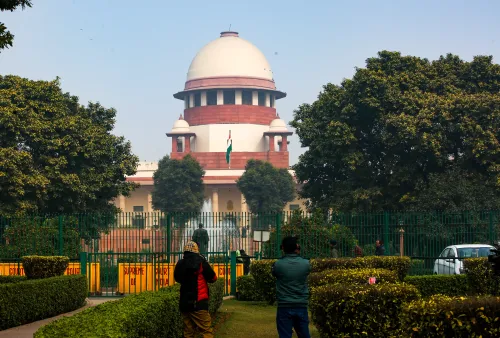
New Delhi, Dec 10 (NationPress) The Supreme Court on Wednesday overturned a ruling from the Bombay High Court that had sentenced a former housing society director to a week's simple imprisonment for criminal contempt. This ruling came after she released a circular claiming that a 'dog feeders' mafia' received backing from members of the higher judiciary.
A Bench of Justices Vikram Nath and Sandeep Mehta granted the appeal made by Vineeta Srinandan, asserting that the Bombay High Court did not appropriately apply its contempt powers when the accused offered an unconditional apology at the outset.
The Bombay High Court found the appellant-contemnor guilty under Section 2(c) of the Contempt of Courts Act for a circular issued on January 29, 2025, while serving as the Cultural Director of Seawoods Estates Ltd. This circular alleged that judges were ignoring incidents of stray dog attacks and hinted at a 'significant dog mafia' in the country, which purportedly had a list of judges in the High Court and Supreme Court sympathetic to dog feeders.
While the Supreme Court acknowledged that the circular indeed met the criteria for criminal contempt, it deemed the custodial sentence imposed by the Bombay High Court inappropriate given the contemnor's immediate and sincere apology.
Justice Vikram Nath stated, 'Once the appellant-contemnor expressed regret and offered an unconditional apology from the very first day of her appearance in the suo motu proceedings, the High Court should have assessed whether this apology met the statutory requirements under Section 12 of the Contempt Act.'
'The legal framework is evident; once remorse is shown, the Court should act generously. However, the apology must be genuine and align with the judicial conscience of the Court,' emphasized the apex court, noting that an apology should not be dismissed solely because it appears conditional if it is made in good faith.
Finding no evidence indicating that the appellant's apology lacked sincerity, the Supreme Court concluded that the Bombay High Court should have considered reducing the sentence.
'In our view, without any evidence suggesting that the apology was insincere, the High Court should have contemplated remitting the sentence in accordance with the law,' stated the Justice Nath-led Bench. By accepting the appeal, the Supreme Court determined that justice would be served by remitting the sentence imposed on the appellant-contemnor by the Bombay High Court.
Point of View
It is essential to recognize that this ruling reflects a nuanced understanding of judicial authority and personal accountability. The Supreme Court's decision emphasizes the need for a balanced approach to contempt cases, particularly when genuine remorse is expressed. This case serves as a pivotal moment in upholding the integrity of the judiciary while acknowledging the value of sincere apologies.
NationPress
19 Sept 2026
Frequently Asked Questions
What led to the Supreme Court's decision?
The Supreme Court overturned the Bombay High Court's decision after acknowledging the former housing society director's unconditional apology, indicating that the lower court did not exercise its contempt powers judiciously.
What was the accusation against the housing society director?
The director issued a circular claiming the existence of a 'dog feeders' mafia supported by members of the higher judiciary, which led to her being found guilty of criminal contempt.
What does the ruling imply for future contempt cases?
The Supreme Court's ruling suggests that genuine apologies should be considered in contempt cases, potentially leading to more lenient outcomes when remorse is demonstrated.