Taj Mahal political slogan row: Urs committee seeks ASI action against BJP leader
Synopsis
A BJP leader's video — reportedly filmed inside the Taj Mahal while raising the political slogan 'Radhe-Radhe Kamal Khila De' — has triggered a formal demand for ASI action. The Urs Committee chairman warned the UNESCO World Heritage Site cannot become a political battleground, citing a Supreme Court bar on campaigning at the monument.
Key Takeaways
A BJP leader allegedly filmed a video inside the Taj Mahal premises on 19 November 2026 , raising the slogan 'Radhe-Radhe Kamal Khila De' and chanting 'Jai Shri Ram' .
Tahiruddin Tahir , Chairman of the Khuddam-e-Roza Taj Mahal Urs Committee , has demanded strict action from the Archaeological Survey of India (ASI) .
Political slogans, banners, and promotional activities are prohibited inside the centrally protected monument under existing law.
A Supreme Court order reportedly bans political campaigning at the Taj Mahal .
The incident coincided with the announcement of free entry to Agra 's centrally protected monuments during World Heritage Week .
The ASI had not issued a formal public response as of 19 November 2026 .
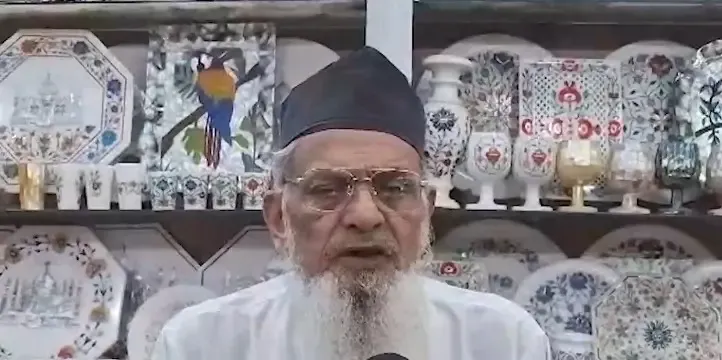
A fresh controversy has erupted at the Taj Mahal in Agra after a Bharatiya Janata Party (BJP) leader allegedly filmed himself inside the monument's premises while raising the political slogan 'Radhe-Radhe Kamal Khila De' and chanting 'Jai Shri Ram'. The incident has drawn sharp objections from the Khuddam-e-Roza Taj Mahal Urs Committee, whose Chairman, Tahiruddin Tahir, has demanded immediate action from the Archaeological Survey of India (ASI).
What Allegedly Happened
According to reports, the BJP leader recorded the video inside the Taj Mahal compound and subsequently shared it on social media, where it triggered widespread criticism. The slogan 'Radhe-Radhe Kamal Khila De' is widely interpreted as a political reference to the lotus — the official election symbol of the BJP. The incident reportedly surfaced around the time authorities announced free entry to all centrally protected monuments in Agra during World Heritage Week.
Urs Committee's Objections
Tahiruddin Tahir described the alleged activity as flatly illegal, citing rules that explicitly prohibit political slogans, banners, and promotional activities inside the centrally protected monument. 'This is illegal. The Taj Mahal is a monument protected by the Central Government, and the rules here prohibit anyone from raising any kind of political slogan, putting up banners or engaging in any kind of publicity. Today, the slogan 'Radhe-Radhe Kamal Khila De' was promoted. This is a political slogan. The government should take action in this matter. The Archaeological Survey of India (ASI), in particular, should take action,' he said.
Tahir warned that allowing such conduct to pass without consequences could effectively convert the iconic monument into a political arena. 'Taj Mahal can't be converted into a political arena. Today they are sloganeering about the blooming of the lotus. Tomorrow they might say, 'Radhe Radhe Cycle Chala De' (referring to the Samajwadi Party's election symbol), or ask people to stamp the Hand (the Congress election symbol),' he added.
Legal and Regulatory Framework
The Taj Mahal, a UNESCO World Heritage Site, is governed by strict regulations under the ASI and the Ancient Monuments and Archaeological Sites and Remains Act. Political campaigning at the monument is also reportedly prohibited under a Supreme Court order cited in connection with this controversy. Tahir stressed that no banners may be displayed and no advertisements may be conducted within the premises under existing law.
Broader Implications
The incident highlights a recurring tension between political activity and the preservation of heritage spaces. Notably, the Taj Mahal has repeatedly found itself at the centre of political debate in recent years — from questions over its ownership narrative to access and security arrangements. Tahir urged the government and the ASI to act swiftly, cautioning that inaction would set a precedent and invite similar incidents in the future. 'Taj Mahal can't be turned into a political training ground,' he said.
As of 19 November 2026, the ASI had not issued a formal public response to the committee's demand. The matter is likely to draw further political and legal scrutiny in the coming days.
Point of View
It signals that monument rules are selectively applied, which will only invite future violations from across the political spectrum. Tahir's warning about the Samajwadi Party cycle and Congress hand symbols is a pointed reminder that once a precedent is set, it cannot be contained to one party.
NationPress
19 Nov 2026
Frequently Asked Questions
What happened at the Taj Mahal that triggered the controversy?
A BJP leader allegedly filmed himself inside the Taj Mahal premises while raising the political slogan 'Radhe-Radhe Kamal Khila De' and chanting 'Jai Shri Ram', then shared the video on social media. The incident drew objections from the Khuddam-e-Roza Taj Mahal Urs Committee, which demanded ASI action.
Are political activities legally banned inside the Taj Mahal?
Yes. The Taj Mahal is a centrally protected monument under the Archaeological Survey of India, and rules prohibit political slogans, banners, and promotional activities on its premises. A Supreme Court order cited in connection with this matter also reportedly bars political campaigning at the monument.
Who is Tahiruddin Tahir and why is he raising objections?
Tahiruddin Tahir is the Chairman of the Khuddam-e-Roza Taj Mahal Urs Committee, an organisation associated with the upkeep and sanctity of the Taj Mahal. He has formally objected to the alleged slogan-raising as a violation of monument rules and called on the ASI and the government to take strict, timely action.
What action has the ASI taken so far?
As of 19 November 2026, the ASI had not issued a formal public response to the Urs Committee's demand. The matter is expected to draw further legal and political scrutiny in the coming days.
Why did the incident occur during World Heritage Week?
The controversy reportedly surfaced after authorities announced free entry to all centrally protected monuments in Agra during World Heritage Week. Critics argue the increased footfall and public attention may have provided the backdrop for the alleged incident.