Tamil Nadu CM Vijay to launch Thaimaman Gold Ring Scheme on 28 Sep

Synopsis
Tamil Nadu CM C. Joseph Vijay is set to hand a one-gram gold ring to every baby born in a government hospital — a welfare scheme rooted in Tamil cultural tradition. With 1.28 lakh rings already procured and 107 distribution hubs readied, the 28 September launch could benefit over 4 lakh families annually.
Key Takeaways
Joseph Vijay will launch the Thaimaman Gold Ring Scheme on 28 September 2026 .
Every child born in a government hospital on or after 22 June 2026 will receive a one-gram gold ring .
1.28 lakh rings have been procured in the first phase; each carries a unique serial number in tamper-proof packaging.
107 designated hubs will distribute rings to babies born before the formal launch, each serving up to 100 children daily from 28 September .
Tamil Nadu records around 7.80 lakh births annually , with government hospitals handling approximately 4.20 lakh deliveries — 53 per cent of the total.
Eligibility requires mothers to be permanent residents of Tamil Nadu, registered on the PICME portal with an RCH identification number .
Tamil Nadu Chief Minister C. Joseph Vijay will formally launch the Thaimaman Gold Ring Scheme on 28 September 2026, under which every child born in a government hospital in the state will receive a one-gram gold ring as a mark of honour and public health encouragement. The scheme, already authorised by a government order dated 23 June 2026, covers all eligible babies born in government hospitals on or after 22 June 2026.
What the Scheme Entails
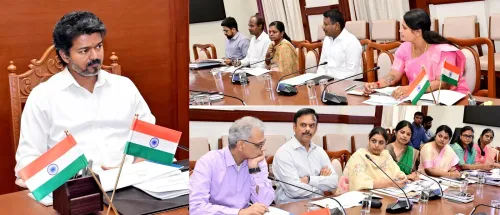
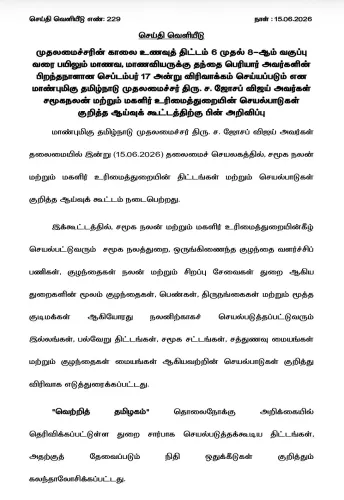
Vijay chaired a review meeting at the Secretariat on Friday to assess preparations for the launch and its statewide rollout. Under the scheme, each gold ring will carry a unique serial number and be supplied in tamper-proof packaging to ensure transparency and prevent misuse.
A total of 1.28 lakh rings have already been procured in the first phase. Mothers permanently residing in Tamil Nadu will be eligible, provided they are registered on the PICME (Pregnancy and Infant Cohort Monitoring and Evaluation) portal and hold a Reproductive and Child Health (RCH) identification number.
Distribution Arrangements
Special arrangements have been made at 107 designated hubs to distribute rings to children born between 22 June and the formal launch date. Each hub will serve up to 100 children daily from 28 September onward. Following the launch, rings will be handed directly to eligible newborns at the time of discharge from government hospitals.
Scale of Tamil Nadu's Government Healthcare System
Tamil Nadu records approximately 7.80 lakh births annually. According to the National Family Health Survey-6 (NFHS-6), nearly 99.9 per cent of deliveries in the state take place in hospitals — one of the highest institutional delivery rates in India. Government hospitals account for around 4.20 lakh deliveries, or 53 per cent of the total, with nearly 90 per cent of those conducted at Comprehensive Emergency Obstetric and Newborn Care (CEmONC) centres.
Broader Health Policy Context
The scheme is part of a wider state push to strengthen maternal and child healthcare. The government has rolled out financial assistance for pregnant women, free delivery and newborn care, emergency obstetric treatment, nutritional support, and advance planning for institutional deliveries. The PICME software is being used for integrated monitoring of pregnant women and infants across the state.
Officials say these combined efforts have contributed to measurable improvements in Tamil Nadu's maternal and child health indicators. The Thaimaman scheme, whose name references the traditional role of the maternal uncle (thaimaman) in Tamil culture, is also framed as a way to strengthen public confidence in government medical services. With the first phase covering 1.28 lakh rings against an annual government hospital delivery count of 4.20 lakh, the scheme's phased expansion will be closely watched.
Point of View
So this is less about pulling women into hospitals and more about rewarding a system that has already earned public trust. The deeper question is fiscal sustainability: at 4.20 lakh government hospital deliveries a year and gold prices at elevated levels, annual outlay will run into hundreds of crores — and must scale with gold prices. If the scheme is funded consistently, it sets a replicable template for other states; if procurement lapses, the symbolic value curdles into disappointment. The cultural framing around the maternal uncle's role is a deft touch that makes the welfare transfer feel like a rite rather than a subsidy.
NationPress
19 Sept 2026
Frequently Asked Questions
What is the Thaimaman Gold Ring Scheme in Tamil Nadu?
The Thaimaman Gold Ring Scheme is a Tamil Nadu government welfare initiative under which every child born in a government hospital receives a one-gram gold ring. The scheme was authorised by a government order on 23 June 2026 and will be formally launched by Chief Minister C. Joseph Vijay on 28 September 2026.
Who is eligible for the Thaimaman Gold Ring Scheme?
All babies born in Tamil Nadu government hospitals on or after 22 June 2026 are eligible. Their mothers must be permanent residents of Tamil Nadu, registered on the PICME portal, and possess a Reproductive and Child Health (RCH) identification number.
How will the gold rings be distributed?
From 28 September 2026, rings will be handed to eligible newborns at discharge from government hospitals. For babies born between 22 June and the launch date, 107 designated hubs have been set up across the state, each distributing rings to up to 100 children per day.
How many gold rings has the Tamil Nadu government procured?
The government has procured 1.28 lakh gold rings in the first phase. Each ring carries a unique serial number and comes in tamper-proof packaging. Tamil Nadu government hospitals handle around 4.20 lakh deliveries annually, so further procurement phases are expected.
What is the significance of the name 'Thaimaman'?
'Thaimaman' means maternal uncle in Tamil, a figure who traditionally plays a ceremonial and protective role at the time of a child's birth in Tamil culture. The name frames the government's welfare transfer as a cultural honour rather than a routine subsidy, reinforcing public trust in government healthcare services.