Has Taslima Nasreen's Exile Fortified Communal Forces in Bangladesh?

Synopsis
Taslima Nasreen, the exiled author, reflects on the alarming rise of fundamentalism in Bangladesh since her departure over three decades ago. In an exclusive interview, she discusses her experiences, the struggle for secularism, and hopes for a better future for her homeland.
Key Takeaways
Taslima Nasreen has been in exile since 1994 due to her writings.
Her novel 'Lajja' sparked significant controversy and backlash.
She advocates for secularism and women's rights.
Nasreen observes a rise in religious intolerance in Bangladesh.
She hopes for a political shift towards secular leadership.
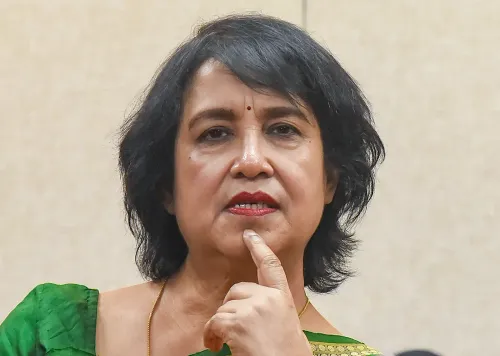
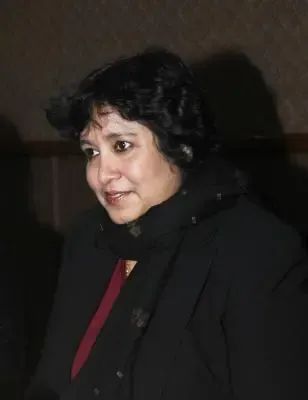
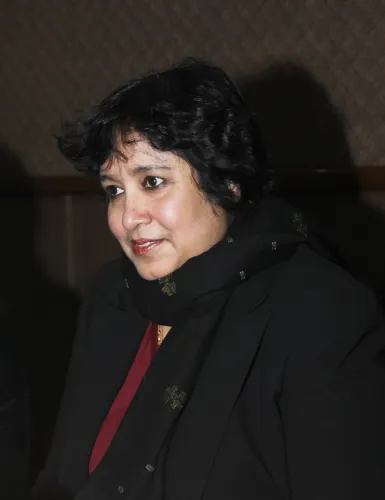
New Delhi, Jan 5 (NationPress) The renowned author Taslima Nasreen, currently in exile, observes that the prevailing circumstances in her homeland, Bangladesh, have deteriorated over time, even more so than when she was compelled to leave more than thirty years ago.
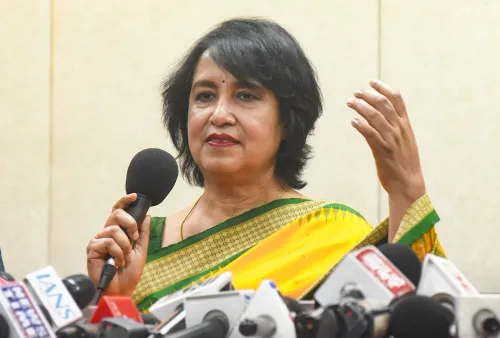
“That period marked the onset of the rise of religious fundamentalism in the nation; today, Bangladesh is teeming with such sentiments,” Taslima remarked during an exclusive interview with IANS.
“The government at that time catered to fundamentalist groups, and I was unjustly punished. Their demands were acquiesced to, which emboldened the bigots, leading to the widespread religious intolerance we witness today,” she asserted.
She emphasized the struggle between freedom of expression and religious fundamentalism, where she stands as a symbol of secular resistance, championing women's rights and the liberty of thought despite her prolonged exile.
Taslima pursued a medical career but was drawn to literature, eventually writing novels and poetry. In 1994, she was exiled after her book Lajja (Shame) angered Islamist factions, who accused her of “offending religious sentiments.”
Published in 1993, Lajja portrayed the persecution of Hindus in Bangladesh following the Babri Masjid demolition in India. The government banned the novel for supposedly inciting communal discord. She received death threats, faced violent demonstrations, and was issued an arrest warrant.
To prevent escalating unrest, the government of then-Prime Minister Khaleda Zia expelled her. Since then, Taslima has lived in exile—first in Sweden and later in India—where she continues her advocacy for secularism, feminism, and freedom of expression.
She holds Swedish citizenship but currently resides in India on a renewable visa.
Initially, she tried to settle in Kolkata, but violent protests forced her to leave West Bengal in 2007. After a brief period of instability, she has been living in Delhi, under government protection.
On various occasions, she has acknowledged the Indian government’s role in allowing her to live in a country where she can express herself freely, somewhat reminiscent of her past.
Despite the challenges, her works have been translated into multiple languages and continue to resonate globally.
Taslima pointed out that successive Bangladeshi governments have quietly witnessed the rise of fundamentalist elements, providing radicalism an unchallenged platform to spread.
“When I was forced to leave Bangladesh, it foreshadowed what was to come for the nation,” she reflected, asserting that successive administrations have exploited religion to strengthen their power.
She mentioned that even madrasa education was recognized as equivalent to a university degree.
“All these policies have led to this state of affairs. The country is facing the consequences of what its political leaders have sown over the years,” Taslima added.
What does she foresee for Bangladesh and its citizens? “I hope that those who support and believe in the ’muktiyddha’ (Bangladesh's 1971 liberation war) will come to power in the upcoming (February 12) general elections,” she replied.
“Regrettably, those promoting religious fundamentalism in Bangladesh are aware that such bigotry is detrimental to the nation, yet they persist for their own selfish motives,” Taslima remarked.
“Even the previous administration engaged in religious appeasement and backed communal forces. Sheikh Hasina was also overthrown because fundamentalists opposed a woman holding power for an extended period,” she added.
Taslima advocates for an end to dynasty politics in Bangladesh, suggesting that familial ties lead politicians to prioritize heirs over the nation.
Nonetheless, she noted, “People are discussing a potential victory for the Bangladesh Nationalist Party (BNP). They support the muktiyddha, so if they focus on the country’s progress, freedom of speech, and women's equality, they may succeed.”
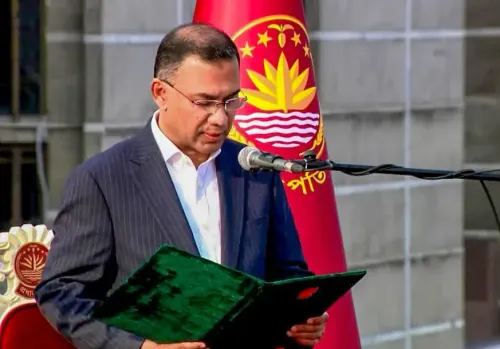
Taslima is also optimistic about Tarique Rahman, the son of the late Khaleda Zia, who recently returned to Dhaka after a 17-year exile in the UK.
“His prolonged exposure to Western culture may have instilled progressive ideals in him, potentially leading to a better Bangladesh. However, if he continues in the footsteps of his predecessors, I see little hope,” she opined.
Will she ever be able to return? Taslima Nasreen did not venture a guess.
Point of View
We stand firmly with Taslima Nasreen's fight for freedom of speech and secularism. Her experiences highlight the ongoing struggle against religious intolerance, and we believe it is imperative to support voices like hers in the pursuit of a more just society.
NationPress
24 Oct 2026
Frequently Asked Questions
What led to Taslima Nasreen's exile?
Taslima Nasreen was forced into exile in 1994 due to backlash from Islamist groups over her novel 'Lajja', which depicted the persecution of Hindus in Bangladesh.
What is the main theme of 'Lajja'?
'Lajja' addresses the suffering of Hindus in Bangladesh following the Babri Masjid demolition in India, illustrating the communal tensions in the country.
How does Taslima view the current political situation in Bangladesh?
Taslima believes that the political landscape in Bangladesh has been increasingly influenced by religious fundamentalism, which poses a threat to secular values.
What are Taslima's hopes for the future of Bangladesh?
Taslima hopes for the emergence of leadership that supports the principles of the 'muktiyddha' and prioritizes freedom of speech and women's rights.
Has Taslima's work been recognized internationally?
Yes, Taslima's writings have been translated into multiple languages and continue to resonate with audiences around the globe.