Why Did Trump Declare an Emergency to Protect Venezuelan Oil Funds?
Synopsis
In a significant move, President Trump has declared a national emergency to prevent the seizure of Venezuelan assets in the U.S. This decision aims to safeguard crucial oil-related revenues that are pivotal for U.S. national security and foreign policy in the region. Discover the implications of this order and its potential impact on U.S.-Venezuelan relations.
Key Takeaways
Trump's declaration aims to block judicial seizures of Venezuelan funds.
Funds are crucial for U.S. foreign policy and national security.
The executive order prohibits legal actions against these funds.
Venezuelan assets are considered sovereign property under U.S. law.
Future regulations will govern the use of these funds.
Washington, Jan 11 (NationPress) President Donald Trump has announced a national emergency aimed at preventing courts and creditors from seizing Venezuelan government assets that are held within the United States.
This measure is crucial for safeguarding oil-related income, which plays a vital role in the national security and foreign policy goals of the United States in the Western Hemisphere.
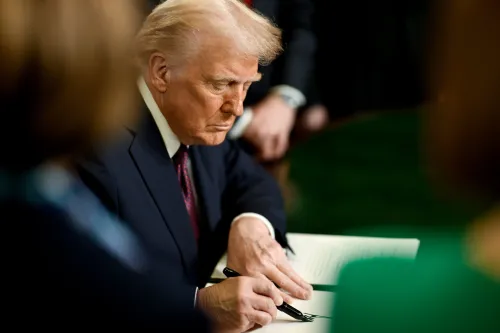
In an executive order signed on Friday and made public on Saturday, Trump stated that the "threat of attachment or the imposition of other judicial processes" against Venezuelan government funds would "materially harm the national security and foreign policy of the United States".
He cautioned that such actions could disrupt U.S. efforts to foster "economic and political stability in Venezuela", emphasizing that failure to do so could jeopardize significant U.S. objectives, including "curbing the perilous influx of illegal immigrants and the surge of illicit narcotics", countering "malign entities such as Iran and Hezbollah", and fostering "peace, prosperity, and stability for the Venezuelan populace and the broader Western Hemisphere".
The executive order prohibits any form of attachment, judgment, lien, garnishment, or other judicial actions against what it categorizes as "Foreign Government Deposit Funds", unless specifically licensed or authorized by the administration.
Any legal action of this nature, as outlined in the order, "is prohibited and shall be regarded as null and void."
The funds in question include payments made to or retained by the U.S. government in designated Treasury accounts for the Venezuelan government or its agencies, such as the Central Bank of Venezuela and the state oil firm Petroleos de Venezuela, S.A.
The order emphasizes that these funds originate from the sale of natural resources or diluents sold to the Venezuelan government.
Trump remarked that the funds "represent an unusual and extraordinary threat to the national security and foreign policy of the United States" if subjected to judicial seizure, thereby formally declaring a national emergency under U.S. emergency powers law.
The executive order clarifies that these funds are regarded as sovereign property of Venezuela, not assets of private entities or judgment creditors.
It also asserts that the U.S. government holds these funds "solely in a custodial and governmental capacity, and not as a market participant".
The order restricts the transfer, export, withdrawal, or any other use of the funds, except as allowed by future regulations or licenses issued by the administration.
Additionally, it states that the funds "have not been, and shall not be, utilized for any commercial activities within the United States".
According to the order, these funds will be retained pending "sovereign disposition for public, governmental, or diplomatic purposes" to be determined by U.S. Secretary of State Marco Rubio on behalf of the Venezuelan government.
Trump instructed the Treasury Department to categorize the funds in a manner that clearly indicates their status as Venezuelan sovereign property held in U.S. custody.
The Treasury is also directed to adhere to disbursement or transfer instructions set by the U.S. Secretary of State and to consult with Attorney General Pam Bondi and Energy Secretary Chris Wright.
The order empowers the Treasury and Justice Departments to assert sovereign immunity on behalf of the funds in any legal or administrative proceedings, in accordance with U.S. law.
Furthermore, it states that placing the funds in U.S. Treasury accounts does not amount to a waiver of Venezuela's sovereign immunity or consent to U.S. court jurisdiction for enforcing private claims.
Trump emphasized that any legal actions against these funds would disrupt U.S. foreign relations and undermine the principles of international comity.
Point of View
It's imperative to acknowledge the complexities surrounding this national emergency declaration. While the intention is to protect U.S. interests and promote stability in Venezuela, the implications for international relations and the Venezuelan populace must be carefully considered. The balance between national security and humanitarian concerns remains a pivotal factor in shaping U.S. foreign policy.
NationPress
21 Sept 2026
Frequently Asked Questions
What prompted Trump to declare a national emergency?
President Trump declared a national emergency to prevent the seizure of Venezuelan government funds held in the U.S., which he deemed crucial for national security and foreign policy.
How does this affect U.S.-Venezuelan relations?
This declaration may further complicate U.S.-Venezuelan relations, potentially increasing tensions while aiming to safeguard interests and promote stability in the region.
What are the implications for Venezuelan assets in the U.S.?
The executive order prohibits any judicial actions against Venezuelan assets, safeguarding them from being seized unless specifically authorized by the U.S. government.
What role does the Treasury Department play in this situation?
The Treasury Department is tasked with categorizing the funds and adhering to instructions regarding their disposition, ensuring they remain protected under U.S. custody.
What are the long-term goals of this emergency declaration?
The long-term goals include promoting economic and political stability in Venezuela while countering illicit activities and safeguarding U.S. national interests in the hemisphere.