Tejashwi Questions Bihar's Rs 22,500 Cr Nuclear MoU With Rs 11-Lakh Firm
Synopsis
RJD leader Tejashwi Yadav has alleged that a company incorporated just five months ago with Rs 11 lakh in capital signed a Rs 22,500 crore nuclear-sector MoU with the Bihar government, calling it a pattern of fake investment announcements and demanding a progress report on earlier MoUs worth over Rs 2 lakh crore.
Key Takeaways
Tejashwi Yadav alleges the Bihar government signed a Rs 22,500 crore nuclear-sector MoU with a company incorporated on February 25, 2026 — just five months before the signing.
The company in question reportedly has a total paid-up capital of only Rs 11 lakh , according to Yadav's post.
Bihar's latest investment drive claims MoUs worth approximately Rs 51,500 crore across various sectors.
Yadav is demanding a progress report on MoUs from 2024 and 2025 that he says exceeded Rs 2 lakh crore in announced value.
He raised concerns that paper companies may be used to acquire state land and subsidies before disappearing, and questioned the absence of due-diligence checks at the signing ceremony.
Yadav said genuine companies bringing their own capital to Bihar would receive full support, but the paper-company route would not be tolerated by Bihar's people.
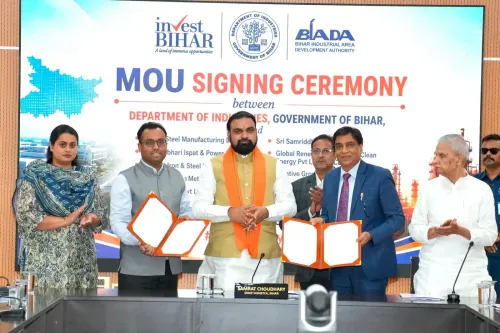
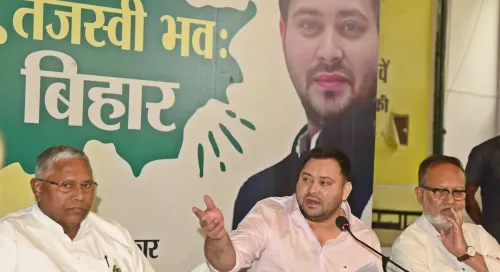
A company founded just five months ago, with a total paid-up capital of Rs 11 lakh, has signed a Rs 22,500 crore MoU with the Bihar government to invest in the nuclear energy sector — and RJD leader Tejashwi Yadav wants to know how that is even possible. On Friday, August 14, 2026, Yadav tore into the NDA-led Bihar government over what he called a pattern of inflated, unverifiable investment announcements designed to generate headlines rather than jobs.
A Rs 11-Lakh Company, a Rs 22,500-Crore Nuclear Promise
At the centre of Yadav's broadside is a company he says was incorporated as recently as February 25, 2026 — barely five months before signing what the Bihar government is trumpeting as the single largest MoU at its latest investment drive, worth Rs 22,500 crore in the nuclear sector. The firm's entire declared capital, he says, stands at just Rs 11 lakh. Yadav's framing was blunt: 'jis company ke paas ek makaan ki chaar deewaari karne ki poonji nahin' — a company that cannot afford to build the four walls of a single house is being presented as a future builder of nuclear power plants or research centres in Bihar.
The Bihar government has been publicising what it describes as MoUs worth approximately Rs 51,500 crore signed between its industry department and various industrial groups. Yadav's challenge is pointed — if this round of announcements is credible, why has the government not released a progress report on earlier MoUs from 2024 and 2025 that he says collectively crossed the Rs 2 lakh crore mark? 'What happened to those MoUs?' he asked pointedly.
Shell-Company Alarm and the Land-Subsidy Question
Yadav's critique goes beyond embarrassment over a single undercapitalised firm. He raised a sharper structural concern: that paper companies are being used as vehicles to acquire subsidised state land and government grants, only to disappear once the assets are secured. His words were direct — if a company takes land at Re 1, builds assets using state subsidies, pockets the grant, and vanishes, the people of Bihar will not tolerate it.
He also questioned how the signing ceremony proceeded without a single official, minister, or bureaucrat in attendance raising due-diligence questions about the nuclear-sector firm. 'Was fooling the people of Bihar everyone's collective goal?' he asked. The implicit allegation — that silence in the room may have been deliberate, anticipating future commission income from land and subsidy allocation — is one the government has not yet publicly addressed.
Two Decades of NDA Rule, and No Large Investor Convinced
Bihar has been governed by NDA alliances for more than twenty years. Yadav's argument is that this tenure is itself the indictment: despite two decades in power, the state has been unable to build the infrastructure confidence or institutional credibility needed to attract established large-scale investors. 'No big company is willing to make a big investment in Bihar — why?' he asked, and answered his own question: the government substitutes media-driven self-promotion for ground-level reform, and relies on caste-religion polarisation, 5 kg free grain, and Rs 10,000 election-eve cash distribution to sustain itself politically.
Yadav was careful to draw a line between legitimate investment and what he is alleging here. Genuine companies that bring their own capital to Bihar, set up real industry, and create employment, he said, would receive not just a welcome but 'every possible help' from his party. The target of his attack is specifically the paper-company route — firms with no capital, no track record, and no plausible path to execution.
What the Bihar Government Must Now Answer
The pressure points Yadav has laid out are concrete enough to demand a factual response. The government needs to explain: the incorporation date and capital base of the nuclear-sector MoU signatory; the implementation status of MoUs announced in 2024 and 2025; and whether any due-diligence protocols exist before a company can sign a multi-thousand-crore commitment with a state ministry. Until those answers arrive, the optics of a Rs 11-lakh company promising a Rs 22,500-crore nuclear facility will continue to define this story.
Bihar's investment credibility is not a small-stakes question. If the pattern Yadav describes — MoU announcements followed by silence, shell firms followed by subsidy grabs — is allowed to stand unchallenged, it poisons the well for every legitimate investor considering the state. The government's next move is not optional; it is overdue.
Point of View
Making this a recurring credibility test for NDA governments in the state. The nuclear-sector angle sharpens the attack considerably: nuclear investment in India is tightly regulated, and a newly incorporated, minimally capitalised company signing such an agreement raises legitimate due-diligence questions that go beyond political point-scoring. If the Bihar government cannot produce incorporation and capital data for the signatory firm, or a conversion scorecard for prior MoUs, the opposition's 'paper company' narrative will be difficult to dislodge ahead of the next electoral cycle.
NationPress
14 Aug 2026
Frequently Asked Questions
What is the Bihar nuclear sector MoU controversy about?
RJD leader Tejashwi Yadav has alleged that the Bihar government signed a Rs 22,500 crore MoU for nuclear-sector investment with a company that was incorporated just five months ago and has a total capital of only Rs 11 lakh, calling it a fake announcement designed to mislead the public.
How much capital does the nuclear MoU company reportedly have?
According to Tejashwi Yadav's post, the company that signed the Rs 22,500 crore nuclear-sector MoU with the Bihar government has a total paid-up capital of just Rs 11 lakh and was incorporated as recently as February 25, 2026.
What is the total value of MoUs Bihar announced in its latest investment drive?
The Bihar government has claimed MoUs worth approximately Rs 51,500 crore were signed between its industry department and various industrial groups in the latest round of announcements.
What has Tejashwi Yadav demanded from the Bihar government?
Yadav has demanded a progress report on MoUs signed in 2024 and 2025, which he says collectively exceeded Rs 2 lakh crore in announced value, and asked the government to explain how the nuclear-sector firm with Rs 11 lakh in capital plans to invest Rs 22,500 crore.
How long has NDA governed Bihar?
NDA-led alliances have governed Bihar for more than twenty years. Tejashwi Yadav cited this tenure as evidence that the government has failed to build the infrastructure and institutional credibility needed to attract genuine large-scale industrial investment.