Telangana orders AC curbs in govt offices amid El Niño power crunch
Synopsis
With El Niño squeezing Telangana's power generation and demand rising, Chief Secretary Sanjay Jaju has ordered government offices to cap AC use at 25°C, directed five special officers at Yadadri plant to maximise output, and announced a Cabinet Sub-Committee meeting — all while assuring industries of uninterrupted supply.
Key Takeaways
Chief Secretary Sanjay Jaju directed all Telangana government offices on 19 October 2026 to use electricity economically amid an El Niño-driven demand-generation gap.
Air conditioners must be set to 25 degrees Celsius during daytime only; use must be significantly reduced after 6 pm .
No power cuts will be imposed on industries; agricultural and domestic supply is being maintained.
Five special officers at Yadadri Thermal Power Station have been directed to maximise electricity output.
Manjeera and Singur reservoir supplies are unavailable; 110 MGD is being supplemented via Mission Bhagiratha ( 60 MGD ), Krishna River, and other sources.
From 1 November , treated STP water will be supplied to Hyderabad construction sites via green water tankers; new borewells permitted only for drinking water.
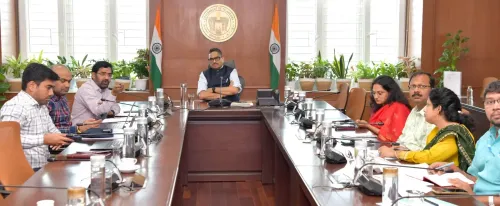
The Telangana government on Monday, 19 October 2026 directed all state government offices to reduce electricity consumption, citing a surge in power demand compounded by poor generation linked to the effects of El Niño. Chief Secretary Sanjay Jaju issued the directives following a video conference with senior officials overseeing conditions across erstwhile districts of the state.
Key Directives Issued
Chief Secretary Jaju instructed that air conditioners in government offices be operated at a temperature setting of 25 degrees Celsius and only when necessary during daytime hours. After 6 pm, their use should be significantly curtailed. Officials were also directed to take all necessary steps to ensure maximum electricity generation at all thermal power stations in the state.
A specific instruction was issued to the five special officers assigned to the Yadadri Thermal Power Station, directing them to take dedicated measures to maximise electricity production at the facility. Officials were further asked to prepare micro-level contingency plans to prevent shortages of both drinking water and electricity arising from El Niño conditions.
Power Supply Situation
Despite the generation shortfall, Jaju stated that the government was continuing to supply power for agricultural and domestic requirements. He also clarified that no power cuts were being imposed on industries in the state, assuring that industrial operations would not be disrupted.
The Chief Secretary added that an all-party meeting would be convened soon to explain the impact of El Niño, and a Cabinet Sub-Committee meeting would also be held shortly. The government, he noted, had already prepared department-wise contingency plans to address severe conditions expected from the weather phenomenon and was issuing periodic instructions.
Illegal Water Withdrawal Straining the Grid
Officials from the Energy Department flagged a contributing factor: water was reportedly being illegally drawn from local water sources for agricultural use through dedicated motor pumps. This excessive withdrawal was increasing the electrical load and causing local transformers to burn out, further straining the grid.
A special enforcement drive is currently underway in Hyderabad to identify and remove illegally installed motor pumps on municipal water taps. The operation is being conducted in coordination with HYDRA and other agencies.
Water Supply Measures and Borewell Regulations
With supplies from the Manjeera and Singur reservoirs unavailable, officials indicated that the 110 million gallons per day (MGD) normally sourced from these reservoirs is being supplemented through alternative channels — including 60 MGD from Mission Bhagiratha, along with additional supplies from the Krishna River and other sources.
Special Chief Secretary Jayesh Ranjan stated that permission to drill new borewells in Hyderabad would henceforth be granted only for drinking water purposes and in line with established regulations. No new borewells would be permitted for construction or other activities, though deepening of existing borewells solely for drinking water requirements was being allowed.
Starting 1 November, treated water from Sewerage Treatment Plants (STPs) would be supplied to construction sites in Hyderabad through green water tankers, officials announced. Meanwhile, Special Chief Secretary Vikas Raj noted that groundwater levels in Rangareddy district were declining significantly and that alternative plans were being prepared and implemented to prevent drinking water shortages in the region.
The state's multi-pronged response signals the scale of the challenge ahead, with El Niño conditions expected to persist and both power and water stress likely to intensify through the coming months.
Point of View
Meanwhile, points to a governance failure that predates El Niño: when agricultural water theft can burn out local transformers at scale, the enforcement machinery has already fallen behind the curve. An all-party meeting and a Cabinet Sub-Committee signal political seriousness, but the test will be whether micro-level contingency plans translate into ground-level action before demand peaks further.
NationPress
19 Oct 2026
Frequently Asked Questions
Why has Telangana asked government offices to reduce electricity use?
Telangana has directed government offices to cut power consumption because electricity demand in the state has risen sharply while generation has remained poor due to the impact of El Niño. Chief Secretary Sanjay Jaju issued the directives on 19 October 2026 following a review of conditions across the state.
What are the specific AC usage rules for Telangana government offices?
Air conditioners in government offices must be operated only at a temperature setting of 25 degrees Celsius and only when necessary during daytime hours. After 6 pm, their use should be significantly reduced.
Will industries in Telangana face power cuts due to El Niño?
No. Chief Secretary Jaju explicitly stated that no power cuts would be imposed on industries in Telangana, assuring industrial management that electricity supply to the sector would not be disrupted.
How is Telangana addressing the water supply gap caused by El Niño?
With supplies from the Manjeera and Singur reservoirs currently unavailable, the 110 MGD shortfall is being covered through Mission Bhagiratha (60 MGD), the Krishna River, and other alternative sources. From 1 November, treated STP water will also be supplied to construction sites in Hyderabad via green water tankers.
What is the role of Yadadri Thermal Power Station in Telangana's power crisis response?
The Yadadri Thermal Power Station is a key generation facility in Telangana, and five special officers assigned to it have been directed to take dedicated measures to maximise electricity production there. The Chief Secretary has also ordered officials to ensure maximum generation at all thermal power stations in the state.