How Will ‘Telangana Rising 2047’ Transform the State's Image?
Synopsis
Discover how the bold initiative ‘Telangana Rising 2047’ aims to reshape Telangana's image and propel it as a catalyst for India's growth by 2047, focusing on sustainable development, economic zones, and innovative urban projects.
Key Takeaways
Ambitious economic target: Telangana aims to become a 3 trillion dollar economy by 2047.
Three economic zones: CURE, PURE, and RARE are defined for structured growth.
Major infrastructure projects: Includes Gandhi Sarovar, greenfield highways, and more.
Urban governance reforms: GHMC expanded significantly for better administration.
Pollution reduction initiatives: Policies in place to encourage electric vehicle usage and relocate polluting industries.
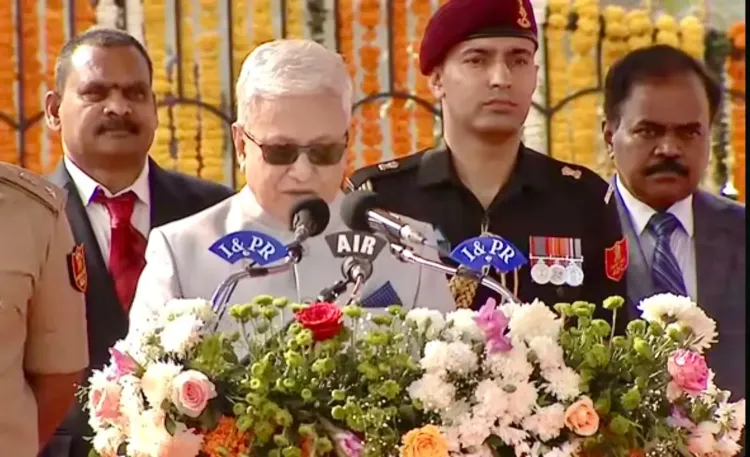
Hyderabad, Jan 26 (NationPress) The ‘Telangana Rising 2047’ vision is designed to significantly reshape Telangana's identity and establish the State as a pivotal force in India's advancement by the year 2047, as stated by Governor Jishnu Dev Varma on Monday.
During the 77th Republic Day festivities, following the raising of the national flag at the Secunderabad Parade Grounds, the Governor emphasized that the Telangana Rising Vision 2047 document, which was introduced on the occasion of the current government's two-year milestone, outlines a detailed plan for inclusive and sustainable development.
As part of the Vision 2047 strategy, Telangana has ambitious plans to evolve into a $3 trillion economy, he noted.
The Governor elaborated that the vision document categorizes the State into three specific economic zones: the Core Urban Region Economy (CURE), with Hyderabad as its growth catalyst; the Peri-Urban Region Economy (PURE), situated between the Outer Ring Road (ORR) and the Regional Ring Road (RRR) focusing on manufacturing; and the Rural Agriculture Regional Economy (RARE), extending beyond the RRR, centered around agriculture, green initiatives, and agri-business ventures.
Significant elements of Vision 2047 include the Gandhi Sarovar project at Bapu Ghat, greenfield highways, dry ports, the second phase of the Metro Rail, and radial roads connecting the ORR and RRR, along with proposed airports in Warangal and Adilabad, plus industrial corridors linking Hyderabad with Nagpur, Bengaluru, and Vijayawada.
In terms of urban governance reforms, the Governor mentioned that the Greater Hyderabad Municipal Corporation (GHMC) has been expanded by incorporating 27 municipalities within the CURE region, extending its jurisdiction from 650 sq km to 2,053 sq km. The GHMC has also undergone reorganization into 300 wards, 60 circles, and 12 zones to promote effective civic administration.
To bolster law enforcement and improve public safety, three new police commissionerates have been established in the CURE area, along with another in the proposed Future City region.
The Governor highlighted that various measures have been implemented to mitigate pollution within the core urban zone, including a 100% exemption on road tax and registration fees for electric vehicles, and the rollout of the Hyderabad Industrial Land Transformation (HILT) policy to relocate polluting industries outside the ORR while permitting landowners to diversify land usage for multi-purpose applications.
He also mentioned the Bharat Future City, envisioned as a 30,000-acre greenfield urban project aimed at creating India’s first Net Zero Smart City. Conveniently located at Mucherla and Kandukur, south of Hyderabad, between the Srisailam and Nagarjunasagar highways, the city’s master plan includes an AI City, the Young India Skills University, a Health City focusing on medical tourism, and a comprehensive sports hub. The initiative emphasizes sustainability, forest cover, and 'walk-to-work' communities, enhanced by advanced connectivity infrastructure.
The Governor further stated that the Musi Riverfront Development Corporation Limited has devised a master plan to develop a 55-km stretch of the Musi River from Osman Sagar to Gowrelli (ORR East) and from Himayath Sagar to Gandhi Sarovar at Bapu Ghat.
To enhance safety in Hyderabad, the Hyderabad Disaster Response and Assets Protection Agency (HYDRAA) has been established to tackle encroachments on water bodies and tanks.
The government also aims to upgrade 12,000 km of Roads and Buildings (R&B) roads under the Hybrid Annuity Model (HAM), with Rs 11,399 crore allocated for Phase I, set to be completed within 30 months. Additionally, 7,450 km of Panchayat Raj roads will be improved under HAM at an estimated cost of Rs 16,007 crore.
The Governor concluded by noting that Hyderabad remains a significant hub for Global Capability Centres (GCCs), hosting about 20% of such centres in India, thereby reinforcing its reputation as a premier investment destination with increasing global recognition.
Point of View
The 'Telangana Rising 2047' vision encapsulates a significant step towards inclusive growth and sustainable development. The strategic roadmap laid out by the state government not only aims to boost the economy but also addresses urban governance and environmental concerns, showcasing a holistic approach that positions Telangana as a critical player in India's progression.
NationPress
20 Sept 2026
Frequently Asked Questions
What is the main goal of 'Telangana Rising 2047'?
The primary aim is to transform Telangana's image and establish it as a key driver of India's progress by the year 2047.
What are the economic zones defined in the Vision 2047?
The Vision outlines three economic zones: the Core Urban Region Economy (CURE), Peri-Urban Region Economy (PURE), and Rural Agriculture Regional Economy (RARE).
What major projects are included in the Vision 2047?
Key projects include the Gandhi Sarovar project, greenfield highways, and the Bharat Future City, among others.
How does the government plan to address pollution in urban areas?
Initiatives such as tax exemptions for electric vehicles and the Hyderabad Industrial Land Transformation policy are in place to tackle pollution.
What is the significance of the Bharat Future City project?
Bharat Future City aims to create India's first Net Zero Smart City, focusing on sustainability and advanced urban living.