Manish Tewari: Delimitation Commission, Not Government, Determines Parliamentary Seats

Synopsis
Congress MP Manish Tewari emphasizes that the responsibility for determining the number of parliamentary seats lies with the Delimitation Commission, not the government, amidst heated discussions about the implications of delimitation for southern states.
Key Takeaways
Delimitation Commission is responsible for determining parliamentary seats.
Government's role is limited to setting upper and lower limits.
131st Constitutional Amendment Bill proposes an upper limit of 850 seats.
Article 82 (1A) emphasizes equal representation.
Concerns arise regarding the Women’s Reservation Bill and its implications.
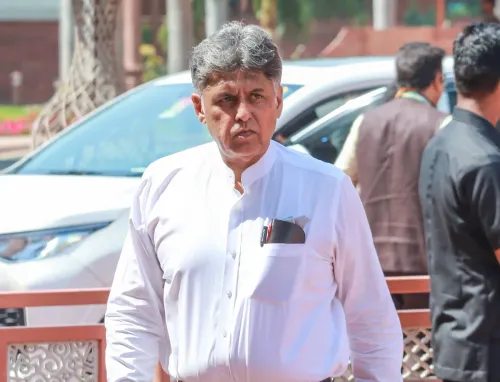
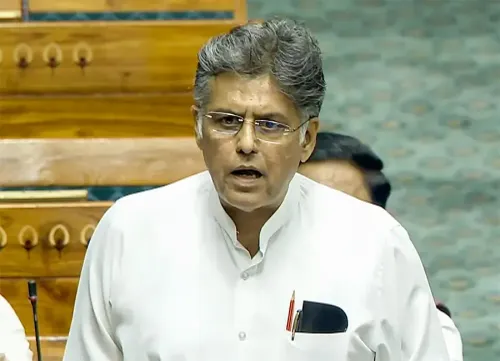
New Delhi, April 17 (NationPress) Congress MP Manish Tewari stated on Friday that the task of determining the number of parliamentary seats does not fall under the government's purview but lies with the Delimitation Commission, amidst an ongoing political discourse surrounding the planned delimitation exercise.
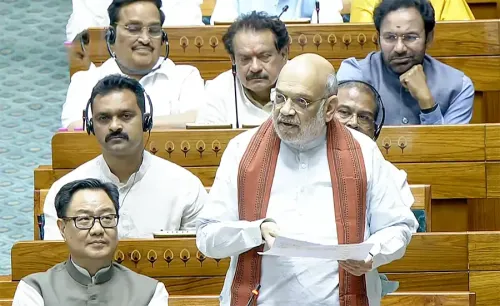
Tewari's comments followed a statement from Union Home Minister Amit Shah, who aimed to clarify apprehensions relating to delimitation and its possible repercussions on the representation of southern states in the Lok Sabha.
Shah remarked: "A narrative is being shaped and confusion is being disseminated that these three legislative measures, namely the Constitutional Amendment Bill and two other associated laws concerning delimitation and electoral procedures, will diminish the representation of southern states in the Lok Sabha and result in a significant loss for them." He provided an illustration, mentioning that Karnataka currently holds 28 seats in the Lok Sabha, representing approximately 5.15 percent of the total 543 seats. He indicated that post-delimitation, the state could see its seat allocation rise to 42.
In his response, Tewari told IANS, "First and foremost, it is not the government's role to determine the number of seats. That responsibility belongs to the Delimitation Commission. The government is only authorized to outline an upper and lower limit."
He elaborated that the proposed 131st Constitutional Amendment Bill establishes an upper limit of 850 seats.
"It is now up to the Delimitation Commission to assess, based on the 2011 census, how the population of 1.21 billion will be divided among 850 or 815 seats, determining how many will be allocated to each state. This is the underlying formula, which is not included in the bill. What the Home Minister claims is not reflected in the legislation," he stated.
Tewari further accused the government of being "economical with the truth".
"In the end, the government is being less than transparent. The essential issue pertains to Article 82 (1A) of the Constitution, which embodies the core tenet of Indian democracy: 'One Person, One Vote, One Value.' Consequently, states with higher Total Fertility Rates (TFR) will naturally secure more seats, while states that have effectively implemented population control measures may face a reduction in representation. The challenge lies in how to uphold the mandate of Article 82 (1A) while also addressing federal aspirations," he expressed.
He characterized this as the pivotal issue in the delimitation process, adding, "Regrettably, either the government does not comprehend this or deliberately chooses to ignore it for specific reasons."
Tewari also condemned the government's strategy, alleging that it is trying to "co-opt the delimitation process under the guise of the Women’s Reservation Bill," warning of potentially serious repercussions.
"They have already enacted the Women’s Reservation Bill in 2023 and are now implementing it 30 months later. This indicates their intentions. The sequence suggests that women’s reservation will coincide with delimitation, followed by constituency adjustments. That is why the Opposition is voicing concerns," he concluded.
Point of View
The debate surrounding the delimitation process highlights the complexities of balancing representation and federalism in India. Manish Tewari's assertion that the Delimitation Commission oversees seat allocation raises important questions about governmental transparency and accountability.
NationPress
22 Oct 2026
Frequently Asked Questions
What is the role of the Delimitation Commission?
The Delimitation Commission is responsible for determining the boundaries and number of parliamentary and state assembly constituencies in India, based on the latest census data.
What did Amit Shah say regarding delimitation?
Amit Shah addressed concerns that the delimitation process might reduce the representation of southern states in the Lok Sabha, claiming that it could actually increase their seats.
What is the significance of Article 82 (1A)?
Article 82 (1A) establishes the principle of 'One Person, One Vote, One Value,' influencing how parliamentary representation is allocated based on population data.
What are the implications of the Women’s Reservation Bill?
The Women’s Reservation Bill aims to reserve a certain percentage of parliamentary and state assembly seats for women, which has raised concerns about its timing and implementation alongside delimitation.
Why is there a debate over the number of parliamentary seats?
The debate centers around how demographic changes and population control measures affect the allocation of seats, potentially benefiting some states over others.