Manish Tewari demands CEC Gyanesh Kumar's resignation, JPC probe into ECI
Synopsis
Congress MP Manish Tewari has escalated the ECI internal dissent row into a constitutional challenge — invoking a 1993 Supreme Court precedent to argue that CEC Gyanesh Kumar's decisions were taken without the required consensus or majority, and therefore illegal. With an alleged 13-crore voter purge on the table, his demand for Kumar's resignation and a JPC probe marks the sharpest institutional attack on the Election Commission in years.
Key Takeaways
Congress MP Manish Tewari on 24 September 2026 demanded the resignation of CEC Gyanesh Kumar over reported internal dissent within the ECI .
Tewari cited a 1993 Supreme Court ruling requiring ECI decisions to be taken by consensus or majority, arguing Kumar's solo decisions were 'illegal and unconstitutional.' He claimed the Special Intensive Revision (SIR) exercise removed approximately 13 crore voters from electoral rolls — calling it the 'biggest disenfranchisement in the world.' Tewari demanded the constitution of a Joint Parliamentary Committee (JPC) to examine the functioning of the Election Commission if Kumar does not resign.
He distinguished the current controversy as more serious because objections are reportedly coming from within the ECI itself , not merely from outside critics.
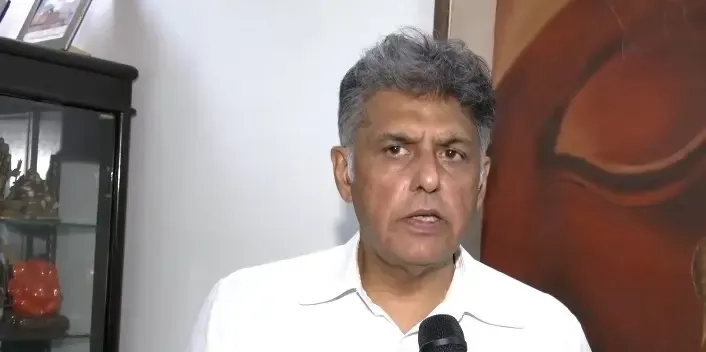
Congress MP Manish Tewari on Thursday, 24 September 2026, demanded the resignation of Chief Election Commissioner (CEC) Gyanesh Kumar and called for the constitution of a Joint Parliamentary Committee (JPC) to scrutinise the functioning of the Election Commission of India (ECI). His remarks came amid reports of internal dissent within the ECI over decisions related to the Special Intensive Revision (SIR) of electoral rolls — a development Tewari described as deeply serious and constitutionally significant.
The Constitutional Argument
Tewari grounded his demand in a landmark Supreme Court ruling from 1993, when then-CEC T.N. Seshan challenged the appointment of Election Commissioners G.V.K. Krishnamurthy and Sardar Manohar Singh Gill. The court, Tewari noted, held that decisions within the commission must be taken either by full consensus or, failing that, by majority vote.
'The basic question is that when two Election Commissioners, G.V.K. Krishnamurthy and Sardar Manohar Singh Gill, were appointed in 1993, T.N. Seshan, the Chief Election Commissioner, had challenged their appointment in the Supreme Court. At that time, the Supreme Court had said that whatever happens, it should happen after full consensus, or if consensus is not reached, then things should be decided by a majority. Decisions will be taken on this basis only,' Tewari said.
He argued that if two sitting Election Commissioners had dissented from CEC Kumar's decisions, those decisions were 'illegal and unconstitutional' under the court's own precedent. 'Now, if two Election Commissioners are saying that they did not agree with the decisions taken by the Chief Election Commissioner Gyanesh Kumar, then those decisions are illegal and unconstitutional,' he added.
The SIR Controversy: 13 Crore Names
Tewari alleged that the SIR exercise had led to the removal of approximately 13 crore voters from the electoral rolls — a claim he called the 'biggest disenfranchisement in the world.' He noted that the number exceeded the total population of many countries.
'If 13 crore people were removed from their voting rights due to SIR, then the biggest disenfranchisement would have happened in the world,' he said. The ECI has not formally refuted these allegations, according to Tewari, who characterised the commission's responses as 'strange statements.'
Notably, this marks a qualitative shift in the criticism: earlier challenges to ECI decisions came from opposition parties and civil society, but the reported internal objections suggest the dissent now originates from within the institution itself — a rare and constitutionally significant development.
Call for Resignation and Parliamentary Oversight
'It is a serious matter. After the revelations, the ECI did not even reject the allegations and instead gave strange statements. Gyanesh Kumar should resign. If he does not resign, a Joint Parliamentary Committee should be constituted to examine the functioning of the Election Commission,' Tewari said.
He underscored the gravity of the internal nature of the objections: 'Earlier, questions were raised by outsiders, but this time, questions are being raised from within. The questions are quite serious.'
On Satire, Punjab Drugs, and Democratic Discourse
Tewari also addressed separate issues during the same interaction. Responding to criticism over mimicry of Prime Minister Narendra Modi at an event attended by Leader of Opposition in the Lok Sabha Rahul Gandhi, Tewari defended satire as an 'integral part' of democratic discourse, adding that it has historical precedent in India and has been used across newspapers, television, and political culture. He did, however, note that 'there should be a limit and dignity.'
On drug-linked suicides in Punjab, Tewari alleged that after terrorism was brought under control in the state in 1995, Pakistan had pursued a strategy of flooding Punjab with narcotics to undermine India's younger generation — a claim he has made previously in the context of cross-border drug trafficking.
With Parliament in session and opposition pressure mounting, the ECI's response — or lack thereof — to the internal dissent allegations is likely to determine whether the JPC demand gains traction beyond Congress ranks.
Point of View
But the Congress has a strategic interest in keeping ECI credibility under pressure ahead of state elections. The more significant fact here is the reported internal dissent: if sitting Election Commissioners genuinely opposed the CEC's SIR decisions, that is an institutional fracture that no party spin can fully explain away. The 13-crore voter removal figure, if verified, would represent a disenfranchisement event of historic scale — yet neither the ECI nor the government has produced a credible counter-narrative. The absence of a rebuttal may prove more damaging than the allegation itself.
NationPress
24 Sept 2026
Frequently Asked Questions
Why is Manish Tewari demanding CEC Gyanesh Kumar's resignation?
Tewari says reports of internal dissent within the ECI — where two Election Commissioners reportedly disagreed with CEC Gyanesh Kumar's decisions on the Special Intensive Revision — render those decisions unconstitutional under a 1993 Supreme Court ruling that requires ECI decisions to be taken by consensus or majority vote. He argues Kumar's unilateral approach violates that precedent and warrants resignation.
What is the Special Intensive Revision (SIR) controversy?
The Special Intensive Revision is a process to update electoral rolls. Tewari has alleged that the most recent SIR exercise led to approximately 13 crore voters being removed from the rolls, which he describes as the largest disenfranchisement event in the world. The ECI has not formally refuted these claims, according to Tewari.
What is the 1993 Supreme Court ruling Tewari referred to?
In 1993, then-CEC T.N. Seshan challenged the appointment of Election Commissioners G.V.K. Krishnamurthy and Sardar Manohar Singh Gill in the Supreme Court. The court ruled that ECI decisions must be taken either by full consensus among commissioners or, if consensus is unavailable, by a majority — establishing a precedent Tewari says makes CEC Kumar's solo decisions legally invalid.
What is a JPC and why has Tewari called for one?
A Joint Parliamentary Committee (JPC) is a panel drawn from both Houses of Parliament, empowered to examine specific issues in depth. Tewari has called for a JPC probe into the ECI's functioning as an accountability mechanism if Kumar does not resign, citing the seriousness of internal dissent and the unaddressed voter-roll allegations.
What else did Manish Tewari address in his remarks?
Tewari also defended the use of political satire — including mimicry of PM Modi at an event attended by Rahul Gandhi — as a legitimate part of democratic discourse, while adding that 'there should be a limit and dignity.' He additionally alleged that Pakistan had deliberately used narcotics to undermine Punjab's youth after terrorism was contained in the state in 1995.